Monday, October 29, 2007

Stage photography, more cribs.

I love my Olympus. It is an excellent camera, and it works fast and smooth... having had it for almost a year, I can work almost intuitively, without looking at a menu option ever. And, of course, the battery lasts forever. I was at the Indian Classical Music and Dance group concert yesterday at the Michigan League. These guys are a really talented bunch of performers.


Hence.. tripod. But then, they decided to close the curtains... ambient light helps me... but distracts the performers.. and then you can see the results: noise!!!!! Shooting at anything like ISO 800 and above is going to fill you up with noise. A leetil bit of despeckling helps, but that is of limited use.


Wednesday, October 24, 2007

Leopard.. alomost here.

http://business.timesonline.co.uk/tol/business/industry_sectors/technology/article2671384.ece

512 MB RAM is way too little.

And let me tell you why. First things first: I run a MacBook with Intel Core Duo 2.0 GHz, a 55GB HD and 512 RAM. Pretty decent. Except that Tiger, or Mac OS X.4.something is a fairly heavy load OS to run. Native OS X applications are totally stable. Stuff that runs on top of the X11 layer, such as Sparky and GIMP 2.2 are also stable, if sometimes a leetil slow. The problem is Firefox. Someone told me that Firefox has an undocumented memory leak which makes it further unstable the longer it stays active. Now Firefox stays on ALL the time. Consequence, my whole system is slowed down. And when I try running something like MS Office, everything comes to a standstill. I tried doing things to trim the basic load, like reducing my dock to a bare minimum of 7 items. I never use iPhoto, or any heavy load graphics package (I have Illustrator CS2). I have most of the dashboard widgets disabled. I even have the funneling effect disabled (less graphics: less CPU). I don't run Eudora or Thunderbird... I use Pine to check mail. Most of my work is at the command prompt. Still slow. This week, my sys-ad was nice enough to do a limited reinstall, without scrubbing the HD. Home directory intact. Not too much help. I need 2 GB of RAM.

Monday, October 22, 2007

The 'best' spy novels in the world and what I think about some of them.

Here is the Link:

And here is my opinion, along with the individual rankings:

Top 15 Spy Novels

Publishers Weekly prints a list of 15 top spy novels (Best spy novels? It doesn't really say.), compiled by Peter Cannon.

1. THE SPY WHO CAME IN FROM THE COLD by John le Carre (1963)

This is a high work of art. There are few authors writing in any field who have the capacity to delve into method and character to the exact depth of detail required to allow the reader to complete the picture himself. That makes Le Carre one of the best writers around. This particular book is the foremost of those novels which brought very close to mind the bleakness of the Cold War and all that it stood for. In the end, the spies on both sides had more in common with each other than with their political masters.

2. THE BOURNE IDENTITY by Robert Ludlum (1980)

This is a piece of sh**.

3. THE DAY OF THE JACKAL by Frederick Forsyth (1971)

An amazing work by the master of method. To be honest, this is hardly a spy novel: this novel deals with a political assassination. But I like it for its precise attention to detail. Hercule Poirot would have approved of Mr. Forsyth. Too bad he turned into a raving right-winger in his latter years.

4. THE SPY WHO LOVED ME by Ian Fleming (1962)

Wha? Mr. Fleming wrote action thrillers. These are not spy novels. Puhr-lease!

5. THE QUIET AMERICAN by Graham Greene (1955)

Haven't read.

6. THE IPCRESS FILE by Len Deighton (1962)

Another classic. Harry Palmer (our unnamed protagonist) cannot pass through an East European town without stashing cash, a couple of passports and a Browning at a railway station locker. And with good reason too: a fairly large number of people want to do him in. Dawlish, his boss and the head of the WOOC(P) isn't much help. The 'P' in WOOC(P) stands for 'provisional', which the Army hates. The Army hates most things professional.

7. THE EYE OF THE NEEDLE by Ken Follett (1978)

I tried to read this. Ken Follet writes absolute cr**. Avoid this.

8. MASQUERADE by Gayle Lynds (1996)

Haven't read.

9. THE MOSCOW CLUB by Joseph Finder (1991)

Haven't read.

10. ABOVE SUSPICION by Helen MacInnes (1939)

Haven't read. Now again, Helen MacInnes was really a romantic novelist who should have never ventured into espionage. Try reading 'Friends and Lovers'.

11. THE 39 STEPS by John Buchan (1915)

Haven't read.

12. HARLOT'S GHOST by Norman Mailer (1991)

Haven't read.

13. THE UNLIKELY SPY by Daniel Silva (1996)

Haven't read.

14. THE RIDDLE OF THE SANDS by Erskine Childers (1903)

Haven't read.

15. MORNING SPY, EVENING SPY by Colin MacKinnon (2006)

Haven't read.

So, here we are.. at the end of the list, with a bunch of recent novels of dubious worth, some pieces of undiluted poison and quite a few worthy contenders missing. The list needs to be remade. That, I will do, when I have some more time.


Desi's Coming Home.

Having spent a couple of years in the US of A, I suppose I can say that I have grown somewhat accustomed to a high speed internet line, continuous power, etc, etc. But having said that, a graduate student lifestyle, or rather, a frugal, careful graduate student lifestyle is barely a few notches from what one would describe as 'poverty' in this country. But then again, I do believe that it is to a huge extent, merely a matter of perception: this country does something strange to you.. it turns you into a recluse. Backhome, waking up to the doodhwalla, the paperwalla, and the garbage collector doing the rounds was normal. hearing your neighbour yell at her delinquent kid for not doing his homework was also normal, as was listening to them turn the volume up on yet another Sonu Nigam hosted singing talent show. These are the sounds of India, and after a while, they are no longer intrusive, but merely an ever-present backdrop which you are only aware of by its absence. These are the sounds of home.

Cut to the West. Empty streets, silence and more silence. The only sounds are the noisy cheers of some frat boys on Saturday. Rich Americans, where possible have chosen to live in walled, secluded places where the cares of the world do not reach them. This country, where there are supposed to be no barriers, has chosen to erect impassible walls and create a new social class system.. or perhaps they have taken the oldest class system in the world and merely given it new shape.

For what it is worth, if you are wealthy and have the right skin colour, and presumably the right associations, you too, can live in their country clubs and wake up to the sounds of birds chirping. The inner cities are slowly cycling into ruin, fuelled by guns and drugs. The urban disenfranchised have nowehere to go, for they have been discarded as a bum job. They will never wake up to birdsongs, or walk on neatly manicured lawns. The leaders of the world have promised people freedom, and this is what it looks like. Scratch the surface of wealth and prosperity and you will feel seething veins of anger running deep.

But the eventual fate of this country does not concern this author. I am an passerby, an interested observer, at the most. My own beautiful India has suddenly woken up from several decades of socialist somnolence and wants a share of the pie. The middle class has decided that it is time to be upper class, and the upper class has decided that it is time to stop merely visiting the West; the West should now be brought here. So, we have CrossRoads, an exclusive shopping malll in Bombay which rather inadvisedly decided to only allow people with cellphones or credit cards to enter. This was in 2001, remember, a time when both items were not common amongst the 'riffraff'. The resulting outrage was interesting to watch.

And these days we have gated communities in our own cities, where the rich can sit back and soak in India, sans the stink coming from the nearby slums. To be at the centre of a potentially violent social transformation is quite edifying: resources are being diverted to these palaces which municipalties can ill afford to squander. But who's listening to reason? We all want in, and we want in now! Add to this the dilution of the meritocracy by the rather stupid decision of the Central Government to introduce large scale reservations at all levels of work and study; and we have a rather potent combination.

This was a rather long winded article which I started writing because I read this article:
http://observer.guardian.co.uk/world/story/0,,2156352,00.html#article_conti%3E%20nue

Thursday, October 18, 2007

Immigrants create a better England?

An excerpt from the Statesman today.

Migrants Score Over Natives

Nigel Morris

LONDON, Oct. 17: Migrant workers contributed (pounds sterling) 6 billion to the country’s economic growth last year and earned higher wages than their British counterparts, Home Office figures revealed yesterday. The study concluded that new arrivals were harder-working, brought sought-after skills and paid more in tax than they used in public services. The population rose by 189,000 last year, with 574,000 migrants arriving and 385,000 people leaving. The government figures suggested migration was throwing a life-line to an economy suffering skills shortages and struggling to support a growing bill for pensions.
It was calculated that new migration accounted for about one-sixth of Britain’s economic growth. The home office said the newcomers had “high levels of skills than the average UK natives” and that employers found migrant workers “reliable and hard-working”. It reported that migrants earned on an average (pounds sterling) 424 per week last year, and as a result paid more per head in tax and VAT than Britons.
~ The Independent

Wednesday, October 17, 2007

Tibetan woes.

Tibet is under Chinese rule... has been since since (I think 1959). That was when a combination of military force and some nasty diplomatic arm twisting forced the spiritual and political leader of Tibet, the Dalai Lama into exile in Dharmasala in North India. These events where followed shortly by the Sino-Indian way of 1962 in which we had our noses thoroughly ground into the dust by our Chinese brethren. Those five years, I tend to think were the defining years of the decline of the Indian polity. Pandit Nehru, for all his wisdom and charisma was at heart a wide eyed romantic and he was thoroughly taken in by the Chinese cant of 'Hindu Chini bhai bhai'.. which translates to 'Hindus and Chinese are brothers'..... of course backing that up with a lot of firepower. Nehru died a disillusioned and heartbroken man. The Tibetans, the unhappy buffers between two local superpowers have lived in exile in India. The Indian government turns a blind eye to Dharmasala and does not negotiate with the Tibetan government in exile.

Bush has recently decided to honour the Dalai Lama with the Congressional Medal of Honour. This is almost two decades after the Nobel Committee decided to give the man the Nobel Prize. And quite predictably, the Chinese are very unhappy- to the extent that they have told the Prez to his face that he must not award the Dalai Lama.

Now let us do a bit of analysis: firstly, the Tibetans are in exactly the same dispossessed position as millions of refugees after partition: their homes have been taken away and they were made almost destitute. They have not assimilated with India, their host nation. They have, for the most part viewed India as a waystation and nothing more. They have contributed little, if anything to the national polity, economy and culture. One can argue that had these Tibetans ended up somewhere in the Western hemisphere, they might show greater alacrity in joining the mainstream.

Secondly, it is not in India's economic interest to piss China off. We can ill afford a confrontation with the PLA. If a few Tibetans have to live in India, they just have to suck it up. Having said that, the Arunachal is a highly disputed territory.. it would not be bad for an Indian protectorate to buffer the North East from PLA aggression.

Thirdly, this immediate event is indicative that the US has cards which it is not showing: the Chinese have been very aggressive at any talks of Taiwanese or Tibetan autonomy. It won't hurt to think about the appalling trade deficit that the US has with China.. money which flows largely into PLA coffers, thanks to slave labour factories. This trade deficit ties these two nations together in many different ways.... right now the Indian response should be to wait and watch.

Back in town.

I was at Cambridge, MA over the weekend and had a lot of work. Went on a whale watching cruise in the Boston Harbour area.... the pics should be up here and on Flickr shortly. Right now I have a bunch of spectra to process and look at.

Friday, September 28, 2007

Clarice loves Lector!

Yes, this was a conclusion long known to people who have read Thomas Harris, but it is only recently that someone put a recut trailer of Silence of the Lambs where it appears as a louvv story on Youtube. Find it here.

Also did Maverick finally get together with his instructor, Charlotte... ? or was he actually falling for Iceman (played by Val Kilmer)? See this recut Top Gun trailor here.

The Shining was a metaphor for the malaise gripping the American nation, and how redemption comes from love and basic family values. People who thought that it was a horror story should see this.

And finally.... Taxi Driver as a romantic comedy.. think Robert de Niro trying to make like Matthew McConaughey.

Thursday, September 27, 2007

Apocrap-lypto.

One fine day Mel Gibson woke up and decided its time to remake the Terminator. Except that instead of Linda Hamilton playing the terrified woman, we have a random bloke playing Jaguar Paw, and he is running. Yes, this is the greater part of the film, if it can be called as such. And instead of an implacable Arnold chasing him, we have a bunch of bad arse Mayans. And that ridiculous 'this is my jungle, so now I am going to kill ya on me own ground' reminded me more of the kid in Home Alone 3 swearing revenge on North Korean spies, than anything else. Which makes me think, why didn't this man put in North Korean spies in this movie, I mean they are everyone's favourite bad arses right now. And Mel, I know, that you are one sadomasochistic git. Stop trying to remake Caligula with each film. Someone put this in the top 10 films of 2007. Yes, if you watched 300 nine times and have an IQ of 300/9.

Monday, September 17, 2007

The Dogs of .. WHAT?!?!?!??!?!!!!!!!??????

So I just started watching the 1981 production of Freddy Forsyth's best novel (open to argument, but I will argue fiercely for this one): The Dogs of War. The plot in the novel is simple: Wealthy mining company discovers high concentrations on platinum ore in a remote African banana republic, enlists a British mercenary to initially reconnoitre, and then plan what is politely called a 'regime change' by today's Great Powers. The mercenary recruits his old buddies in arms and pulls off the operation, at some cost. Then he pulls a kicker. Turns out that he knew about the platinum angle all along (yeah, he slept with the mining boss's nubile and rather naive daughter). So he hands over the keys of the country, so to speak, to this other bloke who represents a wandering tribe in Africa.. the 'Jews of Africa'. These nice people now have the job of rebuilding a nation from scratch.. their Palestine. Of course, with the help of platinum mining revenue... but lets not go into that. So now, maybe 22 minutes into the fillum, just on a lark, I looked at the IMDB review. And it said what is below.. which made my head spin.

Author: Bogey Man from Finland

John Irvin directed this film, starring Christopher Walken as war veteran mercenary who gets a job by government to travel to Africa and inform the situation that is pretty hot in there. He does it, and sees the violence that takes place there, and when he returns to US and tells about the evil dictator that dominates there, the new job for him is to travel there again and wipe out the incarnation of evil..

This film isn't any action film as many seem to have expected - me included - but this is pretty sophisticated, but still also little slow moving (dir. cut. 15mins longer than the US version) portrait about the state of some countries in the world, and what these dictators can do to people and country. I'm mostly fascinated by the film's atmosphere and calmness as there isn't stupid gunplay or other usual flaws often found in these films. Walken acts greatly in his role of retired war veteran who takes the job only because of money offered to him. At the end, a twist in plot is coming and all the greediness and betrayal in the film gets a new face.

The end is little stupid as it tries to imitate Apocalypse Now a little, by depicting Walken's face and "the horror" as Francis Ford Coppola did, and the gun fights at the end are also little unnecessary, especially when the film managed to be without them for so long. Still the result is satisfying, yet little too long and occasionally may make the viewer feel little tired, but this film isn't meant to be watched when tired. The US distributor cut the original version by over ten minutes, and I saw the original director's cut which includes many important bits of dialogue and things that add to the film. So I recommend the director's cut of the film as it is the directors original version.

Dogs of War is pretty intelligent and interesting depiction of power and dictatorship, and also very nostalgic in its atmosphere and scenery. The gun battle at the end of the film is great looking and also gripping, but as mentioned, also little unnecessary and too traditional finale. 7/10

Was the above comment useful to you?


Nope. This comment made me think that you missed the whole point!

Friday, September 14, 2007

Anti-Science.

I just love this kind of writing! There are people out there who can't solve a linear equation to save their lives, and make up for this in myriad ways. One of these is to write stupid critiques of works of Science Fiction masters, such as 2001, A Space Odyssey, and to pepper it with preposterous judgments on why 'science as tool of human progress is bound to fail as it is bereft of wisdom'. Wisdom, of course is something that only the mathematically challenged amongst us can aspire to: the slightest predisposition to understanding and explaining the empirical nature of the world is 'knowledge, not wisdom', and dooms us to an incomplete existence. Aah, these fools, with the wisdom to discuss Plato and Thoreau but without the skills to add up their grocery bills! Anyway, read on and rejoice, for such idiots will pass into the world with their fancy degrees and perpetuate their hatred and fear of science, and replace it with something that can they cannot even begin to define. And such people will influence public policy and public spending.

Corruption at the core: the seamy side of a resurgant India.

From today's Statesman editorial.

Canker at the core
How Corruption Permeates The Critical Sectors

By YP Gupta

Corruption has been spreading at all levels of society. It has permeated academic institutions, public personalities, high-ranking officials, doctors, scientists, engineers, and academics. Transparency International’s global corruption report (2007) has revealed that bribes amounting to Rs 2,630 crore are being paid every year to officials of the lower Indian judiciary. Its earlier report had described India as one of the most corrupt nations in the world, with a dubious distinction of ranking among the top 55 nations in terms of corruption.
The unethical practices and the decline in moral values have corrupted a greed-based society. A number of IAS, IPS, MCD, DDA and bank officials have been arrested on charges of corruption. Also, illegal gratification by some judges has had a damaging effect on the judiciary.
The Central Information Commission recently came across a case of forgery, impersonation and falsification of documents against the holder of a fake MBBS degree from Sri Venkateswara University in Tirupati. He had managed to obtain the MD degree in paediatrics from AIIMS by submitting false documents. He also duped the University of Maryland Medicine Centre (USA) and the American Board of Paediatrics. This alleged doctor was exposed when he was experimenting with viagra on children, resulting in some deaths.

Medical admission

A medical admission racket through a coaching centre has been recently unearthed in Kolkata. Earlier, a verdict by a Delhi court convicted an individual of selling fake “medical degrees”. It was detected that around 40,000 such fake degrees were issued by him across the country. The Indian Medical Association had described such doctors as quacks. A principal of a public school was arrested for selling fake CBSE marksheets to failed students in connivance with board officials.
There is a fool-proof racket in the leakage of questions. It operates like a professionally-run business with a nationwide criminal network. The leakage of an MCA question paper of IGNOU, that of the AIIMS entrance examination paper and that of the pre-medical paper of the central board form only the tip of the iceberg. The leakage of question papers for the Common Admission Test (CAT) for the premier management institutes has undermined the credibility of our centres of excellence.
A chairman of the Maharashtra Public Service Commission along with former UPSC members and the controller of examinations were arrested and chargesheeted for taking bribes and replacing the answer papers of unsuccessful examinees. A chairman of the Orissa Public Service Commission was once suspended for irregularities. And the Bihar State University Service Commission’s office was sealed because of irregularities in the selection of lecturers. Also, a former president of the Medical Council of India was held guilty of corruption by Delhi High Court.
A former vice-chancellor of Himachal Pradesh University was arrested for corruption. A former vice-chancellor of Utkal University was indicted for financial irregularities. The former Kerala chief secretary and ex-vice-chancellor of Sree Sankara University of Sanskrit was sentenced to two years’ rigorous imprisonment on corruption charges. A senior computer programmer of Delhi University along with her husband and the candidate’s father were held guilty of criminal conspiracy and forgery by a Delhi court for increasing the candidate’s marks in the MBBS entrance test.
A former vice-chancellor and registrar of Visva-Bharati University were arrested in a fake marksheet case. The Comptroller and Auditor General of India (CAG) had sought a probe into the omissions and commissions in respect of financial irregularities by the ayurvedic colleges in Bihar. The CBI had chargesheeted a former Meerut University vice-chancellor, his daughter and two officials for forging certificates to get her a job.
Bihar universities have the dubious distinction of issuing fake degrees. BR Ambedkar Bihar University (Muzaffarpur) is notorious. Many of its degrees, including medical, have been found to be fake. The two vice-chancellors of BN Mandal and LNM Mithila Universities (Bihar) were arrested in the fake BEd degree racket. The BN Mandal University is reported to have been selling post-graduate degrees in science for Rs 50,000 each even to those who were not admitted to any of the colleges. The vigilance department has estimated that more than 10,000 persons from Bihar, West Bengal, Rajasthan and Madhya Pradesh obtained such post-graduate degrees.
Professional ethics are brazenly violated in certain institutions of learning. There are serious allegations of corruption and financial bungling against the vice-chancellors of UP universities, and that of Rajasthan and Pondicherry universities. Marks or admissions are often manipulated. The credibility of Delhi University’s examination system has been under a cloud because three senior professors were removed from service for grave misconduct. One of them was indicted for manipulating the admission of his son to the MBA course.
An inquiry into admissions to the post-graduate medical courses in the seven state-run medical colleges of UP exposed a huge racket. Indeed, the examination system has become defective and is open to manipulation.
At least 30,000 quacks are thriving in Delhi. They claim to be practitioners of alternative medicine, and have been prescribing spurious drugs as indigenous medicines. The Delhi government is contemplating suitable action and an anti-quackery bill is on the anvil. The Medical Council of India has revoked the licences of 12 fake doctors with forged certificates. The Karnataka government has initiated action to prosecute quacks who claim miraculous cures for chronic illnesses.

Armed forces

The armed forces have also lost credibility owing to widespread corruption in their ranks. Twelve senior defence officers have been chargesheeted for corruption, going by a reply to a query in the Rajya Sabha. There has been an erosion of values and conduct within the defence services.
It is unfortunate that there is hardly any deterrent effect on corrupt officials as the process of conviction is slow, and has not made an impact. Consequently, corruption has been flourishing with more and more instances coming to light. It is difficult to visualise a corruption-free society because those who profess probity in public life and proclaim to curb corruption are not serious in introducing reforms.
Drastic changes and reforms are imperative to weed out unethical professional and corrupt practices from our academic and public institutions. The process of conviction needs to be speeded up. Apart from recommending legislation to protect whistle-blowers, the Administrative Reforms Commission has suggested a new piece of legislation ~ Corrupt Public Servants (forfeiture of a property) Bill, to curb corruption. The recent landmark ruling by the Supreme Court that public servants can be prosecuted without mandatory government sanction should have a deterrent effect on corrupt officials and politicians. There is need for transparency and accountability in our academic and public institutions, including the judiciary.

(The writer is ex-Principal Scientist, IARI, New Delhi)

Red Dragon/Manhunter.

I recently happened to see Michael Mann's movie Manhunter, which is based on Thomas Harris' novel 'Red Dragon.' Any comparison with the latter movie is a foregone conclusion for three good reasons:
1. Ralph Fiennes.
2. Edward Norton.
3. Anthony Hopkins.

I mention this list in the order they were important to the film. To give Mann his due, he probably had a much harder job on his hands than Brett Ratner. Mann's best point is also his worst: the soundtrack. An excessive on the soundtrack to create a palpable atmosphere of tension works, but it does so all too well. The background music distracts from the actual movie and that dooms the film. Having said that, Red Dragon benefits immensely from the acting skills of the protagonist (also Harvey Keitel, lets not forget him).

The larger question, which I shall explore later is the following: why does great cinema always chronicle events of a harsh and brutal nature. Why don't feel-good movies also become great movies? I also happened to see another Thomas Harris adaptation: Black Sunday some time ago. This has an Israeli Mossad agent desperately hunting down a Palestinian terrorist who is planning some kind of truly horrific attack on US citizens with the help of someone in the US. Such a movie could perhaps only be made properly by John Frankenheimer. Bruce Dern is very convincing as Lander, the brilliant, but insane Vietnam war vet who will have his vengeance no matter what. The best performance, by far is Robert Shaw (yes, him! remember him from Jaws.. the slowly rocking Orca in the ocean, waiting for the great white..?). Understated, but strong, it is a true please to watch him as he closes in slowly, but relentlessly on his target.

Thursday, September 13, 2007

Tyler Durden as Calvin?!

Yes, someone has spend a lot of time speculating that the nameless narrator of Chuck Palahniuk's masterwork 'Fight Club' is simply a grown up Calvin from Calvin and Hobbes. Susie Derkins has metamorphosed into an incredibly sexy Marla Singer with whom Tyler/narrator/Calvin shares a love-hate relationship taken to its farthest point. Add characters from Dave Fincher's film and the image of Susie Derkins growing up to become Helena Bonham Carter fills one with.... ur... mixed feelings. At this point I haven't read the article yet.. but I suspect that Get Rid Of Slimy gurleS ie GROSS has turned into Project Mayhem. Read on here.

Wednesday, September 12, 2007

Quis custodiet ipsos custodes?

Now it is immediately obvious to most people that if we could all get long nice and proper then the world would be a much better place. I have periodically waxed eloquent on how we should disarm, etc etc. But reality tells us something quite different.. that people will always settle differences with fisticuffs and so will nations. We have been relatively lucky in that the last fifty years has not seen the great powers go to war (at least against each other... yeah I am being horribly cynical here). They have, however fought a silent war which has been waged in the darkness of total obscurity. The only time when this silent world intersects the overt one is when something goes frighteningly wrong down there. Of course, this war has been fought because our political masters have deemed it expedient to do so. It may occur to us to blame the pettiness of current leaders.. but note that the necessity of an intelligence network was first advocated by Chanakya, the Prime Minister of Chandragupta Maurya in the fourth century BC.

So these people whom we have mandated to fight a war silently and obtrusively, but viciously, nonetheless; have done so and we have all called their preoccupation- the 'Game'. The Game, like every one of our creations has taken on a life and purpose of its own, one sometimes, perhaps inevitably viewed as malignant to its political masters. That was always meant to be, because we have asked these men to pass judgment and dispense justice within the shadows, and not let anyone pass through the murky, suspicious night; least of all, ourselves. They have done so. They have pursued monsters down labyrinthine pathways and found the masters of these monsters to be men like them. Sometimes they have introspected, and found horrifying beasts of their own creation straining at the leash. They have played the Game in all its subtlety and its dark grandeur; and in the end they have all been played by the Game itself.

Harry Palmer is never actually mentioned by name in any of the books. He simply is: a smart alecky and somewhat unprepossessing exterior concealing a very capable agent. For one who deals in lies, the borders frequently become hazy. The few loyalties that exist are those from person to person.. and our protagonist shares much more with his opposite number, Colonel Stok, the Red Army chief of security for East Berlin. Johnny Vulkan is the other person trying to navigate the quagmire of broken loyalties and forgotten alliances that his life is. Berlin is the only city where darkness is safer than light. The city shifts in its sleep, throwing up human flotsam in a manner so uncaring that one wants to cry out in protest. A rush of feet in the sand followed by a quick burst of machine gun fire.. in the morning, a corpse lies tangled in the wire before the wall. For Palmer, negotiating the treacherous line between Vulkan and Stok, the Game has to be played out till the last stroke. Len Deighton crafts an amazing book with layered complexity, each layer peeled away to reveal one below, infinitely rich and subtle. This is a style markedly different from the moody darkness of the Bernard Samson novels and equally far from the lyricism of Bomber. This is the Game at its best.

Tuesday, September 11, 2007

A little late in the day, but Miss Teen South Carolina said the following...

Yes, this post is a week late, but hey, at least it got here.. for posterity.. or as long as google backs up the blogger servers.. this post will stand witness to the fact that stupidity rules.....

http://blog.seattlepi.nwsource.com/thebigblog/archives/121145.aspLink

Monday, September 10, 2007

Gavin Menzies and why we should not rewrite history.

The study of world history is one of the most important occupations of scholars. There is much to be said for the contemplation and chronicling of the works and thoughts of our fathers. There are two major approaches one can think of (I write here as a complete layman, but one interested in fact and approach). First: history is studied in broad brushstrokes, and is considered to be in dynamic equilibrium with colossal forces of economics and environment. Thus, we study timelines and economics in conjunction with historical developments and try to place them side by side so that they make sense. For instance, the construction of splendid temples in South India during the rise of the Muslim influence in North India in the 15th century coincided with increased patronage of architecture by the ruling Hindu kings. This was also met with an influx of Hindu refugees from the North, amongst them men of skill and knowledge, who, in turn needed employment.

The other approach is that history is the story of human life, and is composed of the stories of individual humans. This personal approach involved the researcher to look back through time and ascribe emotions and aspirations to his subject. This is readily possible if there are enough supporting documents and artifacts. Thus, we have the beautifully researched works of Dominique Lapierre. However, such works are inevitably tinged with the personality of the writer. Such is the nature of the approach. It is my belief that history must be studied in a manner which incorporated elements of both approaches.
Link
Gavin Menzies, a former submariner with the Royal Navy has authored a book called '1421: The Year China Discovered the World'. This can be classified as 'pop history'. It smacks of well researched scholarship. But this impression is rather short lived. Quite soon, the reader discovers that Mr. Menzies is drawing conclusions out of the flimsiest data. He is, in fact writing his own history. What blew me away was the point when he described Malayalam as a dead language. Try telling that to the several million people of Kerala who speak and write it daily. Several scholars have spoken out against Menzies' outrageous interpretation and his unscientific approach. That does not, however do anything to reduce the popularity of the book, I suspect. It appears now, that pop-history, and hideously inaccurate pop-history, at that is worth good money. The wiki entry is here.

Tuesday, September 04, 2007

Almost done.

Our move in is almost done... this was a long and painful weekend... i usually take some pride in not being tied to the internet all the time.. unlike a lot of people.. turns out that I am not that different.. our internet link is still down.. and that bugs me. Also our TV is on the blink.. no sound.. looks like we are going to need a new one... so there...

Also read, against my better judgment, a Ken Follet book. I was right, he is a truly trashy writer with really mediocre ideas and even worse narration skills. And then saw Fail-Safe, based on the book I have reviewed recently (The end of everything)... an excellent piece of work.. brings out the tension and mounting agony beautifully. My favourite scene was was General Bogan is talking to his opposite officer General Koniev who was in charge of air defenses in the USSR and at the moment they realise that the impending catastrophe is actually upon them, and that there is no way out, none at all, they also realise that they are not soldiers on opposite sides of the fence, they are not capitalist and communist opponents, they are simply men overwhelmed by the complexity of their own fears. And at that moment, Koniev says to Bogan, 'goodbye, my friend', an acknowledgement that they had both fought with tenacity and courage against almost impossible odds, but tinged with infinite sorrow, for they had fought in vain, and in spite of their best efforts, men would die in screaming agony, die in the false dawn of the mushroom cloud. Transistors and computers had replaced brave men, because we had deemed it expedient. And the price for such folly would be terrible.

Friday, August 31, 2007

More pictures.


This is one of my favourites.. taken last week. The thing with candid shots is that you have to be a. prepared, b. have the undefinable thing called 'instinct for art' to know what is a great picture moment and what is ordinary and c. have the right equipment. I have long believed that a suitable long lens is what is needed to get the perfect shot. The problem is that long lenses tend to be somewhat dim/slow and do not give the crispness that a 40-150 lens tends to deliver. Also handheld shots with the lens fully racked out can be quite troublesome. That is why people spend so much on fast tripods like Bogen-/Manfrotto kits. I have a cheap Sunpak pan head which is neat for stationary objects but simply unsuitable for moving objects. Then again, shooting at night presents its own problems. Tricky light conditions and moving objects combine to make photographing them really difficult. The only solution is to jack up the ISO to something like 1000. I don't trust the sensor above that.. way too much noise. A really fast lens makes all the difference at that point. Antivibration, either built into the lens or the sensor is mostly useless at night. But f2.0 or wider would be very welcome.

As it turns out recently, I got to look at the Nikon 18-200 mm antivibration lens. There is nothing like it to compare on the market... I would like to see Olympus give us something like that. The problem is that Olympus makes good, but very expensive glass. But who knows, maybe I will get myself the next professional body from Olympus in two years time... and if that has built in antivibration for the sensor and a flip back display (with live-view) then that will be perfect. But expensive.

Tuesday, August 28, 2007

So much for the second law of thermodynamics (aka Pipe dreams of the scientifically unsound).

First allow me to direct you to this link on TG Daily telling you about the potential development of a 'water powered engine.'

Let me summarize how this engine might work: streaming water across an Aluminium/Gallium surface induces the catalytic breakdown of H2O into its component molecules H2 and O2. H2 bubbles away while O2 sticks to the Aluminium surface. H2 can now be burned in a conventional heat engine.

My objection: The bond energy for water is 458.9 kJ/mol which means that this is the energy required to dissociate a molecule of water into its component atoms is roughly twice this. That is quite a lot. Spontaneous dissociation may occur in the presence of the catalyst, but typically, the catalyst will be used up in the reaction. In this context, that would mean that the surface of the catalyst would be 'coated' with a layer of O2 which would prevent further catalysis. To regenerate the catalyst, one would have to 'scrub' the surface; and this will probably need more energy than we can recoup by burning the bubbled off H2. This is because of the Second Law of Thermodynamics, which tells us that one cannot gain any energy by making a spontaneous process run in reverse. An example: water flows downhill, and this is used to rotate turbines and generate electricity. If we had to pump the water uphill in the first place, we would be spending energy in that, and much more than we would recover it flowed downhill. Lesson: there are no free lunches.

Back from Chicago, yet again....

Yes, I was in Chicago for the last week on a training symposium. I had an altogether great time, attended some great classes and met some nice people. They have a beautiful facility there.. with a 600, an 800 and a 900 MHz instrument, all with cryoprobes, all Brukers. Although, our lab uses a Varian 800, I have always had a sneaking admiration for Brukers, which allow for more flexibility (I think). The most important thing I learned at the workshop was to stop butting my head out wondering about the physics and to just grab a ubiquitin sample and start recording spectra. They let us play with the 600 MHz spectrometer, and we had lots of fun.

After the workshop, I spent a very boozy weekend with my friend in Evanston. He works for a SSNMR lab at Northwestern... their magnets are not the super high res contraptions we use.. these are physicists' devices with fifty random wire leads and soldering wire all over the place. Extremely radical hardcore experimental physics.

We went to attend a Latin music festival at Grant Park.. that was a total disaster... remind me to maintain a safe distance from Latin music in the future. Chicago offers open air movie screenings at sunset every Tuesday in summer. Love that city.

Friday, August 17, 2007

Teatime.

Aah! Something to write/rant about before I leave for Chicago and leave my audience out in the cold for a week. First, a link to a bloke's post about how to make tea.

And now, my take on it. Drinking good tea is an Indian habit. Yeah, yeah, the Sri Lankans also drink tea. Chinese tea is an abomination we will not go into. Oh, and yes, while the Brits have been known to love tea, who has ever heard of English tea gardens? So, my point being that I have exclusive moral rights to lecture people about tea. Let me take this a few steps further. The best Indian, correction the best tea is Darjeeling, followed by Assam. The South's claim to fame are the Nilgiri tea estates, but when in in Tam-land, do what Tams do and drink your coffee without a fuss. So, I assert my rights as a Bong to lecture and exhort you to drink tea.

So, how does one go about it?
1. Get Darjeeling/CTC tea leaves (or Assam). Tea bags are a Satanic creation. Avoid them. Tea granules are a creation of minor devils. Avoid them too.
2. A saucepan to boil water in. A heater.
3. Boil water in the saucepan.
4. Prepare a kettle with tea leaves. Depending on how strong you want the tea, perhaps one teaspoon, lightly heaped, per cup.
5. Just before the water boils, pour a small amount into the kettle. This is to pre-heat the tea leaves and the kettle and prevent accidental cracking when the boiling water is poured in.
6. When the water starts to boil, pour into the kettle. Stir, close the lid and put the tea-cosy on.
7. Let the tea soak for 3-5 minutes. Stir once more and filter into cups.
8. Add a spoon of sugar/honey and a twist of lemon.
9. Sit back, open up the Anandabazar Patrika or the Statesman and light up the Gold Flake.
10. Sip.

Following this will allow you to enter the blissful world of the Bong for a brief while, provided you are faithful to the ritual. (There are other things involved like cursing the Centre's step-motherly attitude, cursing the fates for Dada's bad luck, etc). If you can keep this up for a lifetime, you will be elevated to the rank of Honorary Bong.

Contrary to rumour, drinking tea does not confer virility or sex appeal.

Monday, August 13, 2007

The end of everything.

I read Arundhati Roy's essay 'The End of Imagination' while on the bus to Chicago a couple of months ago. As always, I was awestruck by AR's prose, her impassioned appeal to sanity, the use of those formidable skills which make her such a respected writer used with elan. The topic she discusses is of especial relevance now, rather than ever. Just before his rather ignominious departure, Blair initiated steps to enhance England's nuclear deterrent, at a cost of 25 Billion pounds. Why? Who are these enemies that England must be guarded against? North Korea is fighting hard for the unfreezing of a paltry 35 million $ in some off-shore account as a price for standing down its nuclear programme. How can such a country, starving and beggared ever begin to be a threat to England? The real threats are racial strife in inner cities, the vanishing jobs and the disillusionment of the laid-off who were promised that unfettered economic growth would bring milk and honey to everyone, but has simply deprived millions of everything. Those 25 billion pounds could have been better used to improve hospitals and bring back jobs where they are needed. But is anyone listening.

So, back to nukes. The world would be a much better place with no nukes at all. None. Nada. Terms like "credible deterrent", and the "doctrine of mutually assured destruction" make sense only when the enemy thinks and acts like you expect him to. What of the dispossessed, the starving and dying, the miserable and the wretched? They who hold, with good reason that the economic policies endorsed by London and Washington, and enforced by the World Bank are directly responsible for their agony. They who would share that agony with those who have caused it. They who would seek revenge in the searing nuclear fireball. What protection is there against the truly committed fanatic? None whatsoever, except atonement and an honest effort to reverse the injustice of generations. That is where these gigantic military budgets should go. Men cannot reach for the stars by treading on the dying bodies of other men. The only way out of this state is to beat our swords into ploughshares. If only our leaders understood that.

Fail-Safe is a 1962 book by Eugene Burdick and Harvey Wheeler which deals with the terrible spectre of accidental nuclear war when a wing of Vindicator nuclear bombers receive an erroneous message to conduct a full strike on Moscow. With all radio communications shut down, their commander leads a penetration of Soviet airspace. The alarm bells start going off in Washington and Moscow at the same time. While the leaders of the two superpowers try to reason their way through the crisis, the Vindicators continue on their path, true to their orders, each one of them carrying ordnance worth 40 Megatons, enough to scorch the earth. The Russians scramble their best fighters, but even with the USAF advising them, they are unable to shoot down all of the Vindicators. The US President then comes to a terrifying decision: the sacrifice of Abraham. The obliteration of Moscow must be met with an equal bloodletting on the American side, else the reprisal will be too horrific to imagine. Minutes after Moscow is hit with 80 megatons, the President orders a Strategic Air Command bomber orbiting New York to lay an 80 megaton in the same burst pattern. An eye for an eye. This book brings to the forefront the fact that we are playing with fire, and we do not have the fortitude to stand fast on the side of sanity. The only victors in a nuclear holocaust will be the cockroaches. Surely that is something worth contemplating.

Friday, August 10, 2007

Coincidence: trivia.

Maurice Jarre, a French composer of considerable talent wrote the music for the towering epic Lawrence of Arabia, directed by David Lean. Here is a performance by the Royal Philharmonic Orchestra, conducted by Jarre. Now, this cinema was about the Arab revolt against the Turkish Empire against the backdrop of WWI. Jarre's son, Jean-Michael Jarre wrote the music for Peter Weir's landmark film Gallipoli, which has Mark Lee and an unbelievably young Mel Gibson as two friends who are part of the ANZAC troops holding the island of Gallipoli against the Turks in WWI.

Thursday, August 09, 2007

Phoolan Devi/ Bandit Queen.

Here is the link to Arundhati Roy's review of Shekhar Kapoor's 'magnum opus', Bandit Queen, the story of Phoolan Devi.

Terrorism and the Indian State-I

Terrorism and the Indian State.

Contrary to the popular perception of India as a peaceful, perhaps even somnolent land, this country has known violence in its many forms for as long as memory goes. Why then, this perception; that things are going awry at this point?

Let us start with the question ‘who is an Indian?’ This is a very difficult one to answer; for while identification with a religious or linguistic group, identification with the nebulous idea of a greater Indian nation is difficult. The people most recently responsible for giving the people of the subcontinent a national identity were the British. Truly, there is nothing, which brings diverse people together like a common enemy. But for the most part, there have been precious few people who have had the strength and political acumen to forge this amazingly heterogeneous people into one coherent nation; and one of the most enlightened of these was Emperor Ashok the Great. At the height of its power(250 BC), the Mauryan Empire extended across the extent of modern India and onwards to present day Pakistan and beyond to Kandahar. But it is to be remembered that this forging was done on the anvil that was the battle of Kalinga. The Daya river, which flows by the historic Dhauli hill ran red with the blood of a hundred thousand Oriyas before Kalinga was brought to its knees by the might of Patliputra. The reason why Ashok is called ‘the Great’ is not the conquest that he achieved, but the lesson he learned therefrom. Kalinga ended with Ashok being so sickened by the bloodshed that he turned to Buddhism for solace and entered the evening of his life as a force for enlightenment and peace in South-East Asia. However, the post-script to this story is the decline and fall of the Mauryan Empire a scant fifty years after the end of Ashok’s rule.

There are two main points to this story: the first is that a pan-Indian identity is an externally imposed one and not a natural one. When such an identity competes with a more immediately comprehensible one, such as being a Tamilian, an Oriya or a Goanese, it tends to be eclipsed. Regardless of what our leaders tell us, at this point in history, being a Muhammedan is also somewhat at odds to being an Indian.
The second lesson from our brief historical diversion is that every empire has its own life cycle, just like people do. Empires are born as small movements, they grow in strength and popularity and they grow also by conquest. Sometimes, they are fortunate and enjoy an afternoon of peace and prosperity, when the arts thrive. But this is also the harbinger of eventual decline. This decline starts at the periphery when the capital fails to impose its continual will on the inhabitants. Once set in, the rot can be arrested, but almost never reversed, and the once glorious empire will be dismembered. But hope survives. And this hope tells us that out of the ashes will rise other empires, perhaps so glorious that they will eclipse past achievements a thousandfold. Such is human history. But for the first time, things are different. For the first time, the species has the capability to inflict appalling damage on itself and on Earth.

So again: who is a terrorist? Anyone who is willing to trade civilian lives to attain his goal, which is usually contrary to the government of the day is a terrorist. So, was Subhas Bose a terrorist? Was Tipu Sultan, the Tiger of Srirangapatnam one? Was Chhatrapati Shivaji one? These men were all heroes. But that is the perspective that is afforded by history. What of the opinions of those, who lived through those tumultuous events, which shaped history? Why do we feel that what is happening now is happening for the first time? What is so unique about this century?

A number of different things: first, the very idea that human lives are supremely important is a relatively new one. The idea that man owns this world, and is not merely a part of it is a very Western and a very Christian idea. And after the industrial revolution, it also appears to be very true. Hence, the hullabaloo about human rights. (strictly speaking though, ‘human rights’ actually means ‘Western human rights’: events of the past… say five hundred years stand witness to the fact that the West is quite amazingly hypocritical in its attitude towards the others whom it has enslaved, bombed, burned, shot, spread plagues amidst, and now sells overpriced merchandise in shiny plastic wrappings to). Hence; the outrage. Hence; the media coverage.

The truth, if it may be termed as such, is that the human condition, for the greater part has never been milk and honey. Certainly, it is possibly to live in peace, breathe clean air and drink clean water… but as the Mahatma once said.. ‘the Earth holds enough for every man’s need, but not enough for even one man’s greed’. The East, the Orient, the wogs, call them what you will… have historically held a philosophical perspective which does not imply an adversarial relationship between man and his environment. The colossal arrogance in believing that we can and should mould the world in our image is a Western one. Certainly, the West is also the home of pure rationality; but given the current leadership, one is inclined to believe that Kant, Newton and Lagrange were deviants rather than the supreme products of the Western thought-pool as they are traditionally shown to be. It is this appalling concentration of human wealth in a few hands and the shameless way in which these people have beggared the rest of the world that is the cause for all the discord today. Of course, it is only perceived as being somewhat unfair, because when the haves are not looting the have-nots, they are preaching the equality of man to them. It is this peculiar dichotomy between the words and the actions of our economic (and therefore moral) superiors, which is slightly confusing. Hence terrorism.

Undoubtedly, there are always and will be always be evil men who seek to pervert the hearts and minds of other men and lead them to despicable acts. There are always men who will, for reasons of personal ‘glory’ or some warped justification advocate violence against other people because they live across the river, or mountain, or have brown or yellow skin, or are circumcised, or prefer to break open boiled eggs at the little end. But for the most part, people are content to live and let live. It is only when others find it expedient to deprive them of their ancestral grazing lands and lock them up in ‘reservations’, or expect blind obedience in exchange for bread infested with maggots that people rise up in revolt.

.. to be continued.

Tuesday, August 07, 2007

4/3rds sensors and signal/noise.

S/N or signal to noise ratio is something that spectroscopists of all brands dream about maximising. There is a small slogan on our lab whiteboard:

Sensitivity x Resolution x Convenience = Constant.

This sums up the picture very succinctly. Right now, I was busy reading a pep-me-up article about the 4/3rds system. Why did I need the pep-me-up? Because of the disgusting unwillingness of third-party companies to provide cheap tele lenses for the 4/3 mount. Undoubtedly, Nikon and Canon make brilliant cameras, but I have used an E-500 for the better part of ten months now, and I am delighted with its performance. I would not exchange it for anything short of, say a D200. But there is a lot of crap information floating around which needs to be taken with a massive truckload of salt.

1. Sensor Area:
The dimensions of different sensors are given below in mm:
Point & Shoot 2/3 = 6.6 x 8.8 Area(sq. mm) = 58.8
4/3 = 13.0 x 17.3 Area(sq. mm) = 224.9
Sigma/Foveon = 13.8 x 20.7 Area(sq. mm) = 285.66 % of 4/3 sensor area = 127
Canon APS-C (almost equivalent to Nikon APS-C) = 14.8 x 22.2 Area(sq. mm) = 328.56 % of 4/3 sensor area = 146
Full Frame = 24 x 36 Area(sq. mm) = 864 % of 4/3 sensor area = 384

Barring gigantic leaps in semiconductor technology (which I do not rule out), the trend should be towards improving the performance of existing signal processing algorithms and optics, as we seem to be stuck with small sensors for now.

Monday, August 06, 2007

Moving, etc.

I am between leases at the moment... which makes a temporary refugee... however a friend has the opposite problem: two valid leases for much of August.. so that is a partial solution.. however, most of my stuff is still scattered across two basements, and that is pretty sad.

More girl power!!!

Guest Article.

David Usborne
New York, Aug. 5: A new analysis of census data in the United States is upending long-held assumptions about women still lagging behind men in wages.
While it may remain true on a nationwide basis, it is no longer holds for younger females in some of the country’s largest cities, notably New York and Dallas.
Researchers at Queens College in New York show that young women in this city actually began to overtake their male counterparts in earning power in 2000 and have continued to widen the gap. By 2005, women of all education levels aged between 21 and 30 were making 117 per cent of men’s wages.
The study appears to be a reflection both of an accelerated rate of migration of young women to New York and other large urban areas where job opportunities are more plentiful and greater levels of education attainment among women compared with men.
Women in their 20s are also making more than men in Chicago, Boston and Minneapolis, while the gap is greatest in Dallas where they are taking home 120 per cent of what men are managing.
Nationally, however, a more familiar pattern still holds with the median income for women set at $25,467, compared with $28,523 for men, the report says. Some experts predict that the changing dynamics will soon extend to older age groups. Traditionally, women have fallen further behind in earning power as they have aged, either because they have taken to working part time or hit a glass ceiling in the workplace.
But in New York, at least, even women in their 30s are already making as much as men.
THE INDEPENDENT

Friday, August 03, 2007

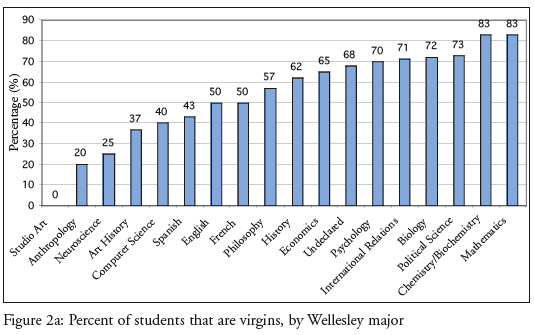
IQ x Sexual Activity = Constant.


Finally explained... why smart people never get laid!!

This graph plots the percentage of Wellesley undergraduates who are still virgins. Let me point out some important facts here:
1. None of the studio arts students are virgins.
2. The highest percentage of virgins is 83%: in Math.
3. Physics does not even figure on this list.
4. Wellesley is a liberal arts women's college.

Feel free to draw your own conclusions about the sexual fate of (male) physicists at premier institutions (read schools which do not label themselves as "liberal arts colleges".. but are better described as "research universities").

This links to the original article found, of all places, on SlashDot.
http://www.gnxp.com/blog/2007/04/intercourse-and-intelligence.php

And the PubMed (and why not? we are scientists here..) reference to a detailed study is here.
http://www.ncbi.nlm.nih.gov/sites/entrez?cmd=Retrieve&db=PubMed&list_uids=10706169&dopt=AbstractPlus

Scary Terminator Robots out already.

See the article here.Link

Thursday, August 02, 2007

Extreme Photography.

This bloke took an Olympus E-300 to the Arctic. Here is the story of how he fared and how his photographs turned out. Link

Harry Potter Rap Songs?

Oh dear me, by the great prophet Zarquon... check out this rap video based on the Harry Potter series.Link

Tears for a House Elf.

Dobby copped it.. or rather he was murdered by Bellatrix Lestrange. Dobby went to wherever it is that free elves go to and his mortal body lies buried near Bill and Fleur's seaside cottage. Rachna wrote a memoriam to him.

PhD ETA: 30 years?

For people who think that the finish line is somewhere on the other side of the Oort Cloud (both in a spatial and in a temporal sense).. here is the inspiring story of a bloke who finished his PhD.. after 30 years. Well, he did take time off to make some music..

Monday, July 30, 2007

Wand loyalties.. mistakes visited.

Mostly the perspective of M (my cousin, not Bond's boss).. that as JKR become the publishing industry's pet Goddess.. her editors were no longer able to yell at her.. and hence the myriad mistakes in DH.

Take for example the whole issue of wand loyalties in the deathly hallows... remember how Ron's wand was shattered by the Whomping Willow in CoS? Also remember the dueling club where Snape disarmed Lockhart with nothing more than a quick Expelliarmus? So.. there should have been a few quick lines about how wands can change loyalties if one loses a duel. And Ron should have won Lockhart's wand in the CoS itself... saving the need to buy him one with the winnings from the Daily Prophet in PoA.

The Hallows were never introduced in the context told by Xonophilius Lovegood ever before... and that is a terrible demerit of the series... for as long as I can remember, I have defending JKR against disbelieving Muggles by responding to their accusations of "its magic! Its for kids!!" by saying that "there are rules... she does not pull rabbits from her hat". This feels like a let down.

Friday, July 27, 2007

Kiss Kiss Bang Bang.

The movie with this name has just zoomed right to the head of my list of great flicks I have seen this year.. just think about it.. Val Kilmer as a hard nosed gay detective (yeah, had to see it to believe it).. Robert Downey Jr. as a small time crook who just turned up in LA on totally false premises (I suspect that was lousy grammar).. he was on the run after a failed boost from an electronics/toys store in the Village in NY when his partner bought the farm and he ended up in a room where they were doing auditions while hiding from the fuzz.. and they liked him so much that they sent him to LA.. and there he runs into his childhood inamorata.. played to perfection by Michelle Monaghan... and well.. Kisses and Gunshots!

BBD's album.

I have added Bibhuti's album to the sidebar for your viewing please. There. I always wanted to use this phrase!

Thursday, July 26, 2007

Liberalisation is not a panacea.

As this article by MP Gurudas Das Gupta says, the miracle of the Indian economic growth hides deep rooted ills and problems which have not been addressed.

Reckless liberalisation playing havoc

By GURUDAS DAS GUPTA
As Mr P Chidambaram blithely inaugurates one conference after another, buoyed by continuing stunning corporate results, corporate acquisitions and the so-called surveys of the consumer sentiment which find Indians consistently topping the charts, he most gleefully declares: “I cannot see any abrupt or dramatic slowdown of the consumption growth.”
His pronouncements sound even more exalted after the Central Statistical Organisation released figures declaring that the Indian economy has almost caught up with China’s pace of economic development. Incidentally, the government boasts of India’s economic growth as most sustainable; being second only to China’s. Symptoms of their claimed prosperity are virtually omnipresent ~ in the sale of cars, the boom in the real-estate business as also the ring of five million mobile connections sold every month never mind whether or not the fast-track “economic development” has improved the human fundamentals of the masses comprising a billion people of India.
As per the government’s appraisal, there are unmistakable signs of unparalleled upward swing in the economy. Taking this story further, leading corporates in India have succeeded in mobilising nearly Rs 2,34,903 crore from the primary market in 2006. The corporate sector has made overseas acquisitions worth of $8 billion in 146 transactions across the world. The prolific growth in corporate performance is further corroborated by increased exports and inflow of private equity. At least four Indian corporate tycoons have virtually taken the corporate world by storm, innovating, improving, strategising, and transforming dreams into a billion-dollar reality. In one weekend in October 2006, corporate jets of three Indian captains of industry were parked at London as they bid for enterprises worth over $12 billion, almost Rs 53,234 crore. In fact, the financial assets of one such billionaire are assessed to be around Rs 1,27,000 crore.
The story of government-backed corporate success goes even further: between 2003 and 2006, corporate India’s net profit had doubled from Rs 55,716 crore to 1,23,173 crore. It has possibly risen to Rs 1,50,00 crore as companies clock 30 per cent profit. The trend of unusual expansion of Indian corporates is further confirmed by analyses of the performances of individual corporate houses. A giant corporate having 23 million mobile subscribers had launched a joint venture for insurance and mutual funds and significantly hooked up with a global giant to foray into retail trade in India. By the end of the decade the revenue of the group is likely to soar up to Rs 67,000 crore.
This vulgar concentration of corporate wealth and increase in prosperity is exclusively derived from lopsided economic growth. The Finance Minister and the Planning Commission pretend to be ignorant of the hard reality. A closer look at the present economic scenario leads to the evidence of a wild spree of spending on conspicuous and wasteful consumption. The booty from the loot of the Indian economy is virtually thrown to the winds to meet the wild fancies of the consuming classes. Of late, there is a frenzy to purchase expensive foreign aircraft by the corporate entities costing millions with goodies and exotic, luxurious comforts thrown in. Even the birthday parties and matrimonial functions organised by the elite of society involve many a crore. While the source of the funds is rarely looked into, the government is happy; the wedding industry has become a burgeoning industry estimated to be $11 billion a year, growing annually at 25 per cent. This does not, of course, include jewellery sales growing at seven per cent annually and projected to reach $250 million by 2015.
The big fat wedding is the worst global export of India. It is obscene and vulgar. One Bollywood superstar reportedly charges Rs 1 crore for a wedding “event”. A government committed to liberalisation has conveniently freed itself from all forms of social and moral obligations. Therefore, it is not considered necessary to ponder on the evil impact of this spending spree of the super rich of the community even as the majority is denied access to elementary amenities of life.
It is easy to become a billionaire in India today but it is difficult to reduce the level of Indian poverty. The glare of five-star economic growth cannot hide the gloom of those living in the backyard of the economy. Unbridled market economy is playing hell with their lives. The Indian model of high economic growth trajectory, as is abundantly clear today, does not create jobs and even fails to alleviate human distress. While unemployment rises atrociously, the marginal job creation comprises only “distress jobs’, having little or no impact on the poor living condition of the working masses: 10 hours daily work on a monthly pay packet of not more than Rs 1,000 without any elementary statutory benefits. While output per worker has increased, managerial remuneration and profit are reaching new heights, the average real wage has stagnated and even declined. Obviously, the increase in productivity has resulted in accentuating gross income inequality instead of augmenting the wage level.
The majority of the jobless who have no alternative are compelled to fall back on jobs where minimum wage is denied and working conditions remain too poor to improve the living conditions of the employed. The growing divergence between output and employment can be crucially linked to liberalisation, especially to open trade. Since advanced capitalist countries are equipped with modern technology associated with higher productivity, developing countries find it difficult to stand the strain of unequal competition. They, therefore, seek to cut labour costs, adopt improved technology and reduce manpower, employ low-cost labour that is overburdened with an unbearable workload. There is not only an anomaly between output and employment, there is also divergence between productivity and wage level. This is no growth with equity; it is growth with grave inequality generating intense social tension.
If growth is to be inclusive, its benefits much reach the poor. Even after 60 years of freedom, an overwhelming majority of the population of the country, may be as much as 70 per cent, remains outside the periphery of economic development. Such growth does not lead to economic empowerment, nor does it increase purchasing power. The additional wealth that is generated due to high growth is obviously cornered by a minuscule minority. If the additional purchasing power is not generated for a larger number of people and people do not earn enough to take care of minimum basic needs, the growth is obviously not of an inclusive nature. Under an inclusive growth model, economic empowerment and particularly employment would most certainly occupy centre-stage.
Unfortunately, in India, economic growth is largely jobless and the gain of development is not sought to be redistributed among the masses of the people by active state intervention, and, therefore denial and marginalisation are the concomitants of the present economic system. The government does not have the political will to adopt an appropriate fiscal policy and there is hardly any move in that direction to ameliorate distress and deprivation of the masses.
The National Sample Survey conducted every five years indicates in its latest report that the ratio of the national level of poverty is at 27 per cent; even the data prepared by the 61st Round appears to be an understatement. If the non-availability of safe drinking water, absence of educational facilities, medical care, and easy communication are also taken into consideration, the level of poverty naturally assumes a dangerous proportion.
Now comes the crucial question of employment. According to the current Economic Survey, between 1991 and 2004 the number of people employed in the organised private sector grew by a meagre 0.6 million, while it remained largely unchanged in the manufacturing sector. Employment has declined in the organised sector as well. While employment stagnated over the first decade-and-a-half since the economic reform began, the real output of the non-agricultural part of the economy increased by a factor of four, the same number of workers produced four times as much from earlier output, thanks to the introduction of automated systems.
The fact that the reduced manpower is producing much larger output is further corroborated statistically by the data obtained from different enterprises. The largest private steel industry of the country had augmented production five times with half of the earlier workforce. In an engineering factory near Pune, a worker mans 27 machines, of course, with the help of the computer, if the informal sector had produced 10 times the job created by the organised sector, only six million jobs would have been created in a decade-and-a-half, while the annual addition to India’s workforce is between eight million and 14 million. This is a short profile of the jobless character of the economic growth of the country.
The nature of the “unemployment explosion” that India is likely to experience as estimated by Team Lease Services: The current unemployment figure of 13 million is likely to undergo a 15-fold rise and reach the level of 200 million, constituting 30 per cent of the population in 2020. The trend of joblessness has set in with the onset of reforms in the last decade. The aggregate figure of employment decline is 0.6 per cent despite the booming service sector. While the service sector contributes 55 per cent of the country’s GDP, only two per cent ~ less than 0.5 per cent of the country’s 400 million labour force ~ is employed in the sector.
Due to low productivity and unstable growth, even periodic decline of production, agriculture no longer provides viable livelihood to the rural population. In the rural sector, the number of employed every one thousand people has declined from 403.5 in 1992-93 to 399 in 2004-05.
If economic growth has lost its capacity to create jobs, it has clearly not succeeded in mitigating poverty. Agricultural production has declined, the country has lost its food security and even has to live on foreign imports. The Public Distribution System has almost collapsed; it is all a blank ration card. The Employment Guarantee Scheme has not taken off; while 130 districts have been added, the additional budgetary allocation increased only by six per cent of the earlier allotment. The political system has utterly failed to develop the needed social infrastructure even after 60 years of freedom to improve the human fundamentals of the nation. The higher rate of growth the economy has attained does not provide better quality of human life; rather it benefits the millionaires and billionaires at the cost of the poor and lower middle class.

(The author is a CPI member of Parliament)


Wednesday, July 25, 2007

As the (late) Mad-Eye Moody would have said...

the things I do not know would fill several volumes.. or something like that I imagine. Take for example the fact that the movie Wing Commander is based on a famous video game. I am not a VG player at all.. so this is one aspect of pop culture totally closed to me. I was thinking about this movie because it is the only other movie starring Mathew Lillard I have ever heard of..and Lillard, (incidentally also a Michigander.. who would have guessed, given his accent?) starred in Wicker Park, a nice fillum made totally beautiful by the presence of Rose Byrne (you might remember her from Troy.. that homo-erotic action epic where she was this wonderful piece of window dressing). Again, she does not appear to be related in any way to Gabriel of the same family name... him of the creepy Catholic persuasion... has much to do with Satanic cloak and dagger in so many fillums. Nice for Rose!

Tuesday, July 24, 2007

Deathly Hallows editorial.

My sis sent me this from MuggleNet Very good reading..

Parseltongue.

Hmmmm.. if you have seen the recent Mel Brook's musical 'The Producers' you will surely recall the hilarious moment when Roger Bart opens the door to Nathan Lane and Mathew Broderick and goes 'yesssssssssssssssssssssssssssssssssssssssssssssss?'. So if Bart just happened to study at Hogwarts, he would probably open the portal to the Chamber of Secrets half a dozen times a day by mistake. Parseltongue cannot be learnt. It is a gift inherent to certain wizards, most of them Dark which enables them to talk to snakes. Assuming that Ron would be able to open the Chamber of Secrets by standing in front of it and hissing is a ridiculous statement and JKR should have come along with something more plausible. And while we are at it, what is the deal with Fiendfyre? Someone should have let us know that it can destroy Horcruxes. Sure, the fact that Basilisk venom can was long known, or atleast indicated. And that fact that Gryfffindor's sword could also destroy a Horcrux, while not directly told to us, was atleast obliquely hinted at.. and there is a pretty huge mythology/literature about special swords with special properties. But Fiendfyre??? Come on, that made it appear that JKR's editors were yelling for a deadline and she just put that in to save pages.

Wand loyalties.

As my sister pointed out.. wand-lore is not a well read or a well understood subject.. in fact it appears to be one of the more jealously guarded of all wizarding knowledge. But think about this.. if a wand switches loyalty when its owner is as much as disarmed, then what happened to the wands during the practice sessions of Dumbledore's Army in the Room of Requirement? That must have been a huge mess!

So coming back to wand-lore being ill understood... there are only two wand makers cited.. Ollivander and Grigorivitch. Are we to understand that there are no other wand makers of equal stature? Don't these people have any pupils or apprentices? How does the art of wand making get passed on to future generations.. there has been no class taught at Hogwarts which might come close .. say 'Magical Engineering'. Points to ponder.

Art Fair pictures.

Some pictures taken during the recent Art Fair are here.

Monday, July 23, 2007

The Boy Who Lived.

The wait is over, I picked up the book early on Saturday from the Borders on Central Campus and got started immediately. This was slightly impeded by the fact that I was navigating for K on a 50 mile drive to some people's place who invited us to stay for lunch. I made it through somehow and got back to the book. Anyways, long story short (pun intended) I finally put the book down, exhausted and drained late on Saturday night.

Spoilers follow!!!

The Boy Who Lived, still lives. That is the most important point. Severus Snape was always one of the most ambiguous characters and undoubtedly one of the most powerful wizards around.. his murder of Dumbledore at the end of HBP had to be explained. To the partial delight of shippers all over,. he had a thing for Lily Evans.... which does explain a lot... including his undiluted hatred of James Potter.

My theory was true,.... well.. sort of. I had predicted that Harry and Voldemort were Horcruxes of each other... well.. that was partially true.. that Harry was certainly a Horcrux of Voldemort, but what I was not able to give a logical explanation for was the converse.. but JKR did.. and now of course I am butting my head against the wall.. how did I forget the fleeting look of triumph in Dumbledore's eyes when Harry told him how Peter Pettigrew had used some of Harry's blood to resurrect Lord Voldemort? Shame!

They shouldn't have killed Tonks. This was one character I really liked... and I get the feeling that this was done only to up the body count.. rather unnecessary.. in my mind. If JKR wanted more gore.. she should have killed Prof. Flitwick, or even Prof. McGonagall. Oh, and yes, some loose ends were not tied up the way I wanted them. For instance, it was okay to satisfy the legions of shippers by making sure that Harry/Ginny and Ron/Hermione get together.. but what about Luna and Neville? Also after the Second Battle of Hogwarts, Arthur Weasley should have become the Minister of Magic. This did not happen. Anyway, the long journey is finally over and it has been worth every moment.

Friday, July 20, 2007

More speculation on Harry Potter.

Snape. The most enigmatic character in the whole wizarding world. For my money, also one of the most powerful and understated people around.. the first time that he set eyes upon Harry, the latter's scar began hurting. What does this mean? Snape cannot be just a bad guy.. he is simply too complex for that. Snape has his own very complicated morality, and he has simultaneously shared the confidence of the two most powerful wizards of the age, both of them deadly foes. To balance such a fine line takes nerve and imagination. Snape has both in spades. I push for him being involved in what has to be a final confrontation between the Dark Lord and Harry and being the deciding factor in what will perhaps become a Mexican showdown.

I had for a few moments entertained thoughts of Fawkes being a Horcrux for Dumbledore, just as Nagini is speculated to be one for the Dark Lord.. this would be nicely symmetrical..but then Dumbledore was simply too good to kill wantonly to create a Horcrux. Even during the battle in the Ministry atrium, he never used a killing curse on Voldemort. Then I remembered that JKR has squished this idea already. But perhaps, the rising from the ashes symbolism will carry itself out elsewhere. Fawkes is important, this is something I am convinced of.

Less than twelve hours to go.

There are less than twelve hours to go before the worldwide release of the seventh volume of the Harry Potter series, 'HP and the Deathly Hallows'. The internet is rife with speculation. Is Snape good or bad? The local Border's, where I have put my name down on the pre-order waitlist is organising a HP midnight party with a quiz and a debate. I just told my labmates about how excited I am.. they are not fans. Quite a damper.

My own pet theory is that Harry is a Horcrux for Lord Voldemort, well that part of the theory is quite widely accepted.. in fact this made its appearance right after HBP. Well.. my theory goes on to state that during the infamous Adava Kedavra performed 16 years ago in Godric's Hollow, there was some kind of transfer of souls between Harry and the Dark Lord.. which has manifested itself in several ways:

1. Harry's scar burning when the Dark Lord gains in physical strength in GoF.
2. The fact that Harry and the Dark Lord can 'see' what the other sees in OoTP.
3. The wands! Harry and Lord Voldemort both possess wands which have a phoenix feather core. The phoenix feather comes from Fawkes, Dumbledore's pet phoenix.

Anyway, all will be revealed tonight!

Thursday, July 19, 2007

Art fair, back from Boston, etc.


Yes, me back. for what it is worth (nothing), me back at AA and at the current moment concentrating a protein sample. Boston was amazing.. T and J were the best hosts possible.. they are people who have been great friends from the Institute days, and it is wunnerful to be able to go meet them and see that the ole magic dosti is still there, and stronger still.

I spent some time with JD and DP in NY and NJ.. we stayed at this place called Union City just across the Hudson river(there was that strange business at the Hoboken Terminal of the NJ Path Line.. but no time spent on that).. amazing view of the NY skyline at night. We explored NY by day and got hilariously trashed at night. Ok, here is something that people should know.. there are plenty of small businesses in and around NYC where people accept plastic, but their credit card machines print all 16 digits of the card no. which they are not supposed to do. Never happens in AA, Chicago, etc.

We got to see the South Sea Port, took a long walk along the Brooklyn Bridge.. what was that movie now where Shahrukh Khan ran down the bridge.. thus giving it an immortal place in the mind of the Indian cinema-going public? Then we ended up at this kabab place in the Village.. very nice! I could get to love this city.

Finally, we rode the Chinatown bus to Boston, and then to Dover, New Hampshire. We met up with our friends who are the University of New Hampshire.. they drove us to Durham, their pretty little town. The place is wonderfully quiet... in fact, so much so that I would get cabin fever in a week or two. A fun night of music and adda followed.. and then it was back to Boston the next day. I caught HP&OOTP there. More later.

Monday, July 09, 2007

Vacation time.

I am taking some time off from work (but not, it would seem, from orkut, or blogger). This post is from Boston, where the weather is rather disappointingly like AA. Anyways, I particularly like this city.. so fun.

Thursday, July 05, 2007

Needs to be told.

A friend sent me this story about India's widows being shunned by their families and being basically thrown out on the street after their husbands pass away. For a society that prides itself on the respect given to the elderly, this is a shame. Read the story here.