Monday, September 18, 2006
Scorpio
There are loyalties to the country and then there are the realities of the job. There are orders issued by nameless bureaucrats from high above, and then there are requests from old friends on the lam. ‘Scorpio’ is about Cross, a veteran cold warrior, played by Burt Lancaster wanted by his superiors at the ‘Company’ for unnamed crimes. Meanwhile, Alan Delon plays Scorpio, a French contract assassin employed at an arm’s length by the Company to eliminate troublesome people. Cross, shown as a master at streetcraft is Scorpio’s case officer. When the Americans want Cross’ head, they recruit none other than his own protégé; Scorpio. The movie rapidly turns into an intense cat and mouse game, except that the mouse is no mouse at all, but a hardened field agent who has played the game as no other. This is not for people who love chick flicks and simple minded stuff. There are distinct flavours of ‘Hopscotch’, Brian Garfield’s tour-de-force about a renegade CIA agent being pursued by his own best friend. We are firmly on Cross’ side, but is he innocent of the double agent charges leveled against him? Or is there a more sinister underpinning to this tale? The movie dares to walk in that area of moral ambiguity which is normally best left as the preserve of people like John le Carre and Len Deighton. If there is a message here, it is brought home when Cross seeks shelter with Sergei Zharkhov, a KGB agent, and thus, a member of the opposition. The line which has immortalized the film was, ‘I have known Zharkhov for thirty years, as an ally and as an enemy; but always as a friend.’


Thursday, September 14, 2006
Thermodynamics
sorry, this post is actually about thermodynamics. there is a very interesting review of the Gibbs' Paradox here. quite an interesting perspective. personally, I believe that no teaching of thermodynamics can ever be complete without referring to both the axiomatic formulation by Caratheodary, which goes in one direction and then to walkk into applications of the various thermodynamic potentials. but then again, it is probably a good idea to talk about the Legendre transformation. this will take up time though, which ... people do not have!
Nmap, Trinity and other stuff
someone showed me this link the other day. it would appear that there people out there waaaaay more geeky than I am accused of being.
Equilibrium
A monochromatic world.
Equilibrium. See the movie. This is had the misfortune of being labeled as a Matrix clone, which it is not. In fact, the Matrix trilogy, while inspiring a whole underground internet culture, finding its way into videogames and the like has also set standards against which all future SF (NOT scifi) efforts will be judged, and for a while, at least, found lacking. This is sad. While I am a pretty big fan of the trilogy, I sometimes think that the scriptwriters were definitely smoking something illegal late at night when the script was completed. But, back to Equilibrium. Again, the question is to obey or not to obey. The government, in this case. The movie borrows from a rather old idea of SF; that of the ‘unemotional society’. A future in which emotion has been banned because of the trouble it causes. A very simple concept of abandoning everything, that brings happiness into our lives because by sacrificing happiness, we have banished despair. The eternal trade-off, completed by governmental decree, issued in the name of an enigmatic ‘Father’, and carried out by daily injections of mind, but not body numbing serum. The very concept of uniformity is shown by the monochromatic shades of the world. This movie looks like it has been made by someone who has read the books, and done his homework. But like a perfect piece of schoolwork, it suffers from perfection. Within their own limitations, the actors have performed very well. Christian Bale looks like he is made of stone, but that is exactly what he has been turned into. Sean Bean is very convincing as the enforcer who is beginning to turn into a heretic. Heroes are not supposed to suffer from cowardice: that is something better left to the character actor who plays the sidekick. In this case, Bean came off looking great as the cleric who is human, but, unfortunately human enough to fear death; until, of course his last moment when he displays textbook dignity. This is my crib; this movie had to be made in the shadow of greater efforts, and is well made for that. But it does all you expect it to, and nothing more. This is a good movie to learn from. But it fails to rise to the heights which it should have rightfully gone to.
Equilibrium. See the movie. This is had the misfortune of being labeled as a Matrix clone, which it is not. In fact, the Matrix trilogy, while inspiring a whole underground internet culture, finding its way into videogames and the like has also set standards against which all future SF (NOT scifi) efforts will be judged, and for a while, at least, found lacking. This is sad. While I am a pretty big fan of the trilogy, I sometimes think that the scriptwriters were definitely smoking something illegal late at night when the script was completed. But, back to Equilibrium. Again, the question is to obey or not to obey. The government, in this case. The movie borrows from a rather old idea of SF; that of the ‘unemotional society’. A future in which emotion has been banned because of the trouble it causes. A very simple concept of abandoning everything, that brings happiness into our lives because by sacrificing happiness, we have banished despair. The eternal trade-off, completed by governmental decree, issued in the name of an enigmatic ‘Father’, and carried out by daily injections of mind, but not body numbing serum. The very concept of uniformity is shown by the monochromatic shades of the world. This movie looks like it has been made by someone who has read the books, and done his homework. But like a perfect piece of schoolwork, it suffers from perfection. Within their own limitations, the actors have performed very well. Christian Bale looks like he is made of stone, but that is exactly what he has been turned into. Sean Bean is very convincing as the enforcer who is beginning to turn into a heretic. Heroes are not supposed to suffer from cowardice: that is something better left to the character actor who plays the sidekick. In this case, Bean came off looking great as the cleric who is human, but, unfortunately human enough to fear death; until, of course his last moment when he displays textbook dignity. This is my crib; this movie had to be made in the shadow of greater efforts, and is well made for that. But it does all you expect it to, and nothing more. This is a good movie to learn from. But it fails to rise to the heights which it should have rightfully gone to.
call it the anti incumbency factor. call it hating the giant. fact: intel leads the world in hardware. fact: microsoft leads the world in software. mad about it? go raise your blood pressure, nothing we can do about it.
but then, do we have to do anything about it? things seem just fine to people the way they are. and sometimes it is way more trouble doing things the 'right' way, rather than the PC Windows way. so we do it the intel/MS way.
but in the meantime, the transition has just taken place. just as in, about a month ago. and G5 fans will now have to back down to second place. the fastest desktop in the world will now be the Mac Pro running Intel Xeons clocking upto 3GHz. it remains to be seen whether there will be any further development from IBM on the powerpc line. i saw this review which compares the xeon, the P4, the G5 and the athlon..... the conclusions seem to tell us that the G5 is the processor to watch, but overheating problems...
however, the other thing to watch is the OS battle which should hot up with Leopard taking on Vista with much the same hardware underneath.. and if Apple stopped their incestuous relationship with MS Office and started supporting an independant platform like.. say StarOffice, maybe the war will be fought all over again.. more power to the user!
but then, do we have to do anything about it? things seem just fine to people the way they are. and sometimes it is way more trouble doing things the 'right' way, rather than the PC Windows way. so we do it the intel/MS way.
but in the meantime, the transition has just taken place. just as in, about a month ago. and G5 fans will now have to back down to second place. the fastest desktop in the world will now be the Mac Pro running Intel Xeons clocking upto 3GHz. it remains to be seen whether there will be any further development from IBM on the powerpc line. i saw this review which compares the xeon, the P4, the G5 and the athlon..... the conclusions seem to tell us that the G5 is the processor to watch, but overheating problems...
however, the other thing to watch is the OS battle which should hot up with Leopard taking on Vista with much the same hardware underneath.. and if Apple stopped their incestuous relationship with MS Office and started supporting an independant platform like.. say StarOffice, maybe the war will be fought all over again.. more power to the user!
Wednesday, September 13, 2006
Vande Mataram
Religion, obfuscation and genuflection.
We Hindus have been, for a long time touching the feet of our fathers, our seniors, family elders, and of course idols. Something that perpetually keeps gnawing at the back of my thinking is this: man created religion. We peopled the skies. I am not an agnostic, rather the view I maintain is that, if the effects of certain belief and faith are indistinguishable from a miraculous act by a divine power, then the question of the existence of that power is quite rhetorical. That is, if you believe that God exists, then he/she/they exist(s).
Didi has been calling me a right wing Hindutva fanatic for a while. In fact, most thinking Hindu men go through an adolescent stage of being extremely right wing, sometimes to the extent of thinking that a certain Adolf had some pretty good ideas.
Most of my friends call me a rabid foaming at the mouth leftist. Such leftists are also usually atheist. I do not know if it is possible to decouple politics and economics from religion.
I prefer to label myself as a ordinary or garden variety Hindu with no particular political leanings. Having said that, there are a few observations to be made.
Religion was created mostly as an aide to survival. Survival comes from being social. This sentence is loaded with multiple layers of meaning. For example, the Great Jasagh, the written code of the Mongol Empire under its greatest lord, Genghiz Khan allowed for respect for the elderly, tolerance for al beliefs. it also called for savage punishment for crimes like gluttony, urinating in running water and so on. All of them crimes against society, things which could hardly be tolerated in the steppes, where survival itself was a matter of cooperation.
Most modern religions have at their base a simple base of rules that make for an ordered society. It is the perversion of these laws to suit the makers which results in the discord we see. At the risk of being a heretic, I could say that we might easily substitute the Indian Civil and Penal Code for the Gita, the KoranSharif and the
Bible. Think of it logically, Prophet Gates provides true believers with a new version of his code every couple of years. He even provides patches and security updates online if you have a registered version. Isn't it time most of the world religions got an upgrade?
So, coming back to the Vande Mataram controversy. This song was called the Indian National Song. So why not sing it? It is also a beautiful song, and actually easier to sing than many national anthems. And lastly, in an era where children do not know who Khudiram Bose and Bhagat Singh were, it might be of some value to sing some patriotic songs to them.
It perpetually surprises me that Indians tend to undervalue their nation this way. Freedon did not come free of cost. That is something that young people should be taught.
We Hindus have been, for a long time touching the feet of our fathers, our seniors, family elders, and of course idols. Something that perpetually keeps gnawing at the back of my thinking is this: man created religion. We peopled the skies. I am not an agnostic, rather the view I maintain is that, if the effects of certain belief and faith are indistinguishable from a miraculous act by a divine power, then the question of the existence of that power is quite rhetorical. That is, if you believe that God exists, then he/she/they exist(s).
Didi has been calling me a right wing Hindutva fanatic for a while. In fact, most thinking Hindu men go through an adolescent stage of being extremely right wing, sometimes to the extent of thinking that a certain Adolf had some pretty good ideas.
Most of my friends call me a rabid foaming at the mouth leftist. Such leftists are also usually atheist. I do not know if it is possible to decouple politics and economics from religion.
I prefer to label myself as a ordinary or garden variety Hindu with no particular political leanings. Having said that, there are a few observations to be made.
Religion was created mostly as an aide to survival. Survival comes from being social. This sentence is loaded with multiple layers of meaning. For example, the Great Jasagh, the written code of the Mongol Empire under its greatest lord, Genghiz Khan allowed for respect for the elderly, tolerance for al beliefs. it also called for savage punishment for crimes like gluttony, urinating in running water and so on. All of them crimes against society, things which could hardly be tolerated in the steppes, where survival itself was a matter of cooperation.
Most modern religions have at their base a simple base of rules that make for an ordered society. It is the perversion of these laws to suit the makers which results in the discord we see. At the risk of being a heretic, I could say that we might easily substitute the Indian Civil and Penal Code for the Gita, the KoranSharif and the
Bible. Think of it logically, Prophet Gates provides true believers with a new version of his code every couple of years. He even provides patches and security updates online if you have a registered version. Isn't it time most of the world religions got an upgrade?
So, coming back to the Vande Mataram controversy. This song was called the Indian National Song. So why not sing it? It is also a beautiful song, and actually easier to sing than many national anthems. And lastly, in an era where children do not know who Khudiram Bose and Bhagat Singh were, it might be of some value to sing some patriotic songs to them.
It perpetually surprises me that Indians tend to undervalue their nation this way. Freedon did not come free of cost. That is something that young people should be taught.
and a birthday


people sometimes celebrate birthdays. i wonder why. anyway, they do. a couple of weeks ago, Rachna had her... well,... something-eth birthday. asking a lady her age not being the politest thing to do, lets just leave it at that. and C and I were invited. P came down from wherever he was doing his internship. or maybe it is 'came up'. not sure. anyway, there was a party of sorts. with one very jetlagged chief guest and a bunch of guys who appeared quite inebriated without a single bottle of wine opened as yet. and two cakes. yes, two cakes. one of the cakes was brought in by P. the other cake was of quite unknown provenance. after a while, the room started filling up with random shady indian people. here are the pics.
graduation party


people have been accusing me of turning political. i take serious offence at such accusations. to begin with, there is an inherent implication that i am actually THINKING. as anyone who knows me knows, the last time i thought was in 1987 and the consequences of that were not too good. anyway, to bring the blog back to what it was born as, a documentation of the lives of people around me, here is a new entry.
my labmate G graduated very recently. he is planning to move on to social work and make a difference in people's lives where it matters. here are some pictures from his graduation party at our advisor's house.
Monday, September 11, 2006
Acts of faith
It takes a certain amount of faith to live in purdah and still believe that the world outside exists. For those people whom we have started to forget, the burgeouning economy and tax cuts mean nothing. Votes mean precious little to people who are hungry and where life does not cost too much. How much longer will we continue living with such things on our conscience and not do anything? Read this.
Chicken Soup
i have frequently been told by people that being happy is a function of telling yourself that you are
happy. that being in love with someone is a function of telling that person that you love him/her.
such advice is frequently backed up with heartwarming stories of 'chicken soup for the soul' variety.
i have also been told that reading some stuff will make me a better person. tyically the type of
reading that is suggested is again, of a very decent and heartwarming theme. there are no four
syllable words, sentence construction is kept to a minimum and no great concepts are propounded.
while i agree that in an age of increased mechanisation, sometimes an 'emotion made easy' is
necessary, disagree that it should be universal.
the points i make are the following:
1. the objective of sentient life is not necessarily to be happy. if that were the case, then all
children, once off the feeding bottle would be dosed regularly with psychotropic substances which
would give them greater happiness that anything else.
2. the purpose of sentient life is to ACHIEVE. let me say that again. TO ACHIEVE. to reach higher,
and greater than before in every sphere possible. in order to achieve, we must, first try making sure
that everyone gets to eat and be clothed. telling someone who is poor and hungry that he should be
happy is not just stupid. it is cruel.
3. unhappiness is an indulgence of the well fed.
4. little heartwarming stories designed to make people cry have their uses. however, the ability to
THINK AND FEEL is one sorely lacking in most. people with a minimum of education should not need such
shortcuts.
5. there is decent reading out there. what makes me slightly angry is seemingly intelligent people
around me reading shite which is supposed to make them empathise. things seem to tend to move towards
the simpler and the simpler. this is sad.
happy. that being in love with someone is a function of telling that person that you love him/her.
such advice is frequently backed up with heartwarming stories of 'chicken soup for the soul' variety.
i have also been told that reading some stuff will make me a better person. tyically the type of
reading that is suggested is again, of a very decent and heartwarming theme. there are no four
syllable words, sentence construction is kept to a minimum and no great concepts are propounded.
while i agree that in an age of increased mechanisation, sometimes an 'emotion made easy' is
necessary, disagree that it should be universal.
the points i make are the following:
1. the objective of sentient life is not necessarily to be happy. if that were the case, then all
children, once off the feeding bottle would be dosed regularly with psychotropic substances which
would give them greater happiness that anything else.
2. the purpose of sentient life is to ACHIEVE. let me say that again. TO ACHIEVE. to reach higher,
and greater than before in every sphere possible. in order to achieve, we must, first try making sure
that everyone gets to eat and be clothed. telling someone who is poor and hungry that he should be
happy is not just stupid. it is cruel.
3. unhappiness is an indulgence of the well fed.
4. little heartwarming stories designed to make people cry have their uses. however, the ability to
THINK AND FEEL is one sorely lacking in most. people with a minimum of education should not need such
shortcuts.
5. there is decent reading out there. what makes me slightly angry is seemingly intelligent people
around me reading shite which is supposed to make them empathise. things seem to tend to move towards
the simpler and the simpler. this is sad.
Friday, September 08, 2006
Rat Kings
Just finished reading 'The amazing Maurice and his educated rodents' by Terry Pratchett. I realise that I am envious beyond belief of the good Mr. Pratchett. Reasons will be gone into in some later blog. This book deals with Rat Kings. There is a great reference from Wikipedia here. Meanwhile, there is also a nice review of some of Pratchett here. And finally, a tiny little extra: a scence fiction listing here. I am going to wrap this up without a review of Pratchett myself. Surprised? Well, it will just take too much time.... way too much. Just this, the book I told you about,.... frightened me.
Thursday, September 07, 2006
Photocopying nightmares
Photocopying: Sealdah and Ann Arbor.
People photocopy stuff all the time. Students, more so than other people, I imagine. Bad for the trees, and in the long term, bad for us. It would be nice if someone came up with a paper substitute which would also be easily biodegradable and clean. Meanwhile, this blog is about copying stuff. Back home, Xerox has become a substitute word for photocopying. Fine. So we Xeroxed stuff all the time. Books(yes, mostly stuff that was out of print, and we needed just that reference on special functions published in 1960!!), notes, and the rest. At that time, electronic media was still somewhat exotic. (shite, I feel old!)
The best place to xerox stuff was at Sealdah. A couple of my friends and I had spent time exploring the back alleys of Sealdah, so we knew where to find the best deals. This place is home to some of the most interesting trades in the world. Keymakers, micro-publishing from tiny places hidden away in alleys which you have to know exist (sort of like Diagon Alley in Harry Potter, if you don’t know it exists, you simply do not see it). This was home to perhaps a few hundred thousand people who lived and worked all inside a tiny area of less than a square kilometer. It would not be inaccurate to describe it as the armpit of Calcutta.
In that place was our favourite Xerox shop. Yes, at that time, we did not have access to things like department copier machines. So we legged it all the way to Sealdah and found a place where they copied stuff for 30 paise a page. And then found suitable binders where the could hard bind, spiral bind, soft bind, pretty much do anything you wanted. These Xerox shops had maybe six sweating blokes operating six machines on two levels (the room was split into two levels). The guys were sweating because the best ventilation in the world cannot take the heat away from six copiers running ALL THE TIME, and they did not exactly have access to the best ventilation. More like one of those high speed pedestal fans. They used to take turns operating the machine closest to the fan; the most comfy position to be in. And they did business with us. We got special deals for bulk orders (as in, the whole class wants the book), and sometimes got stuff Xeroxed on wastage paper (you have to ask for it, they don’t tell you that it exists) There was something called oil Xerox, where they use minimum toner so that the copy does not last forever. Very useful to copy notes which will become absolutely redundant after the exam (assuming of course, that you pass) at which point, the paper can used to simply write stuff on.
Today my boss told me to copy the handouts for his class (I am the TA). The department has its own funky copies with some fifty odd modes and infinitely many features. So its started out by working just fine. About when I was getting confident enough to tell the machine to copy 25 sets, collate and staple them, it started misbehaving. First, it chewed up the original. I got that out. Then it ran out of paper. Ok, I loaded extra paper. Then, it tried to feed paper from a reserve sheet. Which went wrong. Meanwhile, the stapler unit had gone crazy. It started folding the paper any which way it wanted and stapling all over the place. I could just imagine the copier going, ‘aha, this is a class on protein folding, lets start by folding the paper!’ And finally, with a very ominous rumble, the copier jammed. I took five deep breaths and started opening the machine up. I extracted some ten odd papers jammed in strange place in the machine’s innards. It told me to open door 5, press lever 6, pull open slider 8, and pull out the paper. One of our research scientists came in, saw what I was doing and told me that the spectrometer is more complicated. That did not help. I obeyed the instructions, opened door 7, did some stuff and the machine yelled. This went on for a while. Finally, I asked someone from the office to help. He came over. After a while, here we were, both scratching our heads. Then someone else came over and took charge. And we just could not figure out where the FNS conveyance door was. Such is life. Sometimes, FNS conveyance doors will come between you and your happiness. Finally, another member of the staff walked in, and fixed the problem in a jiffy. Bingo!
People photocopy stuff all the time. Students, more so than other people, I imagine. Bad for the trees, and in the long term, bad for us. It would be nice if someone came up with a paper substitute which would also be easily biodegradable and clean. Meanwhile, this blog is about copying stuff. Back home, Xerox has become a substitute word for photocopying. Fine. So we Xeroxed stuff all the time. Books(yes, mostly stuff that was out of print, and we needed just that reference on special functions published in 1960!!), notes, and the rest. At that time, electronic media was still somewhat exotic. (shite, I feel old!)
The best place to xerox stuff was at Sealdah. A couple of my friends and I had spent time exploring the back alleys of Sealdah, so we knew where to find the best deals. This place is home to some of the most interesting trades in the world. Keymakers, micro-publishing from tiny places hidden away in alleys which you have to know exist (sort of like Diagon Alley in Harry Potter, if you don’t know it exists, you simply do not see it). This was home to perhaps a few hundred thousand people who lived and worked all inside a tiny area of less than a square kilometer. It would not be inaccurate to describe it as the armpit of Calcutta.
In that place was our favourite Xerox shop. Yes, at that time, we did not have access to things like department copier machines. So we legged it all the way to Sealdah and found a place where they copied stuff for 30 paise a page. And then found suitable binders where the could hard bind, spiral bind, soft bind, pretty much do anything you wanted. These Xerox shops had maybe six sweating blokes operating six machines on two levels (the room was split into two levels). The guys were sweating because the best ventilation in the world cannot take the heat away from six copiers running ALL THE TIME, and they did not exactly have access to the best ventilation. More like one of those high speed pedestal fans. They used to take turns operating the machine closest to the fan; the most comfy position to be in. And they did business with us. We got special deals for bulk orders (as in, the whole class wants the book), and sometimes got stuff Xeroxed on wastage paper (you have to ask for it, they don’t tell you that it exists) There was something called oil Xerox, where they use minimum toner so that the copy does not last forever. Very useful to copy notes which will become absolutely redundant after the exam (assuming of course, that you pass) at which point, the paper can used to simply write stuff on.
Today my boss told me to copy the handouts for his class (I am the TA). The department has its own funky copies with some fifty odd modes and infinitely many features. So its started out by working just fine. About when I was getting confident enough to tell the machine to copy 25 sets, collate and staple them, it started misbehaving. First, it chewed up the original. I got that out. Then it ran out of paper. Ok, I loaded extra paper. Then, it tried to feed paper from a reserve sheet. Which went wrong. Meanwhile, the stapler unit had gone crazy. It started folding the paper any which way it wanted and stapling all over the place. I could just imagine the copier going, ‘aha, this is a class on protein folding, lets start by folding the paper!’ And finally, with a very ominous rumble, the copier jammed. I took five deep breaths and started opening the machine up. I extracted some ten odd papers jammed in strange place in the machine’s innards. It told me to open door 5, press lever 6, pull open slider 8, and pull out the paper. One of our research scientists came in, saw what I was doing and told me that the spectrometer is more complicated. That did not help. I obeyed the instructions, opened door 7, did some stuff and the machine yelled. This went on for a while. Finally, I asked someone from the office to help. He came over. After a while, here we were, both scratching our heads. Then someone else came over and took charge. And we just could not figure out where the FNS conveyance door was. Such is life. Sometimes, FNS conveyance doors will come between you and your happiness. Finally, another member of the staff walked in, and fixed the problem in a jiffy. Bingo!
Wednesday, September 06, 2006
Higher education in West Bengal.
Higher Education in West Bengal.
There is some misinformation around regarding the quality and relevance of higher education in West Bengal (WB) which needs to be removed. I am going to address various issues individually.
1. Lack of engineering colleges.
As recently as a decade ago, there were merely a handful of engineering colleges in WB, mostly run by the government such as Jadavpur and Shibpur. These colleges were, and still remain highly regarded centres of excellence competing effectively nationwide. The paucity of private engineering colleges lead to a migration of students to other states, principally Karnataka, Maharashtra, Orissa and Tamil Nadu. The departure of perhaps 50,000 students each year lead to an expenditure of 50000 X (40,000+40000) = 4 Billion rupees per year. This money was pumped into the burgeoning economies of these states and it came from the not very deep pockets of middle class Bengalis.
In recent years, there have been many private tech schools established. At last count, there are 91 registered under the umbrella of the West Bengal University of Technology.http://www.wbut.net/ The outflow of students has reduced somewhat, but still remains.
What matters is the economic cost. Most of our departing students do not join centres of excellence like the IITs or BITS, where many students receive scholarships. These students pay hefty fees to study at perfectly average institutions. Money which could have been profitably rerouted to WB.
2. Engineering vs Science vs Commerce vs Humanities.
Most students in high school try to take the tried and tested route of an engineering degree followed by an IT job. Few have the courage to try other things, and who can blame them. Most employers seem to take the blinkered viewpoint that an engineer is the only employable person around. There are precious few engineers who do engineering anyway. By and large, most of our bright girls and boys are busy writing code. Thus, the intellectual, monetary and temporal investment in a BTech degree, in perhaps Mechanical Engineering is largely unutilized. Do note that I say ‘unutilized’ and not ‘wasted’.
The other side to the thousands of IT jobs springing up all over is that all other fields are suffering. Very few students take up the humanities by choice; in most cases, it is an inability to perform in the mathematically intensive fields of engineering which pushes someone to, perhaps, comparative literature. This will undoubtedly have a profoundly deleterious long-term effect on the balance of values we ascribe to things. A society, which lives by the technology of iPods and does not care much for the music which is saved in them is in for trouble. Remember that although Sparta won the war, it is the greatness of Athens, which we speak of.
3. Tuitions.
The practice of high school and college teachers offering private tuitions is a cancer, which infects all of Indian education. This is not endemic to WB at all. All the states of India suffer from this, some more, some less. However, blanket bans on private tuitions have not achieved anything worthwhile. As long as there remain colleges with faculty positions, which have not been filled, tuition classes will continue to thrive. Another factor is the intensity to which competition has been taken. The average student is at war with the system and the system does not take prisoners. People who flunk any major exam like the Class X, the Class XII slip between the cracks in the floor. They are the casualties no one talks about. Sad, but true. One might suggest raising the wages of teachers, especially in Government institutions. There is then the question, ‘where will the money come from?’ Well, raise the fees at the colleges to more realistic levels. Apparently student unions raise hell at this. The members of those same student unions do however, pay, quite substantial sums to their private tutors. Rather fallacious, is it not?
4. The role of elite institutions.
Calcutta is home to some of the better known colleges in India: Jadavpur, the Indian Statistical Institute, St. Xavier’s College, Ram Krishna Mission College, Scottish Church College, Bethune College, Lady Brabourne College and finally, Presidency College. Most of these places operate under the University of Calcutta. The current myth is that these institutions have lost their relevance and that the best in liberal arts education has shifted to other places. The India Times college ranking currently places Calcutta colleges somewhat low on the pole.
The first point to be made is that opinion polls such as the one mentioned above are based on opinions. If one looks at results, the picture will be rather different. So what are the results we look at? From my own perspective, students of the pure sciences and the humanities usually do not enter the job market right after graduation. They typically stay at school for higher degrees. In that context, we might ask what happens at various nationwide entrance exams for graduate degrees in the liberal arts.
Again, from a personal perspective, the important exams in Physics are: the Joint Entrance to Master’s programmes conducted by the IITs, the IISc entrance test, the Joint Entrance Screening Test (conducted by 12 research institutes), the National Graduate Physics Exam (conducted by the IAPT). Speaking from personal experience, at most of these exams, students from Calcutta tend to wipe out the competition. As a case in point, at the 2002 NGPE, 18 of the top 25 students were from West Bengal. All of the final 5 gold medalists were from West Bengal.
This is due to the rigorous syllabus at the undergraduate level followed by Calcutta University. (Most other universities in WB tend to follow CU’s lead.)
Another perspective is here.
To be concluded.
There is some misinformation around regarding the quality and relevance of higher education in West Bengal (WB) which needs to be removed. I am going to address various issues individually.
1. Lack of engineering colleges.
As recently as a decade ago, there were merely a handful of engineering colleges in WB, mostly run by the government such as Jadavpur and Shibpur. These colleges were, and still remain highly regarded centres of excellence competing effectively nationwide. The paucity of private engineering colleges lead to a migration of students to other states, principally Karnataka, Maharashtra, Orissa and Tamil Nadu. The departure of perhaps 50,000 students each year lead to an expenditure of 50000 X (40,000+40000) = 4 Billion rupees per year. This money was pumped into the burgeoning economies of these states and it came from the not very deep pockets of middle class Bengalis.
In recent years, there have been many private tech schools established. At last count, there are 91 registered under the umbrella of the West Bengal University of Technology.http://www.wbut.net/ The outflow of students has reduced somewhat, but still remains.
What matters is the economic cost. Most of our departing students do not join centres of excellence like the IITs or BITS, where many students receive scholarships. These students pay hefty fees to study at perfectly average institutions. Money which could have been profitably rerouted to WB.
2. Engineering vs Science vs Commerce vs Humanities.
Most students in high school try to take the tried and tested route of an engineering degree followed by an IT job. Few have the courage to try other things, and who can blame them. Most employers seem to take the blinkered viewpoint that an engineer is the only employable person around. There are precious few engineers who do engineering anyway. By and large, most of our bright girls and boys are busy writing code. Thus, the intellectual, monetary and temporal investment in a BTech degree, in perhaps Mechanical Engineering is largely unutilized. Do note that I say ‘unutilized’ and not ‘wasted’.
The other side to the thousands of IT jobs springing up all over is that all other fields are suffering. Very few students take up the humanities by choice; in most cases, it is an inability to perform in the mathematically intensive fields of engineering which pushes someone to, perhaps, comparative literature. This will undoubtedly have a profoundly deleterious long-term effect on the balance of values we ascribe to things. A society, which lives by the technology of iPods and does not care much for the music which is saved in them is in for trouble. Remember that although Sparta won the war, it is the greatness of Athens, which we speak of.
3. Tuitions.
The practice of high school and college teachers offering private tuitions is a cancer, which infects all of Indian education. This is not endemic to WB at all. All the states of India suffer from this, some more, some less. However, blanket bans on private tuitions have not achieved anything worthwhile. As long as there remain colleges with faculty positions, which have not been filled, tuition classes will continue to thrive. Another factor is the intensity to which competition has been taken. The average student is at war with the system and the system does not take prisoners. People who flunk any major exam like the Class X, the Class XII slip between the cracks in the floor. They are the casualties no one talks about. Sad, but true. One might suggest raising the wages of teachers, especially in Government institutions. There is then the question, ‘where will the money come from?’ Well, raise the fees at the colleges to more realistic levels. Apparently student unions raise hell at this. The members of those same student unions do however, pay, quite substantial sums to their private tutors. Rather fallacious, is it not?
4. The role of elite institutions.
Calcutta is home to some of the better known colleges in India: Jadavpur, the Indian Statistical Institute, St. Xavier’s College, Ram Krishna Mission College, Scottish Church College, Bethune College, Lady Brabourne College and finally, Presidency College. Most of these places operate under the University of Calcutta. The current myth is that these institutions have lost their relevance and that the best in liberal arts education has shifted to other places. The India Times college ranking currently places Calcutta colleges somewhat low on the pole.
The first point to be made is that opinion polls such as the one mentioned above are based on opinions. If one looks at results, the picture will be rather different. So what are the results we look at? From my own perspective, students of the pure sciences and the humanities usually do not enter the job market right after graduation. They typically stay at school for higher degrees. In that context, we might ask what happens at various nationwide entrance exams for graduate degrees in the liberal arts.
Again, from a personal perspective, the important exams in Physics are: the Joint Entrance to Master’s programmes conducted by the IITs, the IISc entrance test, the Joint Entrance Screening Test (conducted by 12 research institutes), the National Graduate Physics Exam (conducted by the IAPT). Speaking from personal experience, at most of these exams, students from Calcutta tend to wipe out the competition. As a case in point, at the 2002 NGPE, 18 of the top 25 students were from West Bengal. All of the final 5 gold medalists were from West Bengal.
This is due to the rigorous syllabus at the undergraduate level followed by Calcutta University. (Most other universities in WB tend to follow CU’s lead.)
Another perspective is here.
To be concluded.
Drizzle-Downpour-Depression-DVD
D-day.
D day corresponds to the unnamed day on which a military operation is started. Probably dreamed up by some theorist at Sandhurst. The world knows D day as the 6th of June, 1944 when a few hundred thousand Allied soldiers stormed Normandy and established a bridgehead on occupied Europe. D could also stand for Desolation. It could also stand for Drizzle. Which we could upgrade to Downpour.
So it was raining yesterday. Big deal. What is a little rain? But then, there is rain, and there is rain. Rain follows me around. On my more paranoid moments (usually on Thursdays) I imagine that I am turning into that truck driver in the Hitchhiker’s Guide who was followed by rain all over. I like a lot of rain as long as it comes down at one go and then clears up. I dislike the sky being overcast. It makes me feel mildly miserable.
So I started seeing “Ab Tak Chappan”, a hard hitting movie with Nana Patekar playing Sadhu Agashe, an ‘encounter specialist’ with the Special Unit of the Mumbai Police. And the DVD was so badly scratched that it refused to play for more than ten seconds at a go. What do these people do with the DVD, clean it with sandpaper?
So miserable again. So read ‘The Amazing Maurice and his Educated Rodents’. And slept. Today is workday, midweek, Wednesday. Wednesdays are funny. I always go through at least one existential crisis each Wednesday. Finally figured out how to get the pretty software to talk to me. Ya!!
I never knew that Manoj Bajpai acted in Drohkaal. Got to go back and see that movie again. Also never actually made the connection between Severus Snape in the Harry Potter series and Hans Gruber in Diehard. Remember that famous line, ‘Now I have a machine gun. Ho Ho Ho’? Well, both by Alan Rickman. One great actor.
D day corresponds to the unnamed day on which a military operation is started. Probably dreamed up by some theorist at Sandhurst. The world knows D day as the 6th of June, 1944 when a few hundred thousand Allied soldiers stormed Normandy and established a bridgehead on occupied Europe. D could also stand for Desolation. It could also stand for Drizzle. Which we could upgrade to Downpour.
So it was raining yesterday. Big deal. What is a little rain? But then, there is rain, and there is rain. Rain follows me around. On my more paranoid moments (usually on Thursdays) I imagine that I am turning into that truck driver in the Hitchhiker’s Guide who was followed by rain all over. I like a lot of rain as long as it comes down at one go and then clears up. I dislike the sky being overcast. It makes me feel mildly miserable.
So I started seeing “Ab Tak Chappan”, a hard hitting movie with Nana Patekar playing Sadhu Agashe, an ‘encounter specialist’ with the Special Unit of the Mumbai Police. And the DVD was so badly scratched that it refused to play for more than ten seconds at a go. What do these people do with the DVD, clean it with sandpaper?
So miserable again. So read ‘The Amazing Maurice and his Educated Rodents’. And slept. Today is workday, midweek, Wednesday. Wednesdays are funny. I always go through at least one existential crisis each Wednesday. Finally figured out how to get the pretty software to talk to me. Ya!!
I never knew that Manoj Bajpai acted in Drohkaal. Got to go back and see that movie again. Also never actually made the connection between Severus Snape in the Harry Potter series and Hans Gruber in Diehard. Remember that famous line, ‘Now I have a machine gun. Ho Ho Ho’? Well, both by Alan Rickman. One great actor.
Vijaynagar


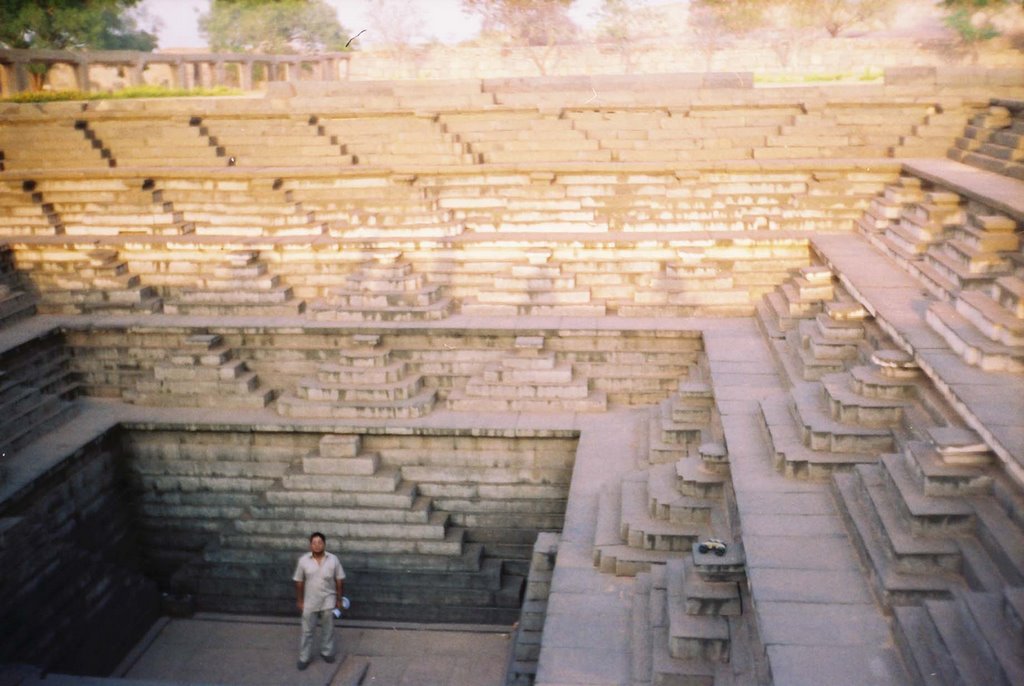
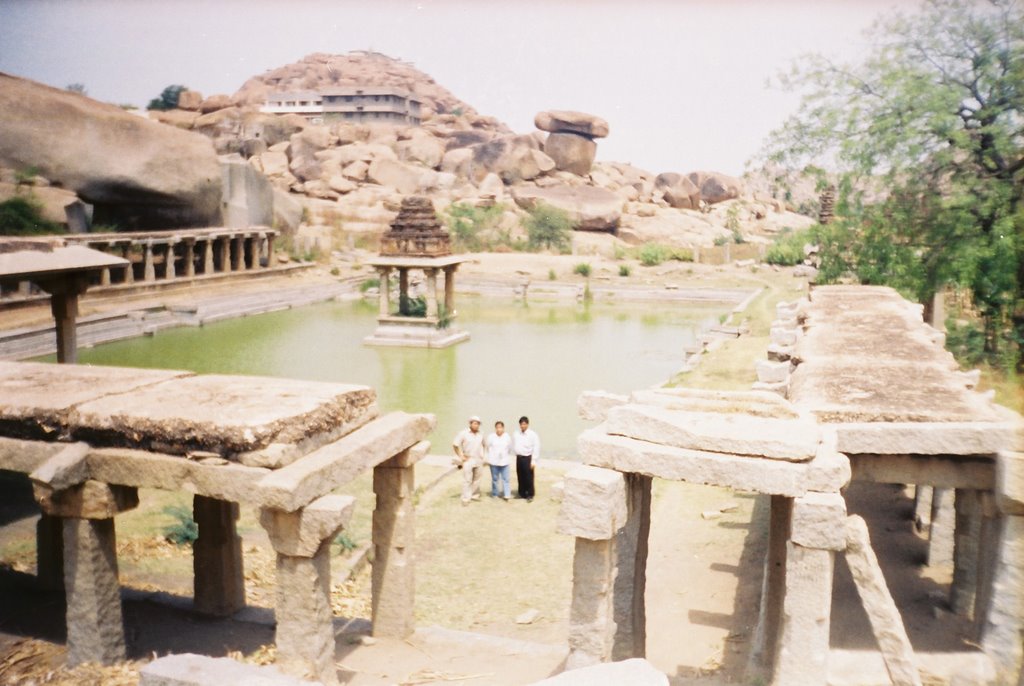
This happened en route to Vijaynagar. The time: sometime during my last semester at the institute. Didi was in town. So was her entire lab. In fact, it seemed like all the theoretical physics people I knew from Calcutta were all over the department. So al those random and not so random people from my batch onwards and maybe upto three years my senior were around. There was this school on Statmech, you see, at the department. Now what do we ‘umble spectroscopists have to do with things like renormalization group theory? Answer: nothing. However, all those theorists do, and having an elder sister amongst them makes things interesting.
So someone in the Calcutta gang decided to organize a trip to Vijaynagar. The last trip that I had been on with this gang, or its equivalent about a year ago was during StatPhys 22 when I ditched a lab meeting to go to Nandi Hills and was duly punished by the rain gods for doing so (somewhere in my blog…). So, Vijaynagar. I may have talked about this place earlier in my blog. But just in case I haven’t please bear with me for a couple of sentences.
1336. The small states of the South like Warangal unified under the banner of the principality of Anegundi. The relentless Muslim onslaught was arrested and brought to a complete halt by the newly founded city-state of Vijaynagar (literally, ‘city of victory’). At its peak, Vijaynagar ruled the vast majority of South India, collected levies from perhaps two hundred ports. It started as the rallying point and banner of Hindu resistance and became an empire so powerful and rich as had never been seen.
In 1556, the five Muslim kingdoms of the south formed a grand alliance and marched against Vijaynagar. These kingdoms were Ahmednagar, Berar, Bijapur, Bidar and Golconda. They faced the armies of Vijaynagar near the banks of the Krishna, in what is modern Karnataka. Descriptions of the battle that remain are inevitably from the perspective of the victors. The king of Vijaynagar, Rama Raya was captured and beheaded. His army was routed. The nobles of Vijaynagar fled. For three days, the citizens of Vijaynagar waited, sure that the invaders could be bought off with gifts from the treasury. Then the Muslim armies arrived. The sacking that ensued was again one, the likes of which had scarcely been seen before. The armies carried out their task of utter destruction with such hideous precision that when they were ‘finished’, all that remained of the greatest civilization of South India were pathetic ruins.
The city was never resettled, never repopulated. Ironically, the Dakhan Sultanates, which had defeated Vijaynagar fell to the Mughal Empire in a few short generations.
Oops, that was more than a couple of sentences.. I will probably have to finish this one later.
Ok, later is now. Now is a week or so after I started writing this blog. The reason that I started writing this blog was not quite Vijaynagar, more like a song. To be specific, ‘Aadorer Nouko’ by ‘Chandrabindoo’. This was part of the album that someone on the trip played ad-nauseum on the trip. So much so, that the song wrote itself in my head. I was listening to the song some afternoon, and suddenly it all came back in a rush.
The Sumo was crowded and were packed like tinned fish. And we had this bloke singing. There are people who cannot sing, those who really should be prevented from making a nuisance of themselves and then there are those for whom singing should be made a capital punishment. And I was nodding off, each time, being woken up by this completely unsonorous bastard howling in my ear. And he was Didi’s batchmate, so by virtue of sheer seniority, I could not tell him to shut up. The others seemed content to just roll their eyes and not do anything else. I decided to take matters into my own hands. When we stopped for a midnight snack at a Dhaba a couple of hundred kilometers from Bangalore, I took this guy aside. I made sure that Didi was not in earshot. And then I told him, in all absolute seriousness that any further singing would have me shoving my unwashed socks down his throat. I don’t know what got to him, the threat or the fact that a junior was doing the threatening. Well, he stopped singing.
We got to Vijaynagar in the wee hours, had enuf time for a brief nap and then went prowling the ruins. The first day, we stayed near the living temples in and around the Hampi bazaar. The last time I had been here was with Toton and her folks. That trip, I had made a rather interesting observation: while lining up for ‘Charanamrito’ from one of the temples, I noted that the ‘ghee’ for lighting the lamps was kept in a pint sized bottle of Old Monk rum! This time, unfortunately, I saw no such thing. In one of the temples, Dipanjan making good use of the optical zoom on his digicam found something interesting. Tucked away amongst the sculptures on the huge walls, some twenty feet up, almost hidden between two figures of chariots and elephants, was s sculpture depicting a man and a VERY well endowed woman, well, doing the good job. This was a distinctly Khajuraho thing. Vijaynagar is not at all known for such sculptures/paintings.
The next day was spent prowling all over the ruins, getting lost amidst the rocks about fifty times. Each. And of course, doing the leetil boat trip. These were the same kind of round bottomed boats which I had encountered at Hogenakkal. Apparently these are quite the rage in South India. So, boats, a few wild scares… put five theoretical physicists in a boat and they actually calculate the centre of mass for optimal balance!!! I have seen it done, people!!
The trip home was somewhat anticlimactic. Music, thankfully from the car stereo and not the passionately unmusical idiot of dubious parentage. Fun.
Thursday, August 31, 2006
maqbool
Most of us remember that Vishal Bharadwaj made his name as the music director of ‘Maachis’, a remarkably sensitive portrayal(directed by Gulzar) of a family torn asunder during the counter-terrorist purges of Operation Night Dominance in the late 1980s Punjab. Vishal has come a long way since. His latest film, ‘Omkara’ has been hailed as a work of rare talent. I feel tempted to ask though, why didn’t ‘Maqbool’ receive the same attention three years ago when it was released. Star power, my friend, star power is the answer.
Maqbool was an adaptation of Shakespeare’s Macbeth brought into the context of the Mumbai underworld. There have been quite a few movies about the Mumbai gangs, one of the most famous being ‘Company’. This was Ajay Devgan’s vehicle to superstardom; the movie in which he played the character of a laconic, intense don to perfection. However, Maqbool was a completely different animal. Everyone knows that Shakespeare was the original ‘masala’ playwright. Sure, sure, the great bard and all that, but he wrote and thought for the ‘janata’ better than everyone before him, and better than most of his successors. Macbeth was written in the context of the accession to the throne of James I (of Scotland) in let me see.. 1603? The entire play contains within itself the continuous application of ‘predestiny’. There is a feeling of hurtling towards an end that is utterly ruinous, towards absolute damnation, and that there is nothing we can do about it. The way the supernatural is woven into the plot (Banquo’s ghost, the witches) adds to this feeling. All of this was captured to perfection by Vishal. Maqbool had our protagonist, played by Irfan Khan assassinating his mentor (Pankaj Kapoor). The events which follow lead to the inexorable unraveling of everything around Maqbool and his eventual downfall. The role of the witches is magnificently captured by two of our legendary thespians, Om Puri and Naseeruddin Shah as a couple of corrupt cops. The role of Lady Macbeth is played by Tabbu, who, quite coincidentally, came of age as an accomplished actress in Maachis. All told, Maqbool is the best possible adaptation of Macbeth I could have imagined, exceeding by far ‘The Throne of Blood’ by the great Kurosawa himself. When I have time, I will finish this article with something about Omkara.
Meanwhile, read this review: http://telegraphindia.com/1060831/asp/opinion/story_6678659.asp
Maqbool was an adaptation of Shakespeare’s Macbeth brought into the context of the Mumbai underworld. There have been quite a few movies about the Mumbai gangs, one of the most famous being ‘Company’. This was Ajay Devgan’s vehicle to superstardom; the movie in which he played the character of a laconic, intense don to perfection. However, Maqbool was a completely different animal. Everyone knows that Shakespeare was the original ‘masala’ playwright. Sure, sure, the great bard and all that, but he wrote and thought for the ‘janata’ better than everyone before him, and better than most of his successors. Macbeth was written in the context of the accession to the throne of James I (of Scotland) in let me see.. 1603? The entire play contains within itself the continuous application of ‘predestiny’. There is a feeling of hurtling towards an end that is utterly ruinous, towards absolute damnation, and that there is nothing we can do about it. The way the supernatural is woven into the plot (Banquo’s ghost, the witches) adds to this feeling. All of this was captured to perfection by Vishal. Maqbool had our protagonist, played by Irfan Khan assassinating his mentor (Pankaj Kapoor). The events which follow lead to the inexorable unraveling of everything around Maqbool and his eventual downfall. The role of the witches is magnificently captured by two of our legendary thespians, Om Puri and Naseeruddin Shah as a couple of corrupt cops. The role of Lady Macbeth is played by Tabbu, who, quite coincidentally, came of age as an accomplished actress in Maachis. All told, Maqbool is the best possible adaptation of Macbeth I could have imagined, exceeding by far ‘The Throne of Blood’ by the great Kurosawa himself. When I have time, I will finish this article with something about Omkara.
Meanwhile, read this review: http://telegraphindia.com/1060831/asp/opinion/story_6678659.asp
Tuesday, August 29, 2006
Hrishikesh Mukherjee
Hrishikesh Mukherjee passed away this week. He was the filmmaker who made us laugh and cry. Long before the current crop of ShahRukh vehicles that ooze emotion out of every pore and coat the floor three inches thick, there was something called good taste. Hrishikesh epitomized just that. Anyone who has ever heard the lines ‘zindagi aur maut to ek khel hai Babumoshai’ knows what I am talking about. The amazing combination of Rajesh Khanna’s acting, Salil Choudhury’s music and Hrishikesh’s direction gave us that absolute gem, Anand. I remember that Anand was one of those movies which became so popular that cassettes were released which had the songs as well as dialogues from the film. Imagine some lazy Sunday afternoon with the umpteenth cup of tea making its way down, and from the neighbouring house, ‘Main huun Isabhai Suratwala’, and ‘Babumoshai, yeh wahi hain, na, jiske saath tumhari continuity hai?’ Imagine also, half a decade later the action hero of the decade, Dharmindra turned into a ‘pure’ Hindi speaking driver who sometimes turned crosseyed. And last of all, imagine a decade after Anand, Amol Palekar and the absolutely incomparable Utpal Dutta in Golmaal. ‘Vaise to Kabir padhne padhane ke liye ek jeevan kam hai, parantu main saath baje tak samapt karne ka prayatna karunga’. I always get confused whether the Sachin Bhowmick screenplay was derived from the Bengali play ‘Tulkalam’ by Deboki Bandopadhyay or vice versa. But I don’t think it matters. What matters is that Hrishikesh Mukherjee is gone, and movies will never be the same again.
Monday, August 28, 2006
Aandhi
Aandhi was a movie of some greatness. It deals with a lady politician (played by the incomparable Suchitra Sen, really incomparable, look at her granddaughters and shudder!) in conversation with her former lover (again, played to perfection by Sanjeer Kumar). The music was by Rahul Dev Barman, again a genius who needs no introduction.
So here I am, sometime in the afty in lab, working on a peaklist. If I knew how to code in python, I would probably write a few lines of snazzy code which would simply edit the file just the way I want it. Well, I do not code. If I had any sense, I would start working in Vi, the king of editors and be done quickly. No! methinks I should work in Nedit, this simplified Notepad clone which runs across quite a few platforms. Well, to be honest, Nedit has its strengths, though I seriously doubt if it can be compared, to Kate. Then I figured that I can work on Vi as well, I mean this is a UNIX machine, right, so Vi should be good. Delight! Ya! It works!!!
I am also listening to Aandhi on streaming music. Kishoreda and Lata sing sooooo beautifully. And yes, for the better part of decade, this used to be my sister’s favourite movie album. Which meant that I hated it from the bottom of my heart. Looks like I have recovered.
So here I am, sometime in the afty in lab, working on a peaklist. If I knew how to code in python, I would probably write a few lines of snazzy code which would simply edit the file just the way I want it. Well, I do not code. If I had any sense, I would start working in Vi, the king of editors and be done quickly. No! methinks I should work in Nedit, this simplified Notepad clone which runs across quite a few platforms. Well, to be honest, Nedit has its strengths, though I seriously doubt if it can be compared, to Kate. Then I figured that I can work on Vi as well, I mean this is a UNIX machine, right, so Vi should be good. Delight! Ya! It works!!!
I am also listening to Aandhi on streaming music. Kishoreda and Lata sing sooooo beautifully. And yes, for the better part of decade, this used to be my sister’s favourite movie album. Which meant that I hated it from the bottom of my heart. Looks like I have recovered.
Chettinad things.
Vodka chettinad.
Yes, the esteemed roomie had a couple of juniors over. One of them is this bloke with a zinc lined stomach. I mean, I generally assume that I can eat reasonably spicy food (that Bangal blood running through my veins, no connection to my Ghoti ancestry at all), but this guy takes the cake. Ok, its not really a cake at all, more like the pickle/achar. The achar in question was a really lethal green very chilli creation I found at the Indian store. Now I am reasonable when it comes to achar, especially such deadly varieties. About as much as one can put on the tip of a fork is enough. Well, this bloke likes two forkfuls with each meal!! And then complains that the food was rather bland!!! Ye Gods!
Which reminds me of a completely peripheral, but still related incident. This happened to my father years ago when he was a field geologist. His driver was pretty awful at cooking. Well, this driver once offered to cook dinner. His brilliant idea of a delicious curry was green chillis fried in a sauce made of mostly dried red chilli powder.
Chettinad food, the other part of the story comes from the hinterland of Tamail Nadu. There is standard lousy Tamil fare, which is idlis and dosas (stuff of my nightmares, comes from having suffered long and hard at the hands, or rather utensils of the Tamil cooks of the Institute Mess), and then there is Chettinad food. Chettinad people really know how to mix spices right. They grind spices fresh and have no truck with the packed stuff that we lesser people use.
Yes, so coming to the point here. This junior, goes by the name of Sethu suggested that we try vodka with green chillis. So, the concoction that we ended up with was one part vodka, three parts coke and one green chilli sliced longitudinally and squeezed into the drink. Lethal combination. If the booze doesn’t get you, the chilli will. This drink, I have decided to call “Vodka Chettinad”. Meanwhile, this other friend suggested that we drink vodka with Pudina Hara. Got to try that.
Yes, the esteemed roomie had a couple of juniors over. One of them is this bloke with a zinc lined stomach. I mean, I generally assume that I can eat reasonably spicy food (that Bangal blood running through my veins, no connection to my Ghoti ancestry at all), but this guy takes the cake. Ok, its not really a cake at all, more like the pickle/achar. The achar in question was a really lethal green very chilli creation I found at the Indian store. Now I am reasonable when it comes to achar, especially such deadly varieties. About as much as one can put on the tip of a fork is enough. Well, this bloke likes two forkfuls with each meal!! And then complains that the food was rather bland!!! Ye Gods!
Which reminds me of a completely peripheral, but still related incident. This happened to my father years ago when he was a field geologist. His driver was pretty awful at cooking. Well, this driver once offered to cook dinner. His brilliant idea of a delicious curry was green chillis fried in a sauce made of mostly dried red chilli powder.
Chettinad food, the other part of the story comes from the hinterland of Tamail Nadu. There is standard lousy Tamil fare, which is idlis and dosas (stuff of my nightmares, comes from having suffered long and hard at the hands, or rather utensils of the Tamil cooks of the Institute Mess), and then there is Chettinad food. Chettinad people really know how to mix spices right. They grind spices fresh and have no truck with the packed stuff that we lesser people use.
Yes, so coming to the point here. This junior, goes by the name of Sethu suggested that we try vodka with green chillis. So, the concoction that we ended up with was one part vodka, three parts coke and one green chilli sliced longitudinally and squeezed into the drink. Lethal combination. If the booze doesn’t get you, the chilli will. This drink, I have decided to call “Vodka Chettinad”. Meanwhile, this other friend suggested that we drink vodka with Pudina Hara. Got to try that.
Wednesday, August 23, 2006
buri's blog
i would like to call the attention of the casual and not so casual visitor to my blogroll. blogs written by my friends are featured here. the newest addition is buri's blog. it is worth reading. enjoy!
planning: bear mountain
the esteemed roomie was busy planning a trip to NY. he had been told that his pal there would take him to bear mountain. so he spends some twenty minutes looking up bear mountain on my computer. after making his plans and everything, he figures out that the bear mountain site he was browsing was for some bear mountain in california. so much for that.
Tuesday, August 22, 2006
and then again.....
Orkut has lost it completely, again! This time it tells me that “Your winsome smile will be your sure protection”. I mean, who is kidding whom? Sure, winsome smile.. big fat hairy deal!!! A then, a couple of days ago, its told me that my spouse and I will live happily forever or some shite like that. Is there some brain dead git employed by Orkut, or rather Google who just sits around all day inventing these one liners which will drive me up the wall. Or is it just me?
I think it is just me. But there is perfect evidence that the world has gone perfectly crazy. People have been making communities dedicated to film stars, rock stars, and all that for a while. Sometime ago, I ranted against this git who had made a community dedicated to a MacD at Hyderabad. Now there are people who have made communities dedicated to Garaiahat, Tollygunge, and then gone on to make communities dedicated to the four and a half buildings which lie on Gariahat Road, between Golpark and the first thirty feet of Gariahat Road, and listen to this, we are talking about the UTI bank side of the flyover, or maybe it was the other side. Dude, get off the computer and go meet your neigbours!!
And finally there are those gits who have to air their sad pathetic excuses for falling in, and out of love on communities… ‘come share your experiences’… this is just sad.
I think it is just me. But there is perfect evidence that the world has gone perfectly crazy. People have been making communities dedicated to film stars, rock stars, and all that for a while. Sometime ago, I ranted against this git who had made a community dedicated to a MacD at Hyderabad. Now there are people who have made communities dedicated to Garaiahat, Tollygunge, and then gone on to make communities dedicated to the four and a half buildings which lie on Gariahat Road, between Golpark and the first thirty feet of Gariahat Road, and listen to this, we are talking about the UTI bank side of the flyover, or maybe it was the other side. Dude, get off the computer and go meet your neigbours!!
And finally there are those gits who have to air their sad pathetic excuses for falling in, and out of love on communities… ‘come share your experiences’… this is just sad.
4.20 in the afternoon
and i have had two bottles of beer. at this farewell party. this is too much beer and too much of some very interesting cheese and tortilla somethingortherother warps, sorry warps. wel, you get the drift. nice farewell party. and two small bottles of beer is really quite insignificant by any standards. but at 4.20 in the afty, well, it does affect one's ability to do useful science.
Voices, Feeling Disconnected and Mr. Lapata
Voices, Feeling Disconnected and Mr. Lapata.
A long time ago, well, to be honest not so long ago, I used to write for a campus magazine called Voices. This was run by, at first, Akanksha and Abhijeet, then later, Anindita (Buri) and Pragyan. It was during Buri’s tenure that I started writing somewhat regularly for Voices. My column was called ‘Feeling Disconnected’, and that happens to be a rather good description of the contents. One of the stars of the Voices team was Sujit, the cartoonist. The character he created was called Mr. Lapata. ‘Lapata’ literally means ‘lost’. And that, again pretty much sums up the experiences of Lapata. Anyone who has ever stepped into a graduate programme will either admit to feeling lost or just happens to be a compulsive liar.
Voices gave me a lot. Starting from learning how to get a tiny magazine printed cheaply in Bangalore (getting to know DTP blokes on a first name basis) to learning how to interview somewhat unwilling administrators and not get kicked out of the institute, yes, I picked up quite a few skills there. Avik and me became the editor’s firemen. I got clubbed with our resident crossword expert, one Rohini to work on, yes, you guessed it right, a crossword. Well, we started disagreeing back then, and its been almost three years and we have rarely agreed on anything yet.
At the annual Voices function, Ayan (Buro) scripted a short skit that revolved around the life (or lack of) and times (way too much of) of Mr. Lapata. It turned out to have hit a chord. Someone had made a huge thermocol cutout of Mr. Lapata which I pinched after the show. While cycling back to my room, there was small accident which resulted in Lapata being very neatly decapitated, but after I put him up on the wall, nobody ever noticed anything strange!
A long time ago, well, to be honest not so long ago, I used to write for a campus magazine called Voices. This was run by, at first, Akanksha and Abhijeet, then later, Anindita (Buri) and Pragyan. It was during Buri’s tenure that I started writing somewhat regularly for Voices. My column was called ‘Feeling Disconnected’, and that happens to be a rather good description of the contents. One of the stars of the Voices team was Sujit, the cartoonist. The character he created was called Mr. Lapata. ‘Lapata’ literally means ‘lost’. And that, again pretty much sums up the experiences of Lapata. Anyone who has ever stepped into a graduate programme will either admit to feeling lost or just happens to be a compulsive liar.
Voices gave me a lot. Starting from learning how to get a tiny magazine printed cheaply in Bangalore (getting to know DTP blokes on a first name basis) to learning how to interview somewhat unwilling administrators and not get kicked out of the institute, yes, I picked up quite a few skills there. Avik and me became the editor’s firemen. I got clubbed with our resident crossword expert, one Rohini to work on, yes, you guessed it right, a crossword. Well, we started disagreeing back then, and its been almost three years and we have rarely agreed on anything yet.
At the annual Voices function, Ayan (Buro) scripted a short skit that revolved around the life (or lack of) and times (way too much of) of Mr. Lapata. It turned out to have hit a chord. Someone had made a huge thermocol cutout of Mr. Lapata which I pinched after the show. While cycling back to my room, there was small accident which resulted in Lapata being very neatly decapitated, but after I put him up on the wall, nobody ever noticed anything strange!
Friday, August 18, 2006
Asimov, Clarke and 2001.
Classic science fiction has as its playground the whole universe, and as its armoury, the whole gamut of human imagination. Having said that, it is equally true that the two giants of SF have been a biochemist and an astronomer. Quite decidedly scientists. Why? It appears that true SF can be written only by people who ave a firm grounding in the sciences. So let’s look at the masterworks by these people. My favourite remains Asimov, although, I sometimes feel that I should show the other master some loyalty due to having the same antecedents in terms of science as Clarke.
Rendezvous with Rama was possibly the greatest work by Clarke, followed very shortly (or perhaps exceeded, depends on your own tastes) by 2001, A Space Odyssey. Rama deals with the reaction of humanity a few centuries from now when confronted with what is obviously an alien artifact speeding through space.
2001 talks about an expedition to the Moon uncovering a monolith of unimaginable antiquity. Then, the Odyssey, a journey of almost impossible ambition, to Japetus, one of the moons of Saturn, which might conceivable hold secrets as old as humanity itself. 2001 became the study of humanity as personified by David Bowman and Frank Poole, crewmen of the most advanced vessel ever designed, the Discovery as she sped to her destination. The third member of the crew was HAL, a computer who would have passed the Turing test with ease. HAL never slept, never fatigued. HAL was the ever present, ever vigilant centurion against anything, which might conceivably go wrong. And ironically, it was HAL who went wrong. Even now, it appears impossibly to write ‘HAL which went wrong’, even though the book addresses the dilemma, which will undoubtedly confront scientists of the future: do machines have morality? Clarke has always held as a central point in his writings that there may be intelligences greater and older than humanity. Intelligences, which may have passed through the playgrounds where civilizations struggle through their infancy. And in their infinitely inscrutable way, they may have lent a helping hand to some. Enter Tycho Magnetic Anomaly I, and the perfect ratio of the squares of the first three natural numbers: 1:4:9. And how, how simplistic of us to believe that the ratio ends in just three dimensions!
There may such a thing as destiny. For now, all we can do is see the stars and dream.
I am going to finish, or rather abandon this essay with a quote from Emerson, a quote, by the way which may have been the inspiration for Nightfall, undoubtedly the best of the writings of Asimov!!
If the Stars should appear one night in a thousand years, how would men believe and adore; and preserve for many generations the remembrance of the city of God which had been shown! But every night come out these envoys of beauty, and light the universe with their admonishing smile.
Ralph Waldo Emerson
Rendezvous with Rama was possibly the greatest work by Clarke, followed very shortly (or perhaps exceeded, depends on your own tastes) by 2001, A Space Odyssey. Rama deals with the reaction of humanity a few centuries from now when confronted with what is obviously an alien artifact speeding through space.
2001 talks about an expedition to the Moon uncovering a monolith of unimaginable antiquity. Then, the Odyssey, a journey of almost impossible ambition, to Japetus, one of the moons of Saturn, which might conceivable hold secrets as old as humanity itself. 2001 became the study of humanity as personified by David Bowman and Frank Poole, crewmen of the most advanced vessel ever designed, the Discovery as she sped to her destination. The third member of the crew was HAL, a computer who would have passed the Turing test with ease. HAL never slept, never fatigued. HAL was the ever present, ever vigilant centurion against anything, which might conceivably go wrong. And ironically, it was HAL who went wrong. Even now, it appears impossibly to write ‘HAL which went wrong’, even though the book addresses the dilemma, which will undoubtedly confront scientists of the future: do machines have morality? Clarke has always held as a central point in his writings that there may be intelligences greater and older than humanity. Intelligences, which may have passed through the playgrounds where civilizations struggle through their infancy. And in their infinitely inscrutable way, they may have lent a helping hand to some. Enter Tycho Magnetic Anomaly I, and the perfect ratio of the squares of the first three natural numbers: 1:4:9. And how, how simplistic of us to believe that the ratio ends in just three dimensions!
There may such a thing as destiny. For now, all we can do is see the stars and dream.
I am going to finish, or rather abandon this essay with a quote from Emerson, a quote, by the way which may have been the inspiration for Nightfall, undoubtedly the best of the writings of Asimov!!
If the Stars should appear one night in a thousand years, how would men believe and adore; and preserve for many generations the remembrance of the city of God which had been shown! But every night come out these envoys of beauty, and light the universe with their admonishing smile.
Ralph Waldo Emerson
Wednesday, August 16, 2006
taming the tiger again
everone tells me that tiger is the only OS to use. what do they know? is there anything which offers the power, flexibility and stability of Linux? well, apparently there is. os X. Tiger.
first, a crib. i listen to online music. i also like to read the newspaper in Bangla. unfortunately, most of the plugins which have been developed for online music or for reading regional fonts have been done so for Internet Explorer. sure, makes sense. after all, IE pretty much owns the market. but then, what about the sane minority which uses other browsers? there are some plugins for firefox, but not font readers. and the plugins make firefox unstable, because with the new generation of intel macs, firefox runs via an emulator which pretends that firefox is actually talking to a powerPC chip instead of an intel dual core chip. and no one has developed those plugins for Safari, which is the browser native to macs.
first, a crib. i listen to online music. i also like to read the newspaper in Bangla. unfortunately, most of the plugins which have been developed for online music or for reading regional fonts have been done so for Internet Explorer. sure, makes sense. after all, IE pretty much owns the market. but then, what about the sane minority which uses other browsers? there are some plugins for firefox, but not font readers. and the plugins make firefox unstable, because with the new generation of intel macs, firefox runs via an emulator which pretends that firefox is actually talking to a powerPC chip instead of an intel dual core chip. and no one has developed those plugins for Safari, which is the browser native to macs.
Tuesday, August 15, 2006
The girl child in India
The girl child in India.
Am going to start this by talking about a personal experience while traveling from Howrah to Guwahati by train sometime in the early 1990s. Our neighbours in the train bogey included a man traveling to TeenSukhia in Meghalaya with his wife, son and daughter. The son was perhaps 11 or 12 at that time,, his sister maybe two years older. The boy quickly made a complete nuisance of himself. As the train passed through New Jalpaiguri and Siliguri, vendors came aboard selling every kind of trinket, portable electronic goody imaginable. And this kid wanted everything. His dad tried hard enough to satisfy him. The girl, on the other hand spent all the time staring out of the window. Later, in conversation with them, we found out that the boy was just two classes junior to me. And that his elder sister did not attend school. I remember being shocked almost witless by that piece of information. Her parents did not see the point in educating a girl.
A couple of days, I read newsreports of some 35 female fetuses being found near a quack’s clinic somewhere in Punjab. That, in gentle reader is the curse of the Indian girl. The oldest continuous civilization in the world, one that prides itself on its humanity does not care about its girls. Do not get me wrong here, the government does its level best. I have studied in Kendriya Vidyalayas where girls do not have to pay any tuition fees. In fact, in remote places, the state administration tries to send social workers to convince village people to send their daughters to school and gives them all kinds of incentives like mid-day meals and so on. But what do you expect when its is ingrained into the minds of people that girls are only destined to be wives and mothers, so why bother to teach them anything?
Dowry. The curse that has been plaguing us for we do not know how long. Along with dowry, we had another beautiful practice called ‘Sati’. This meant that a young widow would be burnt alive on the funeral pyre of her dead husband. Sati was abolished due to the efforts of Raja RamMohan Ray, who founded the Brahmo Samaj in Calcutta. Dowry remain a problem to this day. According to our laws, demanding and giving dowry is a criminal offence. But who is listening? One might imagine that with education, such practices would die a natural death. It so happens that dowry is much more prevalent amongst the urban educated rich than in lower classes. And although young women today are free to pursue any career that they want to, at the time of marriage, it is still expected that they pay a dowry.
This and other reasons are why girl children are viewed as a burden by parents. Hence, prenatal sex determination (which is, by the way, illegal in India). Hence, termination of female fetuses. Hence, a declining gender ratio. Hence interesting social practices come to the forefront again. Such as a woman marrying into a family of four brothers, and being a wife to all of them. This is seen in some of our ‘Bimaru’ states. (Bimaru stands for Bihar, Madhyay Pradesh, Rajasthan and Uttar Pradesh, the most heavily populated, most undereducated states).
It is simply not enough to say that the government is not doing its bit. As long as we Indians sit around condoning such practices, they will continue.
Am going to start this by talking about a personal experience while traveling from Howrah to Guwahati by train sometime in the early 1990s. Our neighbours in the train bogey included a man traveling to TeenSukhia in Meghalaya with his wife, son and daughter. The son was perhaps 11 or 12 at that time,, his sister maybe two years older. The boy quickly made a complete nuisance of himself. As the train passed through New Jalpaiguri and Siliguri, vendors came aboard selling every kind of trinket, portable electronic goody imaginable. And this kid wanted everything. His dad tried hard enough to satisfy him. The girl, on the other hand spent all the time staring out of the window. Later, in conversation with them, we found out that the boy was just two classes junior to me. And that his elder sister did not attend school. I remember being shocked almost witless by that piece of information. Her parents did not see the point in educating a girl.
A couple of days, I read newsreports of some 35 female fetuses being found near a quack’s clinic somewhere in Punjab. That, in gentle reader is the curse of the Indian girl. The oldest continuous civilization in the world, one that prides itself on its humanity does not care about its girls. Do not get me wrong here, the government does its level best. I have studied in Kendriya Vidyalayas where girls do not have to pay any tuition fees. In fact, in remote places, the state administration tries to send social workers to convince village people to send their daughters to school and gives them all kinds of incentives like mid-day meals and so on. But what do you expect when its is ingrained into the minds of people that girls are only destined to be wives and mothers, so why bother to teach them anything?
Dowry. The curse that has been plaguing us for we do not know how long. Along with dowry, we had another beautiful practice called ‘Sati’. This meant that a young widow would be burnt alive on the funeral pyre of her dead husband. Sati was abolished due to the efforts of Raja RamMohan Ray, who founded the Brahmo Samaj in Calcutta. Dowry remain a problem to this day. According to our laws, demanding and giving dowry is a criminal offence. But who is listening? One might imagine that with education, such practices would die a natural death. It so happens that dowry is much more prevalent amongst the urban educated rich than in lower classes. And although young women today are free to pursue any career that they want to, at the time of marriage, it is still expected that they pay a dowry.
This and other reasons are why girl children are viewed as a burden by parents. Hence, prenatal sex determination (which is, by the way, illegal in India). Hence, termination of female fetuses. Hence, a declining gender ratio. Hence interesting social practices come to the forefront again. Such as a woman marrying into a family of four brothers, and being a wife to all of them. This is seen in some of our ‘Bimaru’ states. (Bimaru stands for Bihar, Madhyay Pradesh, Rajasthan and Uttar Pradesh, the most heavily populated, most undereducated states).
It is simply not enough to say that the government is not doing its bit. As long as we Indians sit around condoning such practices, they will continue.
Monday, August 14, 2006
orkut messed up again
this time by telling me that i am 'sociable and entertaining'. those unfortunates who have crossed my path on thursdays know just how entertaining i can be. as for the sociable bit, well, i do not actively growl and scratch, but i am as sociable as a graduate student who works alone in a tiny office and likes it that way can be.
amongst new communities on orkut i noticed one which is for people with 'attitude'. i find myself slightly confused. as always, when i see an advert or something for people with 'attitude', i start wondering what they really mean by attitude. i mean, one can try to be slightly social by smiling (this section is independant of the first, so i am not talking about myself) and helpful. that would make one more popular for sure. one might also try polishing one's shoes, wearing clean, ironed shirts and try shaving. all of which will make one more presentable and hence nicer to work with. but what is attitude? all those big hoardings which show people with 'attitude' who wear some specific perfume, watch or whatever seem to have people who look remarkably snobbish for no particular reason or simply constipated. hence, i am mystified.
is it possible that by virtue of following the trend gurus and by paying too much attention to those who seek to mould us into better people, we are, in fact turning into factory engineered robots with little, or no individuality? let me talk about a particular case in point. this friend of mine was applying for various software jobs after graduating. he told me that one of the things he had learnt as part of interview tactics was to look the interviewer in the eye and not break contact and to shake his hand firmly. this shows character. now, if the interviewer had read the same book, then what happens is that they both end up with watering eyes after a 'stare him down' contest and crush each other's fingers.
bottom line. we might try looking beyond the superficial and find qualities of a more lasting nature. that will naturally demand a larger investment in time, but the reruns will certainly be greater.
amongst new communities on orkut i noticed one which is for people with 'attitude'. i find myself slightly confused. as always, when i see an advert or something for people with 'attitude', i start wondering what they really mean by attitude. i mean, one can try to be slightly social by smiling (this section is independant of the first, so i am not talking about myself) and helpful. that would make one more popular for sure. one might also try polishing one's shoes, wearing clean, ironed shirts and try shaving. all of which will make one more presentable and hence nicer to work with. but what is attitude? all those big hoardings which show people with 'attitude' who wear some specific perfume, watch or whatever seem to have people who look remarkably snobbish for no particular reason or simply constipated. hence, i am mystified.
is it possible that by virtue of following the trend gurus and by paying too much attention to those who seek to mould us into better people, we are, in fact turning into factory engineered robots with little, or no individuality? let me talk about a particular case in point. this friend of mine was applying for various software jobs after graduating. he told me that one of the things he had learnt as part of interview tactics was to look the interviewer in the eye and not break contact and to shake his hand firmly. this shows character. now, if the interviewer had read the same book, then what happens is that they both end up with watering eyes after a 'stare him down' contest and crush each other's fingers.
bottom line. we might try looking beyond the superficial and find qualities of a more lasting nature. that will naturally demand a larger investment in time, but the reruns will certainly be greater.
Sunday, August 13, 2006
Happy Birthday India!!
On the 15th of August, independent India will be all of 59 years old. We have built up a population, which will shortly be the world’s largest. We have created a strong economy that anyone who knows anything tells us is moving fast in the right direction. Our Parliament has gone from the days when one principal party (the Congress) was almost always guaranteed victory to a multitude of parties, each more vociferous than the other. Each party promises to safeguard the interests of some specific group, be it characterized by religion, language or geography. Success can only be guaranteed by hitching our star to someone’s wagon. Thus, caste based politics have come to play a much bigger role than before. We have also fought a few wars against our immediate neighbours. The last was a victory, or so we are told. As a result, we should arm ourselves better, for the inevitable onslaught, which a vengeful foreign administration is sure to launch at some point or the other. And to bolster our defenses, we have that trump card, a nuclear arsenal. Please note, not just a bomb or two, a full-fledged arsenal. But, of course, we need it. Deterrence, you see. Meanwhile, as a highly respected former chief of police put it, another neighbouring country to our east is turning into a ‘demographic bomb’. The situation in West Bengal is remarkably like that faced by all-Americans who are increasingly seeing themselves as shortchanged by their high-ups who find it convenient to employ cheaper foreign labour.
Meanwhile things are happening in New Delhi. The central government, or some parts of it have decided to increase the number of positions reserved for ‘backward communities’ at various academic institutions dramatically. The reduction in the number of ‘general seats’ will be made up for by simply increasing the over all intake. This has lead to a backlash by students, teachers and many others who have a stake. At the point when things appeared to be moving towards something more ominous than mere rumblings, several bombs exploded in commuter trains at Bombay. The final death toll stands at more than 200. If our western neighbour is involved, as it is being suggested, then we should do an Israel on them. But oops, they are also a nuclear power, and should anyone forget issues, at the moment of writing, Israel is facing somewhat unexpected opposition in Lebanon. Not so easy after all. And does anyone else see the connection between wars and internal strife. What better way to sweep internal dissent under the carpet than fight a war? After all, the people in power are hardly the people in the trenches. It is easy to be brave at long distance when the blood being spilt belongs to some poor fellow from some small town in Bihar who didn’t have much of a life anyway, right?
We also have a leftist contingent. This section of our polity does little, but is all the more vocal for it. The two states where it has been in power for a while have been remarkable only in the continuous way they have deprived their own people of jobs by irresponsible trade unionism. The industries have moved to states where the climate is less inimical to investors. Now, it appears they are somewhat lacking in infrastructure and are asking preferred foreign groups to hop in. The Salim group of Indonesia is supposed to build industries in Bengal. Whoever heard of the excellence of Indonesian industry? Not to belittle Indonesia, but what can they do that we do not have the technology and the manpower for? Meanwhile, what will probably happen is that these people will build houses (yes, that seems to be the only form of business which is perpetually expanding) with ‘seed money’ taken from small investors in Bengal and then sell those houses to those same small investors. In short, with hardly any capital, and probably employing local contractors, they will walk away with profits of maybe 5 to 10 thousand crores of rupees. That is about a billion US$.
To conclude, yes the country is moving fast. But in which direction? The people who created this nation, fashionable though it is to criticize them unthinkingly today, built something great. There is too much good in the Indian nation to die out so soon. But our ‘leaders’ are certainly trying hard enough
Meanwhile things are happening in New Delhi. The central government, or some parts of it have decided to increase the number of positions reserved for ‘backward communities’ at various academic institutions dramatically. The reduction in the number of ‘general seats’ will be made up for by simply increasing the over all intake. This has lead to a backlash by students, teachers and many others who have a stake. At the point when things appeared to be moving towards something more ominous than mere rumblings, several bombs exploded in commuter trains at Bombay. The final death toll stands at more than 200. If our western neighbour is involved, as it is being suggested, then we should do an Israel on them. But oops, they are also a nuclear power, and should anyone forget issues, at the moment of writing, Israel is facing somewhat unexpected opposition in Lebanon. Not so easy after all. And does anyone else see the connection between wars and internal strife. What better way to sweep internal dissent under the carpet than fight a war? After all, the people in power are hardly the people in the trenches. It is easy to be brave at long distance when the blood being spilt belongs to some poor fellow from some small town in Bihar who didn’t have much of a life anyway, right?
We also have a leftist contingent. This section of our polity does little, but is all the more vocal for it. The two states where it has been in power for a while have been remarkable only in the continuous way they have deprived their own people of jobs by irresponsible trade unionism. The industries have moved to states where the climate is less inimical to investors. Now, it appears they are somewhat lacking in infrastructure and are asking preferred foreign groups to hop in. The Salim group of Indonesia is supposed to build industries in Bengal. Whoever heard of the excellence of Indonesian industry? Not to belittle Indonesia, but what can they do that we do not have the technology and the manpower for? Meanwhile, what will probably happen is that these people will build houses (yes, that seems to be the only form of business which is perpetually expanding) with ‘seed money’ taken from small investors in Bengal and then sell those houses to those same small investors. In short, with hardly any capital, and probably employing local contractors, they will walk away with profits of maybe 5 to 10 thousand crores of rupees. That is about a billion US$.
To conclude, yes the country is moving fast. But in which direction? The people who created this nation, fashionable though it is to criticize them unthinkingly today, built something great. There is too much good in the Indian nation to die out so soon. But our ‘leaders’ are certainly trying hard enough
Saturday, August 05, 2006
Books, movies and other things
The last few days have been passing peacefully. Barring unavoidable trips to relatives and hobnobbing with some friends, I have been catching up on my reading and movie watching. He last movie I saw was ‘Apharan’, a Nana Patekar directed flick starring Ajay Devgan. Ajay has transformed himself into a raucous college rowdy to a dark hero who acts by just standing around and looking dangerous. Movies like ‘Company’ have showcased his metamorphosis into the thinking man’s anti-hero. Nana has always used his trademark deadpan manner and that absolutely amazing voice to great effect in everything from the pathbreaking ‘Prahar’ to his more recent gangster movies. This movie deals with the kidnapping mafia in Bihar. Truth is usually stranger, and sometimes more horrifying than fiction. Bearing that dictum in mind, what has happened in Bihar, and continues to happen is nothing short of a government of criminals turned politicians.
Cogitation aside, what I have been reading (after brushing up on the Half Blood Prince) is ‘English August’ by Upamanyu Chatterjee. I suspect very strongly that Chatterjee belongs to that class of subversive Bengalis who studied at St. Stephen’s instead of Presidency and proceed to write all these vaguely apologetic novels. English August is a good example. It talks about Agastya Sen, a Delhi educated Bengali who has joined the Indian Administrative Service and has been posted to a small district town in North India for a year. The language stumbles at times and somehow carries with it the soporific effect which Agastya himself feels. However, I will recommend it to anyone who has the patience to sit through what seems to be interminable boredom. This is writing about life as it really is. Tame ending though. Still, worth a read.
Cogitation aside, what I have been reading (after brushing up on the Half Blood Prince) is ‘English August’ by Upamanyu Chatterjee. I suspect very strongly that Chatterjee belongs to that class of subversive Bengalis who studied at St. Stephen’s instead of Presidency and proceed to write all these vaguely apologetic novels. English August is a good example. It talks about Agastya Sen, a Delhi educated Bengali who has joined the Indian Administrative Service and has been posted to a small district town in North India for a year. The language stumbles at times and somehow carries with it the soporific effect which Agastya himself feels. However, I will recommend it to anyone who has the patience to sit through what seems to be interminable boredom. This is writing about life as it really is. Tame ending though. Still, worth a read.
Really awesome Kati Roll

Kati Roll, Park Street.
Street food in Kolkata has always been something of an adventure: as in this is really tasty, but maybe it will, quite literally be the death of me by cholera, gastro, or some other interesting disease. I bet Atilla the Hun, Genghis Khan, Alexander and other conquerors felt much the same as the looked over lands beyond their realm; so peaceful, so much wealth, it could all be mine; but then again, it could rip my empire apart. Anyway, did that ever deter them? Nope! And the prospect of dying a hideous death never deters the average Bong from pursuing happiness in the form of totally unnecessary plates of kabab and mutton rolls. In my limited experience, Kati Roll at the junction of Chounringhee and Park Street is the best place to go to in Kolkata for mutton rolls, chicken rolls, even, God forbid, vegetable rolls, in fact for rolls of any description. This place is truly awesome.
It is also so popular that we have to stand in a line for getting the roll of our choice. In fact, I should change that; we Bongs line up for pretty much everything and anything, from electing absolutely horrid governments into power for the eighth time, to pick up college admission forms, to submit the same, to catch an autorick home, to receive the ‘charanamrito’ after a pujo Apparently there was a rather famous incident near my house where a gang of petty thieves who used to snatch purses and chains from women had been apprehended. Well, the entire neighbourhood stood in line to slap the thieves before they were escorted away by the cops. But we do not line up at Kati Roll. There we see a free for all, where I got elbowed in the ribs by a perfectly respectable bloke with peppered gray hair, old enough to be my father. He just pushed me aside and grabbed his roll first. Bugger!!
The way they make the rolls is a treat to watch. You pay. You wait. The bloke inside is kneading the dough and making it into nice flat paratha sized circles. He tosses them as they are made to the bloke who is frying them. This bloke fries them ten or more at a time on a bloody huge tawa. Once they are fried, he takes them off and passes them to bloke number three. He now places them lined up so that about 40% of the surface area of each is exposed. He now proceeds to shovel pieces of chicken/mutton, salad, dressing and other stuff of indeterminate provenance on the exposed 40%. Now bloke number four joins him in layering this with garnishing salts and sauces. Then they roll the parathas with paper and hand them over. Then you eat and thank heavens that you are a Bong/an Honourable Bong. That is the magic of Kati Roll.
Lady on the Metro
Lady on the Metro.
This is not meant to be a something like ‘lady of the lake’, or ‘lady on the water’. This is a description of something I saw on the metro. First a few lines on the metro itself. The metro was built over a really long 14 year period in the 1980’s. The streets of Calcutta were dug up and filled again ad nauseum until the city had that most wonderful magical thing; an underground train. I have been a big fan of the metro train because this was my primary mode of transport to college. Me and a few of my friends became metro fanatics; as in had specific compartments where we used to rush to and specific doors near which we stood. The reason, of course being that this door opened right in front of the exit gate at Tollygunge, where I got off. In fact, Calcuttans are divided into two classes; one who do not use the metro as part of their daily transport, and do not see any reason to (unenlightened heathen that they are). The second category of people believe very firmly (and sometimes incorrectly) that the metro is the easiest, and fastest way to get from any point to any other point of the city. Somewhat like Einstein Rosen Bridges, in fact. This is not a conclusion drawn by me, it was drawn by one Prof. Siddhartha Bhowmick, one of the most interesting people to have taught us at Presidency.
The other day, I was on my way back from Park Street to Tollygunge. There was this lady on the platform, who got onto the same train as me. She was solving a crossword in Bangla. The first impression that one would get looking at her was that she was a schoolteacher, or perhaps a principal. And that one would be badly mistaken to cross her. Well, she got off at Tollygunge, all the while balancing herself against the door and concentrating on the crossword. This was something of a feat, given the crowd on that train.
This is not meant to be a something like ‘lady of the lake’, or ‘lady on the water’. This is a description of something I saw on the metro. First a few lines on the metro itself. The metro was built over a really long 14 year period in the 1980’s. The streets of Calcutta were dug up and filled again ad nauseum until the city had that most wonderful magical thing; an underground train. I have been a big fan of the metro train because this was my primary mode of transport to college. Me and a few of my friends became metro fanatics; as in had specific compartments where we used to rush to and specific doors near which we stood. The reason, of course being that this door opened right in front of the exit gate at Tollygunge, where I got off. In fact, Calcuttans are divided into two classes; one who do not use the metro as part of their daily transport, and do not see any reason to (unenlightened heathen that they are). The second category of people believe very firmly (and sometimes incorrectly) that the metro is the easiest, and fastest way to get from any point to any other point of the city. Somewhat like Einstein Rosen Bridges, in fact. This is not a conclusion drawn by me, it was drawn by one Prof. Siddhartha Bhowmick, one of the most interesting people to have taught us at Presidency.
The other day, I was on my way back from Park Street to Tollygunge. There was this lady on the platform, who got onto the same train as me. She was solving a crossword in Bangla. The first impression that one would get looking at her was that she was a schoolteacher, or perhaps a principal. And that one would be badly mistaken to cross her. Well, she got off at Tollygunge, all the while balancing herself against the door and concentrating on the crossword. This was something of a feat, given the crowd on that train.
Monday, July 31, 2006
UNIX Joke
I came across this string of commands written by someone on orkut:
# unzip ; strip ; touch ; finger ; mount ; fsck ; more ; yes ; umount ; sleep
Nice:-)))
# unzip ; strip ; touch ; finger ; mount ; fsck ; more ; yes ; umount ; sleep
Nice:-)))
Identity Crisis.
Identity crisis.
I woke up coughing. That should have been my first warning, because I am blessed with a peculiar immunity to common colds. I coughed up a gigantic clod of phlegm, the kind which Amrit is perpetually spitting into the nearest gutter. Amrit chain smokes. He knows it will kill him some day, perhaps sooner than later. He does not care, or if he does, has never showed a sign. I washed my face and looked into the mirror. The eyes which met mine registered shock. Hello stranger. The man who stared at me from the mirror had deep sunken eyes, a skin stretched almost taut over his forehead and cheeks and a spider web of veins below. This was not me. I was about fifteen years younger. I was plump in the way of overfed adolescent Bengalis, which not even three years of hostel food and ganja could remove.
By the time I had collected my wits, of whatever substituted for them these days, I had also managed to notice that this was not my room, this was not my bed, and that alien face also belonged to an alien body. Introspect. That was the greatest lesson which my father had tried to teach me, one which I only turned to when really stoned. I had just begun tracing out the events of last night when the door creaked open. This was another surprise, at the hostel; the door was usually banged open by my roommate Aniket, a horribly exuberant morning person.
The girl who shuffled in was obviously not Aniket. She carried in a tray of; I assume food gingerly, almost as if treading on eggshells. In a moment of insane abstraction, I noticed that she had the most beautiful, delicately boned hands I had ever seen. Then reality kicked in. That sari! I have only seen the sari worn this way by my grandmother and in period movies. She put the tray down and said, ‘eat something Kakababu, the doctor will arrive in a moment’. More confusion. I was saved from having to make any sort of reply by another coughing fit. This time what I spat into the basin was laced with pink. The girl looked concerned, but not surprised. Why?
I sat back and tried to remember last night. The Part II results had been declared. Far from the first class which everyone at home had expected me to bring home, I had failed. The everyone at home did not include me. I retained enough sense to recognize that I would probably bomb the exams. One usually does not do great on exams with God knows how much ganja inside one’s head. Ankit and Amrit had both scraped though. Aniket had even got a high second class. For a while, they had just stood around not quite knowing what to say. Then I said, ‘fuck it, let’s get stoned’. And we did. Like usual. Like always. In a moment of horrible clarity I saw what lay ahead. My father’s quiet disappointment; he never shouted at me. He would just tell me to try one more time and leave for work with his tiffin in that pathetic imitation leather bag, its strap shiny where it had scraped his shoulder for what, ten years? My mother would cry for a bit, but only late at night when no one could see her. I would spend the next six months running around the University asking for a re-evaluation. Nothing would change. I would then spend another six months applying for the exams as a private candidate. My friends would move on, get jobs, and move out, whatever. Relatives would at first, commiserate, then laugh. That job at the factory, assured to the eldest son of whoever completed thirty years of service would go to someone else, perhaps a fresh graduate. And in that moment of clarity, I did not wish to live this life anymore.
Someone shuffled in. I looked up to see an old man, obviously a doctor. Why obviously? That big rexin case, although, the only place I have ever seen it is in movies. And do doctors make house calls anymore? He took my pulse and measured my temperature. I was ordered to open my mouth and say ‘Aaaaaa’ I did. He pulled out a really antiquated looking stethoscope and listened to my laboured breathing. I was about to ask him where I was when he straightened up and said, ‘Bimal Babu, you have never been one to show fear. Your TB is in its final stage’.
I woke up coughing. That should have been my first warning, because I am blessed with a peculiar immunity to common colds. I coughed up a gigantic clod of phlegm, the kind which Amrit is perpetually spitting into the nearest gutter. Amrit chain smokes. He knows it will kill him some day, perhaps sooner than later. He does not care, or if he does, has never showed a sign. I washed my face and looked into the mirror. The eyes which met mine registered shock. Hello stranger. The man who stared at me from the mirror had deep sunken eyes, a skin stretched almost taut over his forehead and cheeks and a spider web of veins below. This was not me. I was about fifteen years younger. I was plump in the way of overfed adolescent Bengalis, which not even three years of hostel food and ganja could remove.
By the time I had collected my wits, of whatever substituted for them these days, I had also managed to notice that this was not my room, this was not my bed, and that alien face also belonged to an alien body. Introspect. That was the greatest lesson which my father had tried to teach me, one which I only turned to when really stoned. I had just begun tracing out the events of last night when the door creaked open. This was another surprise, at the hostel; the door was usually banged open by my roommate Aniket, a horribly exuberant morning person.
The girl who shuffled in was obviously not Aniket. She carried in a tray of; I assume food gingerly, almost as if treading on eggshells. In a moment of insane abstraction, I noticed that she had the most beautiful, delicately boned hands I had ever seen. Then reality kicked in. That sari! I have only seen the sari worn this way by my grandmother and in period movies. She put the tray down and said, ‘eat something Kakababu, the doctor will arrive in a moment’. More confusion. I was saved from having to make any sort of reply by another coughing fit. This time what I spat into the basin was laced with pink. The girl looked concerned, but not surprised. Why?
I sat back and tried to remember last night. The Part II results had been declared. Far from the first class which everyone at home had expected me to bring home, I had failed. The everyone at home did not include me. I retained enough sense to recognize that I would probably bomb the exams. One usually does not do great on exams with God knows how much ganja inside one’s head. Ankit and Amrit had both scraped though. Aniket had even got a high second class. For a while, they had just stood around not quite knowing what to say. Then I said, ‘fuck it, let’s get stoned’. And we did. Like usual. Like always. In a moment of horrible clarity I saw what lay ahead. My father’s quiet disappointment; he never shouted at me. He would just tell me to try one more time and leave for work with his tiffin in that pathetic imitation leather bag, its strap shiny where it had scraped his shoulder for what, ten years? My mother would cry for a bit, but only late at night when no one could see her. I would spend the next six months running around the University asking for a re-evaluation. Nothing would change. I would then spend another six months applying for the exams as a private candidate. My friends would move on, get jobs, and move out, whatever. Relatives would at first, commiserate, then laugh. That job at the factory, assured to the eldest son of whoever completed thirty years of service would go to someone else, perhaps a fresh graduate. And in that moment of clarity, I did not wish to live this life anymore.
Someone shuffled in. I looked up to see an old man, obviously a doctor. Why obviously? That big rexin case, although, the only place I have ever seen it is in movies. And do doctors make house calls anymore? He took my pulse and measured my temperature. I was ordered to open my mouth and say ‘Aaaaaa’ I did. He pulled out a really antiquated looking stethoscope and listened to my laboured breathing. I was about to ask him where I was when he straightened up and said, ‘Bimal Babu, you have never been one to show fear. Your TB is in its final stage’.
Sunday, July 30, 2006
Home?
I have been off the net for a while. Having a whale of a good time generally. Let me define a good time, to make things clear. Yes, climbing mountains, looking at beautiful sights makes me happy, yes. However, I correspond to the description of ‘Ghorer Chele’, which means, I am happiest at home. And where is home? Home is centered in and around Calcutta, where my parents live. Calcutta was once somewhat unpoetically described as the ‘armpit of the world’. Calcutta is a gigantic swarming mass of people, mostly brown in colour, and speaking pretty much every language spoken on the subcontinent. It is home to the Communist Party of India (Marxist), Presidency College, Calcutta University, College Street, Chouringhee Lane, Rabindrasangeet and NazrulGeeti (two schools of music), Muslim leatherworkers, Hindu clothworkers, Jain businessmen, itinerant foreigners, the ubiquitous ‘bhodrolok’, the ‘jhola’ wielding ‘antelectual’ or intellectual, some of the best theorists in this part of the world, Flury’s, Mongini’s, Lord’s and other bakeries, Bedwin, Shiraz and other Biriyani places, Bihari rickshaw pullers, Oriya cooks, Bengali everymen, crazies of every description. Calcutta carries within its sweating ‘gallis’ and ‘paras’, a population greater than half of Sri Lanka.
Home is also at Bangalore, the city I was born and spent some rather raucous years in. Some of the raucous years were spent at the Institute, where I completed my MS (much to my shock and the dismay of some of my instructors). I believe that I am the only person in the illustrious history of the physics dept. who actually traced the entire grading curve from S (highest possible) to F (fail).
Home is also at Ann Arbor, a pretty little university town in Michigan where I have been working towards a PhD. (I use the word ‘working’ rather loosely). At the current moment, home is also where my Didi is. This happens to be Mainz, a town in Germany which I have never had the good fortune to visit. But Didi being there, that is also home.
Home is also Shillong, a really beautiful town in the foothills of the Himalayas. Shillong is the capital of the state of Meghalaya. Meghalaya literally translates to ‘abode of the clouds’, and it is indeed such; Meghalaya is the rainiest place in the world. Well, to be specific, the two rainiest places in the world at Mausinram and Cherrapunjee in Meghalaya which are completely undistinguished places, which are just really, really wet. Shillong was where I grew up and turned into the bitter person that I am. I blame the climate for it.
Home is also at Bangalore, the city I was born and spent some rather raucous years in. Some of the raucous years were spent at the Institute, where I completed my MS (much to my shock and the dismay of some of my instructors). I believe that I am the only person in the illustrious history of the physics dept. who actually traced the entire grading curve from S (highest possible) to F (fail).
Home is also at Ann Arbor, a pretty little university town in Michigan where I have been working towards a PhD. (I use the word ‘working’ rather loosely). At the current moment, home is also where my Didi is. This happens to be Mainz, a town in Germany which I have never had the good fortune to visit. But Didi being there, that is also home.
Home is also Shillong, a really beautiful town in the foothills of the Himalayas. Shillong is the capital of the state of Meghalaya. Meghalaya literally translates to ‘abode of the clouds’, and it is indeed such; Meghalaya is the rainiest place in the world. Well, to be specific, the two rainiest places in the world at Mausinram and Cherrapunjee in Meghalaya which are completely undistinguished places, which are just really, really wet. Shillong was where I grew up and turned into the bitter person that I am. I blame the climate for it.
Saturday, July 29, 2006
The holy men of India.
The Holy Men of India.
Take a short walk down Chouringhee, near Dalhousie, Sealdah or any one of the more busy streets of Kolkata and you will see a half naked bloke with shaggy hair begging on the pavement. Who is he? Who are the thousands of people like him? India has had Sadhus, Rishis and Muni. All of these words refer to sages, people who have talked about religion, science, philosophy, in fact, talked about everything. These men (yes, there have been few women in these ranks) are the Socrates, the Aristotle and the Immanuel Kant of India. The first criterion to the position of a sadhu is to give up wealth and all material possessions. The sadhu who bothers about his next meal is never going to be a sadhu. Such men have always a path so wildly different from that taken by the rest that we can scarcely comprehend their motivation, much less their rewards. For thousands of years, the most respected of these has been the itinerant Brahmin whose sole possession is his loincloth and his begging bowl. His call of ‘bhikhshan dehi’ (alms) brought him food and when needed, shelter. Why? Perhaps because the people who gave him alms recognized his greater understanding of all things. Such people have frequently come to the forefront of society and led others in times of need. The foremost of such sages in recent times has been Sri Ramakrishna Paramahansa, and the disciple who transcended him, Swami Vivekanada. Indeed, the father of our nation, Mahatma Gandhi was somewhat unflatteringly referred to as ‘that half naked fakir’ by the then Viceroy to the Queen. But leaving such greats, we turn our attention to the beggars on the streetside. Even in today’s commercial age, we see people stopping to drop a rupee or two into his bowl. One such person is seen every day outside the Sri Guru Ashrama, which is a place established by yet another sage. Every day on my way to college, I passed this bloke. I usually made it a point to carry some change to give him. He would raise the coins to his forehead and mutter something which I never understood. My father has long maintained that he is a sadhu of some accomplishment who simply prefers to remain incognito. This bloke sometimes talks to people only he can see with emphatic hand gestures. He laughs at their foibles and preaches to them. All I can understand is that he sees more than I do. Isn’t that exactly what a sadhu does?
Take a short walk down Chouringhee, near Dalhousie, Sealdah or any one of the more busy streets of Kolkata and you will see a half naked bloke with shaggy hair begging on the pavement. Who is he? Who are the thousands of people like him? India has had Sadhus, Rishis and Muni. All of these words refer to sages, people who have talked about religion, science, philosophy, in fact, talked about everything. These men (yes, there have been few women in these ranks) are the Socrates, the Aristotle and the Immanuel Kant of India. The first criterion to the position of a sadhu is to give up wealth and all material possessions. The sadhu who bothers about his next meal is never going to be a sadhu. Such men have always a path so wildly different from that taken by the rest that we can scarcely comprehend their motivation, much less their rewards. For thousands of years, the most respected of these has been the itinerant Brahmin whose sole possession is his loincloth and his begging bowl. His call of ‘bhikhshan dehi’ (alms) brought him food and when needed, shelter. Why? Perhaps because the people who gave him alms recognized his greater understanding of all things. Such people have frequently come to the forefront of society and led others in times of need. The foremost of such sages in recent times has been Sri Ramakrishna Paramahansa, and the disciple who transcended him, Swami Vivekanada. Indeed, the father of our nation, Mahatma Gandhi was somewhat unflatteringly referred to as ‘that half naked fakir’ by the then Viceroy to the Queen. But leaving such greats, we turn our attention to the beggars on the streetside. Even in today’s commercial age, we see people stopping to drop a rupee or two into his bowl. One such person is seen every day outside the Sri Guru Ashrama, which is a place established by yet another sage. Every day on my way to college, I passed this bloke. I usually made it a point to carry some change to give him. He would raise the coins to his forehead and mutter something which I never understood. My father has long maintained that he is a sadhu of some accomplishment who simply prefers to remain incognito. This bloke sometimes talks to people only he can see with emphatic hand gestures. He laughs at their foibles and preaches to them. All I can understand is that he sees more than I do. Isn’t that exactly what a sadhu does?
Saturday, July 22, 2006
They covered the roof!!!!

I have very serious objections to people at Shreya's covering the roof. To clarify things, Shreya's is the primary watering hole for us IIScians. There used to be a place called Ratna's which was just outside the YP market side gate. This joint was apparently a pretty great place where people also got great food apart from, of course ethanol in its various avatars. I have never seen Ratna's. The reason being that a year or two before I had joined, they had very inconsiderately closed the place. If you start a conversation about Ratna's with any Physics Dept. PhD or Intie of that time (upto the early 2001, I believe) they might start crying. This place used to be a depositery of the Institute scholarship (a very substantial part). Now it is an Iyengar Bakery. That is about the most insulting thing I can imagine. The great Borda (one of the all time greats in the annals of the Institute, known as much for his intellect as for his gargantuan abilities to imbibe) before leaving with his doctorate had declared an interdict on the Bakery. To this day, we do not buy anything from there.
Ok, I have been talking about Ratna's without ever having seen the place. So let me talk about Shreya's. This place is almost right at Yesvantpur circle. The roof is the best place to sit. On a Saturday or Friday evening, one can sit there and be surrounded by scientists of all inclinations. One cannot throw the bones of an 'Angel fish' fry in any random direction without hitting an IIScian. It was at this place that I was first introduced to Jaguar, which is a 'winey beer', a unique combination which, if compounded with a couple of shots of 8 pm whiskey removes all pain from life. Things like the experiment not working, the gurle who does not pay the subject any attention, the looming thesis deadline all become less important. The roof was bathed in the rather bilous and jaundiced yellow halogen light of the Yesvantpur traffic circle. This strange illumination grows on you though, and with smoke from some fifty odd Gold Flakes, Navy Cuts, Classics and the ubiquitous beedis, one saw precious little anyway.
Well, you get the picture, if you study Physics, Maths or any such thing, Shreya's is the place to be. Also Ecological Studies, various forms of engg and suchlike. I was a Shreya's a couple of nights ago. We were an old group, much depleted, but still active. Debu-da, Jethu, Jayanta-da, Jontu, Bhantu, Usman Bhai and me. Guess what, they had covered the roof!!!!!!!!!! Every line we spoke reverberated like nothing on earth. It was awful! But we still got sloshed.
Thursday, July 20, 2006
Coffee @ TMSC
TMSC is the Tata Memorial Sports Club at IISc, which has mostly staffers as members. I don't know the economics of how they go about it, but these people also run a small canteen where we get reasonably palatable southie food at pretty cheap prices. They also make a rather smashing coffee. This concoction is made in a deep rich liquor form and stored hot. When we leg it to the counter and profer Rs. 2.25 (about 5 cents), the bloke gives us a leetil coupon. We then edge sideways by about a foot and try to reach the counter while reaching over the shoulders of what seems like a sea of eager coffee fanatics and profer our coupon and yell for a regular coffee. At such moments, one is likely to rub shoulders with a Physics prof. (TMSC is just outside the Physics Dept.), as in rub shoulders quite literally. This can be somewhat embarassing if the prof. in question is your own boss. The bloke pours out maybe a thimbleful of coffee liquor and then tops it off with steaming hot milk. The prize in hand, we leg it to the benches and start the adda. In years gone by, when the likes of Rangeet and Rana and others were around, we would pick a spot behind the solitary tree in the middle of the courtyard and light up. Juniors from the lab were on lookout duty; we needed a few seconds of warning to toss the cigarettes if a prof. turned up. I was at TMSC again, this time without the Rangeet or the Rana, and hence without smokes. Things have changed, lab members have changed; thankfully the coffee is the same.
Wednesday, July 19, 2006
A good time to finish up old tasks
That is what my orkut profile tells me on this absolutely fine and beautiful day. That means I have to go back over many years and finish that Hindi homework that I never actually submitted in Class 9 (or was it 8?), I have to work infinitely harder through every year of my life after joining Presi to gain the respect of my peers and stop feeling guilty myself. I should also apologise to all those people whom I have hurt, inflicted unhappiness upon, in whatever small part through my whole life. That could take a while.
Finally, I shouldd track down those people whom I have considered to be a useless drain on the resources of the planet and erase their very existance. Than and only then shall my old tasks be finished.
On second thoughts, maybe I should just concentrate on finishing this blog.
Finally, I shouldd track down those people whom I have considered to be a useless drain on the resources of the planet and erase their very existance. Than and only then shall my old tasks be finished.
On second thoughts, maybe I should just concentrate on finishing this blog.
Tuesday, July 18, 2006
Keeping the Balance
Halfway from CIT road to Gariahat. This was in the happier and somewhat more congested days before the new flyover was built. Buses stopped for what seemed like eternity at Gariahat and the conductors wouldn't start until they had loaded enough sweaty, smelling, overweight calcuttans to actually violate maximum packing ratios known to solid state physics. In such situations, I sometimes found myself packed between two solid walls of human flesh and slowly having the air squuezed out of me. Sometimes it wasn't this bad. It was just bad enough that I could flex my knees. When I was at that trange extremity of tiredness when all I could think off was getting home, my hand would slip from its grip on the overhead rod and my knees would begin to buckle. At which point some well meaning bloke would prop me up and I would flash him a tired and sleepy smile of thanks. Yes, travelling under those conditions helped me develop pretty good balance.
This time around, I was on a CSTC bus from the Bypass to Garia. CSTC buses, as all Calcuttans know manage the incredible feat of roaring down impossibly crowded roads all the while straining and juddering as if the whole bloody contraption will collapse around its passengers. This gurle got on. I was hanging on for dear life, as the bus was cornering at accelerations more suitable to a Mig 29. She had a bunch of notes and a book on an arm, and a cellphone in the other. Into which, she was gabbing for all she was worth. She elbowed me somewhat unceremoniously in the ribs and made her way inside. I couldn't help thinking that some people have learnt to keep the balance, while I appear to have forgotten it.
This time around, I was on a CSTC bus from the Bypass to Garia. CSTC buses, as all Calcuttans know manage the incredible feat of roaring down impossibly crowded roads all the while straining and juddering as if the whole bloody contraption will collapse around its passengers. This gurle got on. I was hanging on for dear life, as the bus was cornering at accelerations more suitable to a Mig 29. She had a bunch of notes and a book on an arm, and a cellphone in the other. Into which, she was gabbing for all she was worth. She elbowed me somewhat unceremoniously in the ribs and made her way inside. I couldn't help thinking that some people have learnt to keep the balance, while I appear to have forgotten it.
Sunday, July 16, 2006
Bombay to Calcutta
Arriving at Bombay.
We were stuck at the transit terminal from the international to the domestic termini. There was apparently a bus every forty minutes. It was sometime around that time that we learnt about the blasts. 7 bombs had been detonated in suburban trains inside a 11 minute span. At least one hundred and fifty deaths had been reported. There were no TV sets in the transit terminus. No bus turned up. There was some indication that a bus would appear in a few minutes, so we legged it to the gate and queued up. My buddy the seaman was insistent upon going out to the city, something I managed to dissuade him from doing. After a while we got irritated; no bus, and apparently no person responsible. Ultimately the bus turned up so late that when we got to the domestic terminus all the restaurants were closed, except for this shady one. I found myself at 3 in the morning sipping coffee and eating a somewhat unhappy looking samosa alone at a table and reading the P D James. And being hideously overcharged for it. Stuff that my socialist soul was writhing in agony at, but then, one has to eat.
Ultimately, I got maybe half an hour of sleep. I ended up wandering around the terminus, looking at the newscasts; all news of the blasts from location. I was mostly too tired for the shock to actually hit me. Anyway, my flight to Kolkata was at 6.50 in the morning. After clearing security, the airline chaps put us into a bus which traveled halfway across the airport to stop in front of a plane, which was the wrong one. We then drove back to a plane parked maybe twenty mts from the gate. the flight was wonderful, so much better service than the international.
We were stuck at the transit terminal from the international to the domestic termini. There was apparently a bus every forty minutes. It was sometime around that time that we learnt about the blasts. 7 bombs had been detonated in suburban trains inside a 11 minute span. At least one hundred and fifty deaths had been reported. There were no TV sets in the transit terminus. No bus turned up. There was some indication that a bus would appear in a few minutes, so we legged it to the gate and queued up. My buddy the seaman was insistent upon going out to the city, something I managed to dissuade him from doing. After a while we got irritated; no bus, and apparently no person responsible. Ultimately the bus turned up so late that when we got to the domestic terminus all the restaurants were closed, except for this shady one. I found myself at 3 in the morning sipping coffee and eating a somewhat unhappy looking samosa alone at a table and reading the P D James. And being hideously overcharged for it. Stuff that my socialist soul was writhing in agony at, but then, one has to eat.
Ultimately, I got maybe half an hour of sleep. I ended up wandering around the terminus, looking at the newscasts; all news of the blasts from location. I was mostly too tired for the shock to actually hit me. Anyway, my flight to Kolkata was at 6.50 in the morning. After clearing security, the airline chaps put us into a bus which traveled halfway across the airport to stop in front of a plane, which was the wrong one. We then drove back to a plane parked maybe twenty mts from the gate. the flight was wonderful, so much better service than the international.
Friday, July 14, 2006
Coming Home
Returning home.
I packed two changes of clothes and filled up the rest of the suitcase with chocolates and a few boxes of mashed potatoes in powdered form. Don’t ask. On Monday, after packing and repacking my luggage for the 459th time, legged it down to the lab. I got to doing stuff like assigning ten odd peaks and reporting to the bloke I work with. I then wrote tiny blog. Then I went home, listened to Fossils, had lunch and twiddled my thumbs until B turned up. B gave me a lift to the airport. The airport is all of half an hour’s drive away. I had taken prints from Mapquest and Yahoo, which came to a total of ten pages or so. Yes, I know what you are thinking. I had an e-ticket, so I decided to take no chances and get there well in advance. B dropped me off at maybe 3.15 PM. My flight was at 7.10 PM. Check in took all of two and a half minutes. Security check was slightly longer. Maybe ten minutes. The only part when I was slightly flustered was when the bloke told me to take off my shoes. Now my socks are slightly.. shall we say.. disreputable?
Anyway, I found myself in the terminal with a cool three hours to spare. And a PD James novel which had 390 something pages to be read. A simple straight six hours and forty minutes going at normal to slightly high speed. Five hours under high speed. Four under stressed conditions. I sighed, and put the book away. Time to explore the terminal.
Walkways.
The NW world gateway has walkways. These are moving roads meant for two standing side by side which run straight for maybe 70 mts. Really nice and sophisticated. I had some fun getting on those walkways and walking/streaming up and down. This is really smart. Like out of a science fiction book. In fact, totally out of a science fiction book.
The red electric tram.
There was an overhead electric tram between termini. I prefer to use the word termini as opposed to terminals. Terminals is pedestrian. Termini is somewhat more sophisticated. And the tram was red. Until that point, I was not aware of the deep unhappiness in what passes for my soul. This unhappiness was brought about due to the fact that one of my childhood ambitions had never been realized, and I guess, will never be. This ambition was to be a conductor on a big red double decker bus. Anyway, I was tremendously excited at seeing the red tram. I called a friend and told her as much and said that I am going to explore it. It was quite nice. It is entirely automated. The track edge of the platform is guarded by glass windows which have inset doors. The tram slowly lines up with the sliding doors such that suicidal/adventurous people cannot hurl themselves in front of an incoming bogey. This tram has no seats, but then it travels for maybe a few hundred feet.
The long wait.
There was a long wait. I called various people and expressed my views on red trams and other things.
The plane.
Was an Airbus A330. I had an aisle seat which some bloke wanted to exchange with another aisle seat. Aisle seats being much the same, I did; and found myself sitting next to this huge bloke. After figuring out how to use the handheld remote for the little seat mount TV, I started watching V for Vendetta. That movie has Hugo Weaving who gained infinite notoriety as Agent Smith, although I believe his greatest role was as Douglas Jardine (the bloke who invented Bodyline Bowling). Yes, Hugo spouting Shakespearean lines with aplomb while killing people. Neat. I never got through the movie. A combination of me being tired and the stupid remote conking out halfway through the movie. Yes, after a long flight I got to Schipol. There was a short wait for my connecting flight to Bombay. This was a crappy old DC10. These western airlines have a habit of allotting their bad old planes on the Asia side flights. The food was much better though. I was sitting next to this Dutch lady who does something concerned with fillums. As in teaches a course, is involved in distribution. Proper aantel and all that. So we got talking, and to my shock, she had heard of Rituporno, Aparna Sen and hold your breath.. Ritwik Ghatak (the greatest and least known Indian director). I remember once telling someone that international flights which originate or terminate in Calcutta or have Bongs on them will suffer from unusual crowding at the ends of the aisles where a bunch of Bong men will be bonding and complaining over the non smoking rules. Well, I got up to strech my legs, and this random chap asked me if I was a seaman. Turns out that he was a marine engineer and I looked like one myself. I had to tell him that no, I am a mere .. whatever. Anyway, we got to bond over several bottles (those tiny bottles on planes) of wine and by the time we entered Indian airspace, I was feeling no pain whatever. This chap was full of good advice on everything from food to marriage.
Bombay.
The plane came down over the Arabian Sea coast. Bombay at night is like an incredibly rich collection of jewels as seen from the sky. The moment the plane’s wheels hit the tarmac, the whole cabin erupted in cheers, clapping and whistles. My Dutch neighbour told me that this happens every time. Mera Desh Mahan!! I got to Immigration sweating like nothing on earth. Bombay on a sultry July night. Tired, somewhat dishavelle, dirty, unshaven, looking like a tramp I walked up to the Immigration officer with a huge grin on my face. He asked me the standard, ‘how are you today?’ To which I replied ‘AWESOME!!!’. This stopped him. He took one long look and asked me why. I answered, ‘Cos I am home!!’
I packed two changes of clothes and filled up the rest of the suitcase with chocolates and a few boxes of mashed potatoes in powdered form. Don’t ask. On Monday, after packing and repacking my luggage for the 459th time, legged it down to the lab. I got to doing stuff like assigning ten odd peaks and reporting to the bloke I work with. I then wrote tiny blog. Then I went home, listened to Fossils, had lunch and twiddled my thumbs until B turned up. B gave me a lift to the airport. The airport is all of half an hour’s drive away. I had taken prints from Mapquest and Yahoo, which came to a total of ten pages or so. Yes, I know what you are thinking. I had an e-ticket, so I decided to take no chances and get there well in advance. B dropped me off at maybe 3.15 PM. My flight was at 7.10 PM. Check in took all of two and a half minutes. Security check was slightly longer. Maybe ten minutes. The only part when I was slightly flustered was when the bloke told me to take off my shoes. Now my socks are slightly.. shall we say.. disreputable?
Anyway, I found myself in the terminal with a cool three hours to spare. And a PD James novel which had 390 something pages to be read. A simple straight six hours and forty minutes going at normal to slightly high speed. Five hours under high speed. Four under stressed conditions. I sighed, and put the book away. Time to explore the terminal.
Walkways.
The NW world gateway has walkways. These are moving roads meant for two standing side by side which run straight for maybe 70 mts. Really nice and sophisticated. I had some fun getting on those walkways and walking/streaming up and down. This is really smart. Like out of a science fiction book. In fact, totally out of a science fiction book.
The red electric tram.
There was an overhead electric tram between termini. I prefer to use the word termini as opposed to terminals. Terminals is pedestrian. Termini is somewhat more sophisticated. And the tram was red. Until that point, I was not aware of the deep unhappiness in what passes for my soul. This unhappiness was brought about due to the fact that one of my childhood ambitions had never been realized, and I guess, will never be. This ambition was to be a conductor on a big red double decker bus. Anyway, I was tremendously excited at seeing the red tram. I called a friend and told her as much and said that I am going to explore it. It was quite nice. It is entirely automated. The track edge of the platform is guarded by glass windows which have inset doors. The tram slowly lines up with the sliding doors such that suicidal/adventurous people cannot hurl themselves in front of an incoming bogey. This tram has no seats, but then it travels for maybe a few hundred feet.
The long wait.
There was a long wait. I called various people and expressed my views on red trams and other things.
The plane.
Was an Airbus A330. I had an aisle seat which some bloke wanted to exchange with another aisle seat. Aisle seats being much the same, I did; and found myself sitting next to this huge bloke. After figuring out how to use the handheld remote for the little seat mount TV, I started watching V for Vendetta. That movie has Hugo Weaving who gained infinite notoriety as Agent Smith, although I believe his greatest role was as Douglas Jardine (the bloke who invented Bodyline Bowling). Yes, Hugo spouting Shakespearean lines with aplomb while killing people. Neat. I never got through the movie. A combination of me being tired and the stupid remote conking out halfway through the movie. Yes, after a long flight I got to Schipol. There was a short wait for my connecting flight to Bombay. This was a crappy old DC10. These western airlines have a habit of allotting their bad old planes on the Asia side flights. The food was much better though. I was sitting next to this Dutch lady who does something concerned with fillums. As in teaches a course, is involved in distribution. Proper aantel and all that. So we got talking, and to my shock, she had heard of Rituporno, Aparna Sen and hold your breath.. Ritwik Ghatak (the greatest and least known Indian director). I remember once telling someone that international flights which originate or terminate in Calcutta or have Bongs on them will suffer from unusual crowding at the ends of the aisles where a bunch of Bong men will be bonding and complaining over the non smoking rules. Well, I got up to strech my legs, and this random chap asked me if I was a seaman. Turns out that he was a marine engineer and I looked like one myself. I had to tell him that no, I am a mere .. whatever. Anyway, we got to bond over several bottles (those tiny bottles on planes) of wine and by the time we entered Indian airspace, I was feeling no pain whatever. This chap was full of good advice on everything from food to marriage.
Bombay.
The plane came down over the Arabian Sea coast. Bombay at night is like an incredibly rich collection of jewels as seen from the sky. The moment the plane’s wheels hit the tarmac, the whole cabin erupted in cheers, clapping and whistles. My Dutch neighbour told me that this happens every time. Mera Desh Mahan!! I got to Immigration sweating like nothing on earth. Bombay on a sultry July night. Tired, somewhat dishavelle, dirty, unshaven, looking like a tramp I walked up to the Immigration officer with a huge grin on my face. He asked me the standard, ‘how are you today?’ To which I replied ‘AWESOME!!!’. This stopped him. He took one long look and asked me why. I answered, ‘Cos I am home!!’
Monday, July 10, 2006
Today on Orkut
My fortune on Orkut says that :
Today's fortune:
The time is right to make new friends.
This kind of stuff is dangerous.. you already have all these psychos out there on Orkut who come up with 'do yu want to make friendship with me' stuff and nonsense all the time.. and if anyone else got this, and decided to take this seriously...and in fact sent friend requests to everyone out there.. wel, we would be in a pickle wouldn't we? In fact, I am really glad for the existance of Orkut.. it has helped me get in touch with people I have not been in contact with for.. aeons!! Bt seriously, there are crazies out there....
Today's fortune:
The time is right to make new friends.
This kind of stuff is dangerous.. you already have all these psychos out there on Orkut who come up with 'do yu want to make friendship with me' stuff and nonsense all the time.. and if anyone else got this, and decided to take this seriously...and in fact sent friend requests to everyone out there.. wel, we would be in a pickle wouldn't we? In fact, I am really glad for the existance of Orkut.. it has helped me get in touch with people I have not been in contact with for.. aeons!! Bt seriously, there are crazies out there....
Going Home Today
There is a song by this bloke Protul Mukhopadhyay called 'Aami Bangalye Gaan Gai'. It is the usual 'I love my homeland song' which every culture has about a hundred of. Well, the thing about Protul is that he is a fifty something bank manager who also sings. And he sings as if he has no teeth. No he may or may or may not have teeth, but it sure sounds like he has no teeth. Anyway, the song is pretty awesome. And every time I came home from the institute, at about the time the train crossed Kharagpur, I always used to remember that song.
Anyway, i am going home today.
Anyway, i am going home today.
Sunday, July 09, 2006
Tu Aashqui Hai and concerts long ago.
Some two years ago, with an entirely different cast of friends and enemies in the picture, I went to a concert. This was by Rhythmica, the institute music group. One of ther lead singers was a guy called Jayabrata. His nickname was 'tari' (on account of the fact that tari means country liquor which was his mainstay). But that is beside the point. I once had the pleasure of being in the same team as him (backing vocals only!!) and he always struck me as the most effortlessly brilliant singer I have ever personally met.
The song that Tari was singing that night was 'Tu Aashqui Hai'. I remember him grabbing the mike and singing the first line. At which point the audience erupted in applause, catwhistles, howls etc etc. He had to stop until everyone was quiet and then he started again. That was the best rendition of that song which I have ever heard. It has been my favourite song to this day.
I was logged on to raaga.com and listening to that particular song. Hence the nostalgia.
The song that Tari was singing that night was 'Tu Aashqui Hai'. I remember him grabbing the mike and singing the first line. At which point the audience erupted in applause, catwhistles, howls etc etc. He had to stop until everyone was quiet and then he started again. That was the best rendition of that song which I have ever heard. It has been my favourite song to this day.
I was logged on to raaga.com and listening to that particular song. Hence the nostalgia.
Saturday, July 08, 2006
Chinese Junk Food
A Return to Chinese Junk Food.
Something I was long against. And for good reason too! Indians have a peculiar habit of eating Chinese food with Indian spices. This comes to a peculiar mixed breed cuisine which is neither here nor there. The ubiquitous little trolley with egg rolls and chowmien on any Calcutta street corner to me symbolizes early evening linners (something halfway between lunch and dinner). Not something that was ever very tasty, but just about kept me going till ten at night, at which point I would find myself at home and at dinner proper.
So, I was at the mall last evening. And really hungry. So what do I see but this Chinese junk food shop with this Chinese bloke waving at me (now that is a very welcoming gesture given that fact that it was a choice between this joint and another eatery, somewhat more posh, and all told, not as appetizing.) So I toddle along and exchange greetings with this bloke. At which point, he offers me a piece of Orange Chicken to taste. It was like nothing I had ever tasted before. It was sweet!
Then I just had to grab a bag of fried rice with mushrooms, chicken and something really interesting which I have no clue what to call. That was an excellent meal! And brought back all these memories of street food back home. (Which given the inevitable weakening of my immune system here, I should stay away from).
There should be a post later about Kati Roll, the famous shop on Chouringhee back home.
Something I was long against. And for good reason too! Indians have a peculiar habit of eating Chinese food with Indian spices. This comes to a peculiar mixed breed cuisine which is neither here nor there. The ubiquitous little trolley with egg rolls and chowmien on any Calcutta street corner to me symbolizes early evening linners (something halfway between lunch and dinner). Not something that was ever very tasty, but just about kept me going till ten at night, at which point I would find myself at home and at dinner proper.
So, I was at the mall last evening. And really hungry. So what do I see but this Chinese junk food shop with this Chinese bloke waving at me (now that is a very welcoming gesture given that fact that it was a choice between this joint and another eatery, somewhat more posh, and all told, not as appetizing.) So I toddle along and exchange greetings with this bloke. At which point, he offers me a piece of Orange Chicken to taste. It was like nothing I had ever tasted before. It was sweet!
Then I just had to grab a bag of fried rice with mushrooms, chicken and something really interesting which I have no clue what to call. That was an excellent meal! And brought back all these memories of street food back home. (Which given the inevitable weakening of my immune system here, I should stay away from).
There should be a post later about Kati Roll, the famous shop on Chouringhee back home.
Friday, July 07, 2006
The Other SIde of the Software Boom
The other side of the software boom.
Indian software people are amongst the best in the world, known for good quality work at low prices. Indeed, at this point, or best known export product is the ubiquitous software engineer. There is, however another face to this software boom which is hardly discussed, at least not at all in places where it may matter.
1.The medium term objective of large numbers of Indian engineers is to acquire software skills, and thereafter a software job.
2.Traditional engineering, as in the science of building things is hardly being practiced. As a result, there are hardly any electronics/semiconductor industries in India. Metallurgy, materials technology, etc are fields in which there is substantial scientific research being undertaken, but very few developments in industry.
3.The expenditure incurred by a student's family and by the taxpayer (the paltry tuition fees payed at state universities does not cover operational costs, much less salaries of faculties) is largely wasted.
4.The same requirements of a software job could be met by specialised software courses taught at professional schools or private centres like NIIT.
5.IT enables services (or ITES), the most prominent being the 'Call Centre' requires Avinash and Shreya to become John and Lucy during working hours and answer the calls of idiot customers in the US of A like the writer who cannot figure out how to eject the CD tray on their jazzy new laptop (assembled in China).
6.Call Centres recruit from colleges. (This one is actually funny, GE once came recruiting to Presi Physics Dept. for their call centre at Gurgaon. Presi Physics produces physicists, writers and the occasional Naxalite. No call centre people.)
7.Call Centres recruit successfully from colleges. What, pray is the point of a college education, knowing about the Harappan civilisation, or about Economic geology, if you end up with that kind of a job?
There are things which are fundamentally wrong with the Indian education system at the moment. College education must be made as expensive as it truly is for professional courses. The Humanities and the Sciences must be incorporated in the form of a liberal arts curriculum as is practiced at American universities. Finally, standardization of syllabi is something which is talked about, but rarely attempted. This should be remedied. In this, the sciences should take the lead (there are not that many ways one can interpret Maxwell's equations), and national level screening exams like the JEST, the NET and the GATE should be made mandatory for all university upperclassmen.
Indian software people are amongst the best in the world, known for good quality work at low prices. Indeed, at this point, or best known export product is the ubiquitous software engineer. There is, however another face to this software boom which is hardly discussed, at least not at all in places where it may matter.
1.The medium term objective of large numbers of Indian engineers is to acquire software skills, and thereafter a software job.
2.Traditional engineering, as in the science of building things is hardly being practiced. As a result, there are hardly any electronics/semiconductor industries in India. Metallurgy, materials technology, etc are fields in which there is substantial scientific research being undertaken, but very few developments in industry.
3.The expenditure incurred by a student's family and by the taxpayer (the paltry tuition fees payed at state universities does not cover operational costs, much less salaries of faculties) is largely wasted.
4.The same requirements of a software job could be met by specialised software courses taught at professional schools or private centres like NIIT.
5.IT enables services (or ITES), the most prominent being the 'Call Centre' requires Avinash and Shreya to become John and Lucy during working hours and answer the calls of idiot customers in the US of A like the writer who cannot figure out how to eject the CD tray on their jazzy new laptop (assembled in China).
6.Call Centres recruit from colleges. (This one is actually funny, GE once came recruiting to Presi Physics Dept. for their call centre at Gurgaon. Presi Physics produces physicists, writers and the occasional Naxalite. No call centre people.)
7.Call Centres recruit successfully from colleges. What, pray is the point of a college education, knowing about the Harappan civilisation, or about Economic geology, if you end up with that kind of a job?
There are things which are fundamentally wrong with the Indian education system at the moment. College education must be made as expensive as it truly is for professional courses. The Humanities and the Sciences must be incorporated in the form of a liberal arts curriculum as is practiced at American universities. Finally, standardization of syllabi is something which is talked about, but rarely attempted. This should be remedied. In this, the sciences should take the lead (there are not that many ways one can interpret Maxwell's equations), and national level screening exams like the JEST, the NET and the GATE should be made mandatory for all university upperclassmen.
Thursday, July 06, 2006
going home!!
I am going to the Desh. Will get there in one piece, NW airlines, monsoons and sundry other entities willing. Will continue to blog from the Desh if I get the time. If not, well, I wil lhave lots to blog about when I get back!!
against inequality
Reservations and inequality.
The Govt. of India is currently in the process of implementing various measures aimed at ameliorating the unfortunate lot of 'lower castes', and 'other backward classes'. The word 'Reservation' is one which has divided the country down the centre and lead to quite a bit of unhappiness in recent times.
I am not going to talk about the historical details of why reservations exist. But then,, maybe, I should. The 'lower castes' have been, for long treated awfully by the 'higher castes'. The wrongs against them were to have been corrected by a decade or so of remedial measures. This was the idea at the time the Constitution was written. But government after government found it convenient to keep reservations going without actually probing the efficacy of the process. There are numerous statistics pointing in both directions; numbers which show that at the grassroot level, changes have occurred and more people are being educated. Also numbers which show that some of our most prestigious universities have students who have been admitted under reservations and are barely keeping up.
The suggestion that the 'creamy layer' of people under reservations be excluded, on the basis of them not needing any further help was met with skepticism. In a country where people claim to have five extra family members in order to get some more rice from the ration shops, who is going to identify the creamy layer. And given the fact that it is this highly vocal creamy layer which is the cause of the current amendments, what are the the chances that an SC/ST/OBC will voluntarily sign his name off the reservation list. And some of our ministers have suggested that after implementing 30% or 40% or whatever reservations, the reduction in the number of general category seats can be made up by increasing the overall intake. Which will dilute the reservations to a lower percentage. Which must then be made up (to make things Constitutional). Which means we have to increase the intake further to accommodate more general category students. And so on. It appears as if I am alone in seeing an infinite loop here.
My 'umble suggestions:
1.Conduct an accurate and verifiable economic census.
2.Help people based on income. Not caste, not any other criterion.
3.If someone stops a 'lower caste' bloke from entering a temple/building/toilet/swimming pool, then jail the someone.
4.When someone receives help, let it be in terms of tuition fees for a school/college. Let them win a seat based on pure merit. Then the govt. can take over the financial burden. Allowing for quotas in the admission system itself simply dilutes the quality of students.
Reservations do not promote equality. At least not in their current form. The idea behind helping those who need help is a noble one. Unfortunately, it has been perverted to the immediate goals of those in power and their cohorts. It is time things were made right.
The Govt. of India is currently in the process of implementing various measures aimed at ameliorating the unfortunate lot of 'lower castes', and 'other backward classes'. The word 'Reservation' is one which has divided the country down the centre and lead to quite a bit of unhappiness in recent times.
I am not going to talk about the historical details of why reservations exist. But then,, maybe, I should. The 'lower castes' have been, for long treated awfully by the 'higher castes'. The wrongs against them were to have been corrected by a decade or so of remedial measures. This was the idea at the time the Constitution was written. But government after government found it convenient to keep reservations going without actually probing the efficacy of the process. There are numerous statistics pointing in both directions; numbers which show that at the grassroot level, changes have occurred and more people are being educated. Also numbers which show that some of our most prestigious universities have students who have been admitted under reservations and are barely keeping up.
The suggestion that the 'creamy layer' of people under reservations be excluded, on the basis of them not needing any further help was met with skepticism. In a country where people claim to have five extra family members in order to get some more rice from the ration shops, who is going to identify the creamy layer. And given the fact that it is this highly vocal creamy layer which is the cause of the current amendments, what are the the chances that an SC/ST/OBC will voluntarily sign his name off the reservation list. And some of our ministers have suggested that after implementing 30% or 40% or whatever reservations, the reduction in the number of general category seats can be made up by increasing the overall intake. Which will dilute the reservations to a lower percentage. Which must then be made up (to make things Constitutional). Which means we have to increase the intake further to accommodate more general category students. And so on. It appears as if I am alone in seeing an infinite loop here.
My 'umble suggestions:
1.Conduct an accurate and verifiable economic census.
2.Help people based on income. Not caste, not any other criterion.
3.If someone stops a 'lower caste' bloke from entering a temple/building/toilet/swimming pool, then jail the someone.
4.When someone receives help, let it be in terms of tuition fees for a school/college. Let them win a seat based on pure merit. Then the govt. can take over the financial burden. Allowing for quotas in the admission system itself simply dilutes the quality of students.
Reservations do not promote equality. At least not in their current form. The idea behind helping those who need help is a noble one. Unfortunately, it has been perverted to the immediate goals of those in power and their cohorts. It is time things were made right.
Subscribe to:
Posts (Atom)