Thursday, February 16, 2012

Why I haven't logged into Reddit for over a year

This is not a rant. This is NOT a rant. Understand? Ok, lets continue.

I loved Reddit. Loved it with the impassioned zeal of a nerd who just stepped into a room full of nerds - who were different. Different in delightfully strange ways. I seem to remember some poll which came up with results that said that Reddit was mostly male, white, late 20s and large your sysadmin. I did see it turn into something more diverse, but still, delightfully quirky. But you know what the deal with quirky is? It eventually begins to pall. At some point, you ask the question - is being quirky merely a phenotype, or is it the be all and end all of this person (or club). Hence, Zooey Deschanel. Seems, somehow, that quirky is her main stock-in-trade. Hence, also, Reddit's abiding unidirectional love affair with said Zooey.

But this aside, Reddit appeared to be this fantastic place where people can be fanboys with no fear. Where "The Hero of Canton" is a real song and you cannot say River Tam without half the thread bursting into sobs. Where, also, inexplicable mediocrity like Arrested Development becomes gold. I do not effin' get this obsession with Michael Cera. Why?

And the smarts. I remember a random post about the Depression Era with Studs Terkel referenced in the very first comment. Yes, the Redditors were smart. They were funny too - what with the narwhal bacons at midnight and much, much, more. And then there was Bozarking... dear Gawd, there was Bozarking.

But the plain fact of the matter was that it was turning into a 4chan meme repeater more than anything else... and a gigantic time drain into the bargain. So one day, I pulled the plug on this delightful bad habit and never logged in again. I was mostly a quiet lurker with very leetil karma. So the withdrawal symptoms were minor. But I do still have my weak moments. Anyway, Redditors, hope ya'all are having a good time of it.

Tuesday, February 07, 2012

Danger words

I am compiling a list of words which sound the warning bells. Whenever you hear someone use such words, you can tell that they have been, or would very much like to go to business school. Further assessments about their character, legitimacy of birth and suchlike might follow, but that is mostly up to you. My job is to present you with the words. Here goes.

1. Leverage: should be used in a context which involves pulleys, chains, and machinery. Not in finance. Especially not in finance. If you use it in daily conversation, chances are you might have brought on the Great Recession.

2. Incentivize, also incent: an example: "we should cherish the for-profit college model because when executed well, it can incent a much greater focus on learning outcomes." Makes sense, in a certain perverse way. Only people espousing for profits are likely to use words like "incent".

3. Synergy: a douchebag word if ever there was one. Interestingly enough, finds its roots in Greek.

4. Team Player: a circle jerker. Also one with no responsibilities and a 401k.

Monday, January 23, 2012

Red Tails

A film by George Lucas about the Tuskegee Airmen - the first US Army Air Force unit made up entirely of African American. Does anyone remember the mid 90's made for Tv film - "the Tuskegee Airmen"? Yeah, didn't think so. I remember Laurence Fishburne putting up a bravura performance in it. Far superior to what I saw in Red Tails.
Also, while we are at it, why does Terrence Howard always look as if someone kicked him in the nadgers, took his lunch money and his 401k and buggered his aunt for an encore? I mean, has that man ever played a happy role?
So, back to Red Tails - fantastic action. Fabulous sequences of aerial combat, but completely let down by one dimensional characters and dialogue that sounded like it came straight from the Commando Comics. And the music - dear Gawd... remember Glory? Remember the rousing music. Well, now imagine the opposite. Amateurish, at best.
All in all, a rather mediocre effort. Probably put together with the best of intentions. But hardly worth your time.

Thursday, January 12, 2012

Of bootloaders and boiling seas

Bootloaders. What, pray, is a bootloader? Oh you are not sure? Here, read this. Now, in the normal course of events, when your Windows system does something terrible, you usually pray that your backup DVDs are not lost, or your trusty passport drive is still alive and well and thank your lucky starts that its just the last week worth of porn (sorry, work) which is lost. You might buy (beg/borrow/steal) an install disc and voila! Back to lolcats! With a Mac, well if you have Applecare, good for you. Or else, it might just be a 1500$ hit. Now with most flavours of linux, there usually is a way.....

That way goes through the bootloader. This is something that makes strong men curl up and cry. A couple of weeks ago, I decided to rid my computer of the unused Ubuntu partition, and extend Win7 to the liberated space. I also have a Kubuntu partition (totally useful, with tonnes of data). Anyhoo, I did something horrid to the MBR and it refused to boot into anything. Back in the day, I would have enlisted the expert help of mah boys Padala and/or Nandi, or gone seeking the sage advice of Tony the Wise (our sysadmin, a person of Godlike powers). These days, well.. I was forced to walk the path alone. Until helped by Kamerad Kovalsky! Another one of them Wizards.

So... short story shorter - hard disc recovered, and I think I am slightly better equipped to do this myself the next time around. Woot!

Dream sequences

I dreamed last night that I drank a small quantity of some sweet wine, very viscous. I remember wondering if it was Imperial Tokay, and whether in my previous life, I had been a dawg. Rather appropriately, this dream seamlessly segued into my father instructing me in hushed tones that some high personage in the Imperium, possibly the Queen - had passed away. And that he was convinced that there was a mole hidden deep in the heart of the Geological Survey - and I had to bring him some files from Registry so that we could make sure. It was rather trippy. There might have also been something about a gangster driving a Mercedes W140. Although, it should have been a W201. I might need help. I am dreaming of Tokay and Cosworth engines.

Saturday, December 24, 2011

Don 2. And hopefully the last.

Don2.

The Khan in what looks suspiciously like cornrows. Also him kicking the everloving shite out of many, many baddies. Who else bought that? Ya' know what, I am going to be all systematic an' jazz and write out a list of all that was not well. Here goez:
  1. Cornrows. Cornrows and shades and rivergoing powerboat (have you no consideration for the fishes, what with your 400 hp motor an'all?)
  2. Fighting. Like serious fistfighting. But what would look convincing if done by Brad Pitt and even more so if done by Hrittik, looks uber fake when done by the Khan. Granted, Farhan, the wunderkid diro does much to make it look even summat realistic. But it fails. The Khan should spend less on botox and ask Hrittik to lend him some sixpacks.
  3. Car chase through the strasses of Berlin. A Toyota SUV chasing a late model Hyundai. In Berlin. In effin' Germany. In the land of bimmers and mercs and audis. Is that sacrilege? Yes it is.
  4. The plot. With gaping holes like a fishing net. Still, this was better than Ra-One.
  5. Irani fighting. Uncool.

There were many things which were right with this fillum.

  1. Priyanka Chopra. That official uniform with the shoulder holster. Hawtness. Try asking Amisha Patel to pull that off.
  2. The car chase. Again. Wasn't too bad as car chases go. Even ended up with a medium sized pileup in front of the Brandenburg Gate. Seeing as how Indian movies are all about the armchair tourism bizness, this one did quite well.
  3. Irani acting. Very cool.
  4. I am conflicted about this one. Whenever a SWAT or GSG9 type of team heads out, the blokes are all in bulletproof Kevlar flask jackets and shite. The dames are in tank tops. So, here Ms. Chopra, in her substantial hawtness, has about half the body armour she should be wearing. On the other hand, tank top. See, tough call.

The verdict - if you like the Khan, go see it. Otherwise, don't bother. Also, when will they make films which are do not revolve around a superstar? And in that same breath, thank goodness, this did not have Salman.

Friday, December 23, 2011

Ship names

Aah, whimsy strikes again. Inevitably, whilst in the can. And this time, brings a quartet of names. Names suitable for Shipminds (Culture). Or bands. Or cars. Here goes:
1. Mrs. Darcy
2. The Princess of Blandings
3. The Bespoke Semicolon
4. Occam's Salon

Friday, November 11, 2011

Economics and ecologies

This is something that other people, far cleverer than your truly have thought of - however, it is always worthwhile to put some random thoughts down. Consider an economy as an ecology. Most economies will begin as primitive ecosystems - where meagre resources (basic chemicals) will be traded amongst almost lifeless entities. And economies, just like ecosystems, given the right mixture of resources (nutrients) and conditions (an energy surplus, moderate stability in the environment) will evolve. As they do, more complex traits will emerge. At some point, the barter system of trade will become something more sophisticated. A common currency of trade might emerge. In the living world, this is, mostly chlorophyll derived carbohydrates. There will, of course be primary producers, like farmers - or in the biological case, plants. Almost everyone else will use the primary product (crops/carbohydrates) and act as middlemen. At the same time, there will be continue to be niche markets and niche ecologists, such as the lovely anaerobic bacteria which help in fermenting any number of things we love to eat and drink. Think also of the tenacious little buggers (like my old friend Thermus thermophilus) surviving absolutely extreme conditions in volcanic springs like any Glen Beck viewing survivalist who wants nothing to do with trade treaties.

And as every economy grows, it creates a surplus. With a sufficient surplus, there comes the opportunity to do more than merely eke out a living. There will be people who do other things - which, in turn can accelerate the rate of development. The first person to make a wheel was perhaps greeted with the same derision that the first sea-dweller who liked hanging out on beaches was subjected to. There might even be a critical mass, a tipping point for every economy and every ecology after which the rate of growth increases and increases.

And inevitably, in both systems, there will be predators. And there will be predators of predators, superspecialized creatures which usually represent the current peak of development in that system. But such apex predators can only survive when their footprint, their constituency, or simply put, their garden isn't wiped clean. If these predators kill everything that sustains them, then the whole system collapses. Probably examples are many current deserts. (side note- does the goat count as an apex predator, when protected by the benign hands of humans?)

I leave it to your active imagination to think of hedge fund managers as apex predators in today's economy and why their untrammeled greed can lead to the undoing of a functional economy which has taken a long time to build up.

But, before leaving, two links which are the reason I started thinking about such things: the first concerns the use of cellphones as a barter system in Africa - which is a new economic development - and should merit close study. The second is a podcast by Kaspersky's people on frauds in the cellphone economic system. The predators have arrived.

Wednesday, November 09, 2011

Guest post - on building a tech base

Guest post from the Statesman.
All content belongs to the Statesman, Kolkata - but this is worth reproducing here.

From body shop to hi tech

8 November 2011

The tendency of India’s government and its industrial sector to play safe when it comes to technological invention will prove disastrous in the long run if more emphasis is not put on research and development, writes arunabha bagchi

A new controversy regarding IIT graduates made headlines recently in India. It was sparked off by comments made by Mr Narayan Murthy at the IIT 2011 Global Conference in New York while ruing the poor quality of recent IITs graduates. His contention was that the quality of students gaining admission to the IITs had deteriorated over the years owing to overemphasis on coaching classes. Chetan Bhagat, a well-known writer and an IIT graduate, hit back, wondering how could someone, who ran a “body shop and calls it hi-tech”, make such sweeping comments.
While Bhagat’s observations about Infosys were just as candid as Mr Murthy’s take on the quality of recent IIT graduates, the point worth exploring is whether the perception that IT bellweathers such as Infosys are no more than mere body-shops and not really pioneering centres of technological excellence holds good or not. Newspaper articles and books churned out by American and Indian presses would give a layman the impression that Indians are giving a tough competition to Americans in the technology race with only the Chinese still in the reckoning. Japan and Europe already seem to have disappeared from the picture. A glance at an article titled Special Report: Technology in India and China that appeared in the 8 November, 2007 issue of The Economist, made it clear that outside of the pharmaceutical and software sectors, India finds hardly any mention. Our technology handicap in other sectors of the world economy cannot be more glaring. What is also surprising is that while the article lauded the remarkable success of the Indian pharmaceutical industry and had special words of praise for Biocon, to name a few, it pointed out: “Few Indian firms are creating drugs, rather than recreating them.” Furthermore, according to The Economist, exports of indigenous software comprised a tiny fraction of the Indian IT industry’s total service exports. Most telling was the comment of the then head of the National Association of Software and Services Companies (Nasscom), Mr Kiran Karnik: “…companies are either born as product companies or as service companies, not both. Scribes want to become better scribes. To be a poet, you probably need to be born as one”. This is likely what Bhagat had in mind when he had reacted to Mr Muthy’s comments. Why should we then bother about the deteriorating quality of IIT engineers? The truly bright among the IIT graduates should be busy inventing products for companies in the West. Perhaps the not-so-brilliant ones would serve India’s interests better!
How does one then reconcile this scenario with the barrage of good Press that the “India story” seems to be enjoying? Well, it would seem that this had been made possible by a twist in the tale provided by desi and phoren business gurus. They put the thrust on “innovation”, as opposed to “invention” to forecast India’s continuing high growth in the foreseeable future. Roughly speaking, innovation has three levels: “know how”, “know why” and “invention”. “Know how” means learning and tweaking the production process, better quality control, making slight adjustments to the technology already in use and adopting other minor measures to improve business performance. “Know why” involves delving into the technology in use and improving the design by trial and error. This is commonly known as “reverse engineering”. The third level, of course, is genuine technological invention. In fact, a subtitle in the 8 November, 2007 issue of The Economist suggests: “A new way of mixing existing technologies is also innovation.” The argument often advanced is that India has unlimited potential in this broad area of technological innovation.
In fact, the World Bank and other organisations advise India against making large investments in technological inventions. A report put out by one such organisation argues that traditional companies in India are so inefficient that just improving the functioning of a vast majority of them in order to bring them to the level of the few well-run ones would increase India’s production by five-fold. So, the World Bank and other moneybags of the world recommend that India remain in the “know how” stage and protect the impressive growth rate witnessed during the last decade without disturbing the status quo. But, given India’s lack of “inclusive innovation”, this growth model is bound to hit a wall in the medium term. International experts do not advise India to even dabble in the “know why” stage of innovation. The argument is that the “know why” stage does not give much of an immediate return though it is, of course, an essential step to reach the invention stage that guarantees an enormous return ~ something enjoyed by the developed economies. India is warned again and again that any policy favouring investment in invention would be very expensive, highly uncertain and unnecessarily stressful.
So, how does India fare by international standards in the matter of technological innovation? The World Competition Index: 2011-2012 prepared by the World Economic Forum puts India in the 38th place in the field of “Innovation” ~ way above Pakistan but nothing to write home about. A closer scrutiny makes it clear that India would have done far worse but for the economic meltdown of the former USSR and some Soviet bloc countries during the 1990s. But India is advised to remain optimistic. For any country, optimism of such a nature is derived from its level of “technological readiness” or, the current state of human resources in a country deemed necessary for successful absorption of new technologies. Another glance at the World Competition Index: 2011-2012 made it clear that India has very little to be optimistic about for the simple reason that it ranks 93rd under the head “Technological Readiness”. In fact, in terms of both innovation and technological readiness, India is doing no better than Indonesia ~ a country that is rarely mentioned by business gurus.
India’s poor performance in technological readiness is a very serious matter and needs a separate discussion. It will be appropriate at this stage to recount India’s efforts to develop innovative technology since Independence. Even before Independence, top Indian scientists had been making plans. The final strategy adopted was two-fold: to develop strategic technologies and to help foster indigenous technologies for both capital and consumer goods through import substitution. The first strategy led to the birth of Bhaba Atomic Research Centre (Barc) and the Indian Space Research Organisation (Isro). The success of both Barc and Isro is now well known. The only pity is that the technology developed in these centres did not appear to have much of a spin-off effect on the industry as it happens in developed countries. To implement the second strategy, diverse government-run research centres were set-up under the aegis of the Council for Scientific and Industrial Research (CSIR). Research undertaken in these centres had only a marginal impact on the private sector. Big companies catering to sheltered markets were not particularly interested. And, import substitution efforts resulted in horrible inefficiency, obsolete technology, shoddy products and the license raj.
There was also a parallel effort by the government to create a technologically-trained workforce by setting up a number of IITs, complemented by National Institutes of Technology and other engineering colleges. India’s best and the brightest were attracted to IITs because of their world-class facilities. Some of the IIT graduates went on to become highly-successful engineers and scientists abroad, mostly in the USA. The opportunities for successful invention offered by the Indian industry were, however, limited. So, in effect, India eventually gave some very expensive gifts to the West. No wonder, IITs received universal acclaim and the attention of multinational corporations.
With economic liberalisation, efforts were undertaken by the government to provide fiscal incentives for research and development (R&D) in the private sector at the expense of R&D in government-run research institutions. As such, one would expect the private sector to invest more in R&D in the new economic climate. Expenditure on R&D as a share of the gross national product (GNP) is an important indicator of a country’s level of innovation. In the case of India, this share steadily increased from 0.17 per cent in 1958-59 to 0.98 per cent in 1987-88 and thereafter started declining before settling around 0.8 per cent. This confirms the general perception that India’s technology remains primarily in the “know how” stage, despite the fact that huge profits made after economic liberalisation by Indian companies have given them the wherewithal to move into the “know why” stage. We know that Japan, and later South Korea and Taiwan, deployed the “know why” strategy extremely successfully in the years following World War II. It would seem that the only exception to the rule has been delivered by India’s pharmaceutical industry that has clearly crossed over to the “know why” stage.
While writing this article, I tuned in to the BBC World Service just when the presenter was announcing that Europe’s first satellite-navigation (sat-nav) spacecraft, developed as part of its Galileo mission, had been launched into orbit. This sat-nav system is Europe’s answer to the GPS system ~ developed originally for defense, and now used widely for civilian purposes all over the world ~ put into orbit earlier by the USA. I recalled that at the planning stage of the Galileo mission, the USA had put every conceivable pressure directly and indirectly through Great Britain, to dissuade the European Union from going ahead with the mission. The argument advanced was that the GPS system was available to everyone for free and to try to develop an alternative system would be very expensive, highly uncertain and unnecessarily stressful. Sounds familiar? The stance of European Commission’s Vice-President Mr Antonio Tajani, as reported on the BBC website could not have been clearer. “Galileo is at the heart of our new industrial policy,” Mr Tajani said once the separation (of satellites from rockets) confirmation had come through. “We must commit very strongly to Galileo. We need this; this not entertainment. This is necessary for the competitiveness of European Union.”
When will policymakers and business leaders show the same determination in India? To not move our focus beyond the “know how” stage in order to play safe with economic growth will prove disastrous in the long run. Our nuclear and space research must find a resonance in the industrial sector. Even more important is to develop an indigenous defense industry with a strong research base. The civilian spin-off of defense technology would give a big boost to new inventions and the private sector can play a major part in this endeavour. Indian business houses must spend far more on R&D than they do at the moment. The ultimate key is in forming a research triangle involving universities, government-run research institutions and the private industry so that India’s “Innovation” ranking climbs steadily. Only then will India be able to shed its “body shop” sensibilities and put its economy on the “hi-tech” track.

The writer is ex-dean and professor of applied mathematics at University of Twente, The Netherlands


Saturday, October 29, 2011

Ra-One

We Desis don't do subtlety. It does not come naturally to us. Melodrama has always been, and will continue to be a big seller when it comes to entertaining us. Hence 'jatra'. Hence, also our enormous love for bling, be it in our clothes or our houses. Hence, also the Punjabi word 'shosha' - the meaning of which I leave you to find. Not that I am against any of the above. Oh wait, I am. That is why I feel compelled to to take some time away from sleep to write this review of Ra-One straight after returning from the late night show.

The one sentence summary - this movie sucks giant, hairy balls. Avoid. At all costs.

However, since I have subjected myself to this ordeal, I will tell you about what you should miss. This movie is about a viddy game archvillain jumping the barrier from the digital world to the real one, and the superhero doing the same to save the day. The superhero is, of course woodenly acted out by our beloved Sharook Khan. SRK delivers his best post ki-ki-ki-ki-Kiran acting here - straight from the HART - by which I mean the viddy game's Hertz Analog something Transmitter. Yes, the movie is full of such technobabble. Of course the nice thing is that it references EVERYTHING. Yeah, really everything. If, for some reason you have been completely oblivious to the movie and pop culture milieu of the last twenty or so years, fear not. Messrs. SRK and company have taken it all, shoved it into a giant blender and served you a cocktail which has the same aftereffect as a New York mugging.

The whole thing about the HART being part of the villain (Ra-One) and the hero (G-One) and has to be integral to the bloke in orde for him to be vanquished smacks of different flavours of the "shaitan ki jaan us pinjre mein band tote mein hai". Apparently the budget was 150 crore Rs. That is what - 30 million $? A lot of money. And you can tell where it has gone. A liberal application of bullet-time Matrix style shows up. As do shades of Terminator, and of course Iron Man. But the actual philosophical underpinnings - well they might have well been derived from the David Cronenberg sleeper eXistenZ, and also from the rather awful Virtuosity - where a cyber villain Russel Crowe battles Denzel Mr. Eternally Righteous Washington. All of that has been updated here, and very slickly done, all the way down to a Tron style lightcycle.

The masses have not been forgotten. The great Rajni makes a surprise appearance, and what I really liked - Munnabhai comes in - but not to peddle 'Gandhigiri'. Kareena is her usual ravishing self - and there is a song and dance routine which is almost worth sitting through. Seriously, there are very few wimmen who can look like that one in a sari. My 'watch this!' scene was when Kareena was powersliding a bloody huge Volkswagen Panzer, um.. sorry, Touareg for what seemed like 6 or 7 turns. Speaking of which, this was the first movie in which I have seen a veedub Phaeton. Methinks that most underrated of overachieving German exec saloons will now be sold in the Des.

But then again - what is completely lacking in this movie is a marginally competent storyline and good dialogue. The emoshuns are ladelled on nice and thick. And the music changes gear like a suburban mom suddenly placed in a racecar. This is supposed to cue you into the current emoshun. Bang, bang, dishum, dishum! And then, suddenly a wailing mandolin informs you that it might be time to turn on the the tears. The screen-changes and lines have all the finesse of a sledgehammer. Typical Bollywood blockbuster.

Bottom line, avoid this. Bollywood has a long way to go and shelling out money for tripe like this will only encourage them to produce more movies where everyone gets a paycheque except for the scriptwriter.

PS - the best acting, by far in this movie, and I mean by miles is by the obviously gay transit security bloke at Heathrow who almost wants to see all of Sharook's piercings. Bemused? Don't be - I am sure someone has put this scene on the web. Me-also-thinks that this is a not-so tongue in cheek reference to when the SRK was strip searched at Newark Liberty Airport. Go Jersey!

PPS - ladies, Arjum Rampal takes his shirt off. You might like that.

Sunday, October 23, 2011

Battleship New Jersey


This day is propitious. Or it was, almost six hundred years ago, for the British. For on the 25th of October, 1415, in a recently ploughed, rain muddied field in an entirely undistinguished place in France called Agincourt, the English won a battle. The English monarch, Henry V's inspired leadership and exhortations aside, this battle was won by the English commoner, in the form of the most effective European artillery of the time - the longbowman. And in turn, this battle was lost by the nobility of France, their knights in armour - the very flower of French society and the natural leaders of their state. The event lives in memory through the words of the bard himself. This is where the 'Band of Brothers' speech on St. Crispin's Day comes from. But that is not why we are here. The reason for this extremely complicated start to this discussion is because this battle heralded the end of the age of chivalry and the beginning of a process which I can only describe as the democratization of war itself. Armor would not show itself to be superior on almost any European battleground for more than 500 years, when these two former enemies would join hands at a place called the Somme. But for the moment, Agincourt had shown that heavily armoured knights were easy targets against the massed firepower of poorly paid common archers.

The naval parallel is almost too easy to make. Battleships are as the armoured nobility of the high seas. When these capital ships engage, the engage as did the knights of yore. They move in close and slug it out like heavyweight boxers magnified a billionfold and encased in unbelievably thick armour. Smaller ships, like minnows, get out of the way of these orcas. The art and science of battleship warfare came to its stunning climax off the coast of Jutland in midsummer 1916 where the two greatest fleets in modern history, the British Grand Fleet and the Imperial German High Seas Fleet met, and sought to annihilate each other.

With this engagement, the day of the battleship was over. Unfortunately, no one had mentioned this to many of the naval strategists of the world powers. What few doubts remained about the obsolescence of battleships were put to rest on a Sunday in December 1941 by the Japanese. The future belonged to carriers and now, as we know it to submarines. But battleships continued to be built, if only for the remaining years of WWII. And they continued to be marginally useful as giant gun platforms, but as smaller vessels increased their firepower, even this role was usurped from them. Still, the very word "battleship" evokes a very special feeling - that of awe. With that immense scale, that terrifying firepower, battleships were the last titans of the ocean - when they fought, the heavens stood still and watched.

In the days following the debacle at Pearl, the US Navy scrambled to replace the losses it had suffered. The Iowa class of capital ships formed part of that plan. The USS New Jersey was commissioned in 1943 and saw service throughout WWII in the Pacific. Later it was decommissioned, then recommissioned in time for Vietnam, the mothballed again, then brought back - well you get the picture. Suffce to say that this was one of the longest serving battleships ever and was probably the last such vessel to sail the seas. Today it lies moored quietly off a pier on the Camden waterfront, just across the river from Philly. This was where I spent my Sunday midday with my friend Rudra - and I have a few pictures to show for it. Here goes.

Tuesday, September 27, 2011

Images, images

The beginning of every interesting piece of art is a canvas. This is especially true in the world of storyboarded cityscapes rendered in hypercontrast as Robert Rodriguez does. There are other ways of going about creating art and putting it down on film though.

Some auteurs have managed to think of every frame as a canvas in itself - and have spent loving hours (sometimes years) in turning such frames into masterworks. Examples? Certainly. Ray's Pather Panchali, Sergio Leone's Once upon a time in the west - remember Harmonica's thousand year old face, enduring and indestructible like the mountains which framed him? And yes, remember also how a camelback rider suddenly appears in the view on the far left of a huge, huge, vista - they called that 'the anvil of the sun', in David Lean's Lawrence of Arabia.

The very best of these works have told beautiful stories, and have used fantastic imagery to imprint those stories into our consciousness. But sometimes, the story takes second place to the canvas. A fabulous example of this is Refn's Valhalla Rising. This is a ponderous work, which creaks under its own burden of self importance.

Every frame is created with the utmost care. Vivid nightmares of colour appear, to be washed away by the everpresent mist. There is a long and arduous Rime of the Ancient Mariner chapter, save that there is no albatross, and no redemption. The violence is sporadic, but always threats to break loose. And the soundtrack. Dear Gawd, the soundtrack. The use of harsh guitar tones from an obsessive compulsive strummer you cannot see - mixed in with the sound of a heart beating. This, frankly is baiting. Very skilfully done, effective, even - but not subtle.

There might be a story here. Who knows? Depends on how psychotropic your last indulgence has been. But this will leave you shaken.

Thursday, May 12, 2011

A bunch of crazy sites

About tipping http://15percent.tumblr.com/

ABout the best dads in cinema http://www.brobible.com/bronews/advice-cinemas-greatest-bro-dads-supercut

Wednesday, April 20, 2011

Guest article: Ghosts of Bretton Woods

From today's Statesman, Calcutta edition - no copyright violation intended, its just that you guys do not maintain archives - and this article deserves to be read and re-read.

Ghosts of Bretton Woods
In A Global Collective Action Trap
andrew sheng
LAST week I attended the second annual meeting of the Institute for New Economic Thinking (INET) in Washington Hotel, nestled in a beautiful snow-capped valley, in Bretton Woods, New Hampshire. In 1944, the historic meeting on the international monetary system was held there. The British delegation was led by Lord Keynes, the foremost economic thinker of his day. The US delegation was effectively led by US Treasury adviser, Harry Dexter White. Even though all the Allies attended the meeting, including China and India, it was essentially a debate between the declining superpower, Britain, and the rising superpower, the United States.
Keynes understood full well the problem that Britain faced as the issuer of sterling. Since Britain was running large current account deficits because of the two world wars, she was having a tough time maintaining sterling as the main reserve currency. By the end of the Second World War, the US emerged as the dominant global power, since she ran large current account surpluses by supplying food and raw materials to Europe in exchange for gold. To avoid the Triffin dilemma, Keynes argued for the creation of a new international currency, called Bancor that would not be related to the issue of a national reserve currency.
The Triffin dilemma is the problem that the issuer of the global reserve country had to continually run large current account deficits to meet the liquidity needs of the world. In the short-run, the reserve currency role benefits from an “exorbitant privilege”, since the issuer country could pay for its imports by printing more currency, whereas non-reserve currency countries could only import by paying in foreign currency.
However, Harry Dexter White rejected the idea of the Bancor because he did not like the idea of the issuance of global currency by a global central bank. Instead, the idea of the Special Drawing Rights (SDRs) was adopted, where the SDR was a reserve unit of account, which could only be created through the exchange of national currencies with the issuer, the International Monetary Fund. As the dominant IMF shareholder, the US could reject the issuance of SDRs, thus ensuring the US dollar remains the dominant reserve currency.
There is common confusion that the SDR can eventually become a reserve currency to replace the US dollar. It is a unit of account between the IMF and the member-countries, but it cannot be used for international payments. Currently, it is issued to member-countries to increase their foreign exchange reserves. However, when the member-country needs foreign exchange, it must exchange its holdings of SDR with the IMF in four component reserve currencies, namely, the US dollar, the euro, sterling and yen.
Thus, the components of the SDR can change, but the reserve currency role remains national, not global.
Keynes was right. Sixty-seven years later, the US had become the leading global borrower, whereas the net lenders are Japan, China, Germany and the oil producers, creating what is now called the Global Imbalance.
Last year, the Italian central banker, Tomaso Padio-Schioppa gave a speech about the international monetary system, called the ‘The Ghost of Bancor’, because the idea of Bancor was killed in Bretton Woods 67 years ago. Mr Padio-Schioppa, who had a major role in the creation of the euro and became a member of the Board of the European Central Bank, unfortunately died early this year. Interestingly, he equated Bancor with Banquo, the Scottish king who was murdered by Macbeth, in the famous Shakespeare play Macbeth. As is well known, Macbeth met three witches in the forest. They predicted that he would murder his king, Banquo, and become king, but he would be succeeded by Banquo’s successors.
Keynes conceived the idea of Bancor as the steward of the king (gold). But the replacement SDR has yet to emerge as an effective replacement for neither gold nor the US dollar. At the heart of any global currency (issued by one country, a number of countries or the IMF) remains the Triffin dilemma: what is the hard budget constraint to prevent the global currency issuers from printing too much money and, therefore, creating global inflation?
The ghost of Bancor basically says that no national central bank or a global central bank, can resist the temptation of printing too much money.
Currently, the deficit countries blame the surplus countries for saving too much and the surplus countries blame the deficit countries for printing too much money. The reality is that it is the current international monetary system that is flawed. We cannot return to the gold standard, but a fully flexible system of fiat money is also not desirable.
We are in a global collective action trap, where everyone must share a burden of being part of the global game. The difficulty lies in how to allocate that burden in a fair manner.
My humble opinion is that the crisis of fiat money is due to excess consumption financed by excess leverage. That excess consumption is also the fundamental cause of global warming, as natural resources are depleted, while fiat money keeps on increasing. No one likes to use gold because there would be price deflation which would automatically cut down excess consumption. That is too painful, so everyone still keeps on printing money by passing the pain to savers and future generations.
If there is more and more quantitative easing (money printing) and less and less natural resources in a shrinking world, should we be surprised that gold and oil prices keep going up?
Who speaks the truth, the ghost of Bancor or his successors, the current reserve currency issuers? Perhaps it is the witches in the misty forest, the shadow banking system. That story will be revealed in the next article.


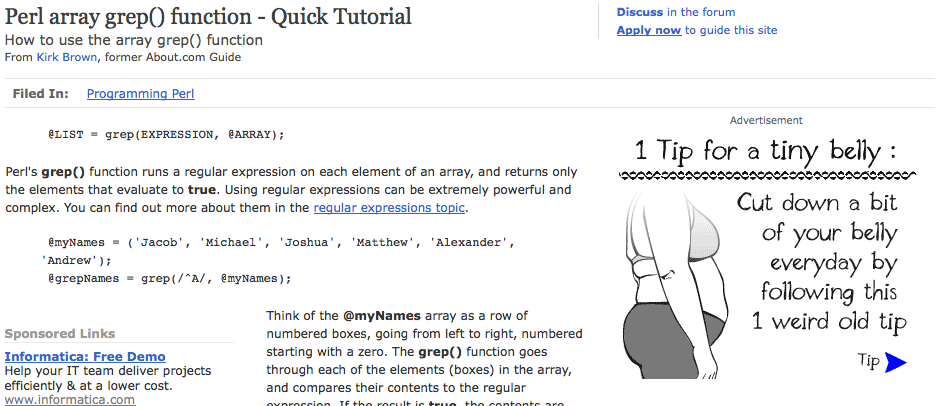
Perl grep = fat?


I present for your perusal this webpage which sez summat about ze Perl grep function. Also, it comes with an advert for reducing ze tummy. Why? Implicit assumption that anyone interested in perl will be pasty faced, eating Doritos and fat?

Thursday, March 31, 2011

So, about Last.fm and other online players

My laptop has gone kablooey. After 5 years of more or less loyal service (yes, Deep Thought, we shall not speak of that one time. Or that other time. Or the third time, when I had to enlist the assistance of our Godlike SysAd at Ann Arbor). [They hire good people at the U of M. And I have always held that while 'one should never meddle in the affairs of sysads, for they are subtle and quick to anger' - the man we went to was like the White Wizard reborn].

Anyhoo, the dear old Macbook having gone the Vashangshi jeernani way, I have decided to invest in a desktop. Prolly (and yes, do gasp) from Walmart. Apparently they sell nice computer deals - Athlon X2. 5 Gigs DD3. ATI Radeon and also 1TB. Sounds good, no?

But my music collection, as eclectic and awesome as it was has also gone to the great beyond of randomized ones and zeros. Hence, last.fm also this cool project called Bollywood Production (go ahead, Google it.You know you want to). But as clever as Last's algos are - in that it can send from one member of the 27 club to another in 3 steps or less - it more or less screws up with Desi music. Why else would Kishore Kumar radio start playing Bhangra. Yech!

Thursday, February 24, 2011

The Cosworth

So, here I was about to start muh car and pull of the lot when I espied a Merc opposite me. It was an old, low slung, rather nondescript looking car, with those straight lines and right angles that so fascinated the misguided designers of the seventies and mid eighties (and I am not just talking about the people who, say designed the Eldorado - this was an affliction that crossed continents as a whole generation of designers forgot how to draw curves. Apparently, Volvo was the last to recover.) Anyway, something, a sixth sense perhaps, told me to take a closer look. I legged it over and spotted a muscular spoiler, almost Evo-esque in its aggressiveness. And then I saw the legend.

190E 2.5-16

And my mouth went slightly dry.

Which was about when this bloke strolled up with a questioning slant to his eyebrow. I asked him if it was his ride. He responded in the affirmative. I then asked, somewhat hesitantly, if it was the Cosworth. His jaw hit the blacktop with a dull thunk.

Now you, worthy reader are prolly familiar with the TopGear episode when the Hamster talks about future classics and rambles on about the Cosworth. No? Ok, here, take a look.

Back to the story. So this bloke is rather tickled that I recognize his Merc for the beaut that it was. He was kind enough to give me a dekko under the bonnet. Aah, the loveliness of it. Just a 2.5 litre straight-4, but what an engine! Remember this was made by Cosworth which made a name for itself making those awesome Formula 1 engines which dominated the entire field. The reason why Merc wanted this car was because they wanted to ace the World Rally Championship. But then, around that time, another game changer came out. This happened to be the Audi Quattro. In its turbocharged shadow, the E190 had to be relegated to track and touring racing, where, of course it took the DTM. This was also the car that brought AMG into the Mercedes fold.

So, long story short, bonded with said bloke over his 190E. And then he tells me that his other car is a Delorean. A bloody Delorean!! I wanted to know if he had ever pushed it to 88 mph. He hasn't. Yet. Well, time to go build him a flux capacitor.

Wednesday, February 23, 2011

Citius, Altius, Fortius


I have long salivated over stuff that moves fast, turns corners violently and generally looks badarse. For the longest time, this led to a deep fascination with things that fly. Thus, the Supermarine Spitfire. The plane that is frequently, and erroneously, referred to as the plane that won the Battle of Britain. It was not. The plane that did win it, was the much underrated, Hawker Hurricane, and the equally (then) underrated (and in hindsight, unmatched) brilliance of Air Chief Marshal Dowding. But, here, for what it is worth, is the Spitfire. Is it a coincidence that the most beautiful things that fly, created either by the hands of Gawd, or men, are also the most deadly?


Friday, September 17, 2010

Tax cuts and how the media talks about them

I am not an economist. Neither am I a journalist. However, I understand that the perceptions of people are moulded by media. This much, I imagine you will agree with. So when you read an article like this one, you wonder why the coverage appears to be so biased.

Consider this section: "While about three-fourths of Democrats favor raising taxes on the rich, about half of independents and nearly two-thirds of Republicans oppose the idea. Support for cutting everyone's taxes exceeds four in 10 people in every region of the U.S. except the Midwest, where one-third back the proposal. Even among people earning under $50,000 a year — mainstays of the Democratic Party — 43 percent want to continue the tax cuts for all."

Would that not have been better written as
"While about three-fourths of Democrats favor raising taxes on the rich, about half of independents and nearly two-thirds of Republicans oppose the idea. 6 in 10 people in every region of the U.S. favour ending the Bush tax breaks. In the Midwest; 7 in 10 people favour ending them. Among people earning under $50,000 a year — mainstays of the Democratic Party — a majority of 57 percent want to end the Bush tax breaks."

Just a thought.

Thursday, August 12, 2010

Visa blues

OPT - visa

quite a quagmire of paperwork and timings. Officialdom (sigh)

Monday, August 02, 2010

The best of Science Fiction

The best of Science Fiction. This is a tall order. Who defines the best? In a field as subjective as literature, who draws arbit margins and delineates the awesome from stuff like Twilight? The answer is, I do. As do you, my dear reader. Anyone has the right of judgment. Of course, I will then judge what you have judged, and probably laugh at your choices, especially in hard SF.

But enough proselytizing.
The Hugo and Nebula awards are considered the two most prestigious awards in SF writing. They are the Nobel prizes of true geekdom. There is a small and very exclusive list of books which have been graced with both awards. Check it out. I am making my way through this list. And being rather impressed with what I am reading here.

Wednesday, July 21, 2010

The Rain

There was a brief sotto voce rumbling of distant thunder. I looked up to realize that the rains have arrived. Our lab has huge windows, which are usually covered up by these industrial grade pulldown curtains which I have come to loathe. Sometimes, however, in the early evenings you can see the sun go down somewhere just over the horizon; and the sky turns every hue of crimson and red as if the setting sun had told had come up with a particularly risqué joke.

The rain means something special to those people who live or lived between the tropics. For most of us it signifies relief from the killing heat of summer. On a more prosaic note, it means the difference between a good crop and penury for all too many of my countrymen.

But, I do not wish this to turn into a political diatribe. There are enough people spewing vitriol (and oil) at the moment without me having to add to them (I am looking at you Joel Stein).

Rain, as I was saying is special to me. I always view (or have viewed) rain as cha-pakoda-adda weather. Perhaps, I should explain that. Cha is tea. Not the refined milkless-sugarless tea that I usually drink. Cha is a milky, sweet concoction served best in tiny earthenware pots called “bhanrs”. A “pakoda” is a deep fried mixture of onions, chillis and sometimes giant peppers coated in chickpea flour (besan). It tastes of heaven. Adda is what we Bengalis are perhaps forgetting to indulge in (there has to be a correlation between the decline of adda and the rise of heart attack rates and divorces). Ok, adda is a strange mishmash of discussion, mixed with a dash of debate, flavoured with old fashioned gossip and rounded off with some very tall story telling. It is a very Bengali thing. Most other Indian ethnicities are waaaay more hard working than us, and have never discovered the joys of adda. I have been told that apparently there is something approximating adda in the coffee shops hidden away in the bazaars of Istanbul and Cairo. If I ever get to visit these great cities, I will let you know if people there, do indulge in adda.

Our man Nandi refers to this kind of rain as ‘suicide weather’. Hmmmm.

I finished watching this wunnerful fillum called ‘Wake Up Sid’. It has Konkona Sensharma who is, in my humble opinion, one classy lady. Up there with the always delectable Nandita Das. Beautiful performances flesh out this fillum, even from the actors with bit parts. In fact, especially from them. And, of course, the fillum revolves around the rain.

Which brings me to the fact that I am going out to enjoy some of the rain. Bye.

Sunday, April 11, 2010

Rajinder Puri on India's internal security problem

From today's Statesman:

Special Article

10 April 2010

The enemy strikes
Invisible War Becomes Visible

By Rajinder Puri

DURING the last half decade this scribe wrote almost two dozen articles related to terrorism. One article in January 2007 was titled “India’s Invisible War”. It started by stating: “India is in the midst of an invisible war. It is an unrecognized war.” Well, the war has become very visible now. Over 70 policemen killed in one Maoist ambush compelled even our media, besotted with sports weddings and Bollywood brand ambassadors, to take note of the attack. Newspaper headlines blared: “This is war!” Stirring words! But is terrorism being recognized for what it really is ~ undeclared war against the Indian state? Do people who lightly toss around the word realize the implications of fighting a war? Wars are fought for conquest or for survival. India is fighting for survival. To triumph it must be prepared to pay whatever price required. For an effective war against terror there are six aspects that should command attention.
First, the government must recognize the enemy. The enemy is not Maoism or jihad or separatism. There is authentic evidence of terrorist groups with avowedly different aims assisting each other. That suggests all groups are branches of the same trunk. One Congress leader reportedly said: “While terrorists are basically sponsored by foreign powers… Naxalites are our own misguided indigenous people.” This is the kind of nonsense to be discarded. ULFA leaders, Kashmiri separatists and Maoists are all indigenous. Both ULFA and Maoist leaders get sanctuary in China. Both are aided by the People’s Liberation Army (PLA). Now even foreign-funded Hurriyat leaders, acting as the voice of Kashmiri terrorists, are openly seeking China’s help. The Pakistan army is nothing but a clone of the PLA. It has discarded the army culture it shared with the Indian army bequeathed by the British. Pakistan army generals are into big business. They have access to independent funds like their mentors in the PLA. Like the PLA they control politicians, not the other way around. The government does not have to state that China’s PLA is the mastermind directing all wings of terrorism in India. It has merely to recognize this truth. It should ask itself why Chinese hackers accessed secret Indian government documents dealing with Maoists and North-east insurgencies.
Second, there must be law and order reform. Insurgencies in India may propagate different grievances. They all have the same aim. They serve their foreign master by destabilizing India. There may be sincere dupes committed to a cause serving these outfits. They are manipulated by their commanders who serve the PLA. When the enemy has a unified command, can India afford to have split command structures? Parliament and government must immediately establish a central federal agency empowered to fight insurgencies throughout India. This agency must have its own independent intelligence network in all states.
Third, there must be economic reform. Human rights activists mistakenly assume that Maoists fight for economic justice. If the grievances of tribals were removed the Maoists would seek another issue. However legitimate the grievance ~ whether related to identity, language or economic deprivation ~ the insurgency is predetermined. Grievances are not the cause of insurgency, but the excuse. That is why the government must remove all legitimate grievances regardless of insurgency to decrease the nation’s vulnerability. Economic disparity and lack of governance in India are horrendous. Out of 602 districts, 165 are affected by Maoist violence. This is not surprising. The World Bank’s poverty line for India is set at Rs 1400 a month. If this is accepted there are 700 million Indians below the poverty line. There are also 700 million below 35 years of age. The unemployed number 300 million. At present a mere 5 million new jobs are created every year. Over 70 per cent of the population is rural. Less than 30 per cent is urban. The publicized benefits of economic reforms are limited in the main to the English-speaking class in urban India. With or without insurgency, are such conditions tenable? A massive stimulus package for rural employment and infrastructure from resources acquired through disinvestment in cooperation with trade unions is imperative.
Fourth, there must be governance reform. Political parties collude with terrorist outfits in order to garner votes. Terrorist penetration of the government makes nonsense of secrecy in intelligence. In Andhra huge consignments of rockets manufactured in Tamil Nadu were seized. These were meant for Maoists spread across five states. In Ahmednagar district of Maharashtra police stumbled on huge catchments of crude RDX bombs meant for nationwide distribution. Can such factories operate without some official connivance? Can government owned State Bank branches continue to distribute fake currency that facilitates terrorism without official complicity? Can such lax governance fight terrorism? To stem this rot one is led to the fifth aspect.
Fifth, there must be systemic reform. Two basic reforms are vital. The Constitution must be followed as written to allow the President who is above partisanship, who represents Parliament and all assemblies, to exercise due authority assisted by a full-fledged secretariat. The proposed federal agency to fight terrorism, along with various other bodies, should be made accountable to the President. That will eliminate collusion between vote-seeking politicians and terrorist outfits. This will not violate the Constitution but implement it. At the same time genuine Panchayati Raj as directed by the Constitution must be established. To achieve it, a new primary police tier accountable to the assembly of the urban or rural panchayat must be created. Basic law and order and security entrusted to the primary local body will ensure effective monitoring of suspicious activity in each locality. This primary police force could become an invaluable intelligence source for the anti-terrorist federal agency utilizing cyber connectivity.
Sixth, there is need for foreign policy reform. The government must follow the law of reciprocity while dealing with all nations. It must talk bluntly with America, China and Pakistan. This week a hotline was established between New Delhi and Beijing. President Hu Jintao and Premier Wen Jiabao emit positive vibes. That is not enough. Neither of them ever served in China’s army. Are their intentions translated on the ground by the PLA? Are they more effective in dealing with their army than President Zardari and Prime Minister Gilani are in dealing with Pakistan’s army? India does not need words but deeds.
The enemy does not aim for revolution in India. Revolutions strengthen nations. The enemy seeks to balkanize India. It is the people of India who should seek revolution as suggested by these reforms. It is not enough to defeat the Dantewada Maoists. The goal must be to secure India against all subversive terrorism fomented from abroad.

The author is a veteran journalist and cartoonist

Monday, April 05, 2010

Union Square pillow fight + veselka + yakitori = awesomeness

I will only use lolspeak from now. So I hope out of the metro at union square, and there is this epic pillow fight going on on saturday. So i wade into the crowde.

With my SLR held high ovah muh head

clickety clickety all the way... i get bopped on the noodle many times with pillows

someone rips their pillow open and suddenly da air is full of fine cotton

oh fuck, mah allergies jus went inna overdrive/

oh noes!

den i sees a bloke with a rolleiflex


epicness


and this bloke rips his shirte off and gets into a bare kunckle fight with people with pillows

imagine bringing your fists to a pillow fight. musta been irish.


den somehow i am smack in da middle of the da fight and i get effin chakravyuhed by a bunch of screamin chicks. with pillows.


i somehow struggle out of there with my glasses askew, but camera intact. my lungs coated with a fine deposit of cotton fibres. And then went into a random bookstore and found a cheap copy of the complete Yes Minister. New York rocks.


Saturday, March 13, 2010

Trolled by the cryoscopic effect

Refers to the depression of the freezing point of a solution due to the presence of some solute, or impurity. This does not depend on the nature of the impurity, just on its relative amount w.r.t the solvent. So, this means that the equivalent amount of potassium chloride and sodium chloride will lead to the same depression of the freezing point of water. Which is, of course why the put some salt in the water pipes in North East India, where it is cold. Also why they put ethanol/glycerol as antifreeze in car radiators.

Here is the Wikipedia page. Observe that the cryoscopic constant of water is K=1.86 C/M. Assuming a van't Hoff factor of i=1 for glycerol, for a 20% mass/vol solution, that comes to a comcentration of 2M. So, the maximum freezing point depression should be about 4 C. Which means that the cell stock should have thawed at -4C. And when I grabbed the cells from the -80 C freezer, I should have scraped some off and stuck them back in pronto. Not left them on the benchtop (on ice) for five minutes where they thawed out. I tried blaming the croscopic effect, but the calculation shows that without the depression of freezing point, the stock would have thawed out at 0 C, as such, it did at -4 C. And they should have not thawed out more than, say -70 C.

95% personal stupidity
5% being trolled by the cryoscopic effect.

Sunday, February 28, 2010

Where did the 12 Monkeys come from?

I was recently made aware that Terry Guillam's 12 Monkeys is derived from an older work. Of course, the theme of time travel from a post apocalyptic world into the past is not new.. it has been explored in the literature rather extensively. But 12 Monkeys was a rather nice piece of work. Bruce Willis pulls off one of those confused roles which he seems to fit so well in, and Madeline Stowe is quite delectable as the psychotherapist trying to help him. But the cake goes to Brad Pitt, around whom the entire film revolves.. aarrr.. go see it yourself.

So.... 12 Monkeys was inspired by, and gathers a certain part of its compositional aesthetic from an older film, called La Jetée, a 1962 B/W film which was composed almost entirely out of still shots! Some of those shots were undoubtedly painstakingly staged, some others, I am not so sure. But the film is something worth watching. Reminds me of another experiment in cinema which I have spoken about earlier here.

Wednesday, February 24, 2010

Which camera

Sometime this year, I will be flipping a lot of cash (presumably enough to buy a couple of kidneys on the black market) over for a camera and some associated paraphernalia. I have a few choices. But before that, let me talk about what the dream-wishlist.
  1. The Leica M9. Just released. An astonishing 18 MPixels in a full frame 24X36 mm sensor. The legendary Leica M series construction. And of course, the ability to use any number of prime lenses from the Leica Summilux/Summicron/Elmarit series. All the way to the ultrabright 0.95 Noctilux 50 mm lens which goes for a cool 10 thou... This belongs to a type of camera called a rangefinder. The principle of operation is very different from an SLR. No swinging mirrors or anything like that. This leads to a much quieter machine which is discreet. Something that a master of street photography like Cartier Bresson apparently loved. Here is some of his work. One of his most famous photos, the man jumping over a puddle was taken with an M3. But the point remains that Leica's are quite insanely expensive. Not for me.

.. to be continued

Tuesday, February 23, 2010

Office suites

I feel the need to express my disappointment at MS Office. The version on the lab iMac is the Office for Macs 2008. The Powerpoint package is somewhat unstable and crashes easily. This has happened to me before, but I was usually running multiple things and Office is something of a resource hog. But this iMac was running almost nothing else, just a Safari window. Strange? Yes.

But that can be dealt with. Coming from the Linux world of OpenOffice, which is nowhere near as snazzy as Office (but gets the work done), I am used to hitting Ctrl-S or Cmd-S every ten seconds. (Back in the day, OO used to crash ALL the effin time). HOWEVER, and this is a huge lifesaver, OO has a file recovery system which kicks in when you restart the suite, and should recover your files from the last autosave. Does MSO not have it? Am I missing something here?

Saturday, February 20, 2010

Movies lately

So, I ended up seeing "My Name is Khan" with a couple of labmates a week ago. Our man Kaushik told me that this movie "sucks arse". Not true. It is not horrid, just ambitous, but does not really make it. It was a treat to see Kajol again after a while... she has aged rather well, methinks. Shahrukh Khan is stuck doing his "Kikikikikiki Kiran" act again. I mean, this bloke finished optimizing his acting skills in the mid 90's with Darr and has been putting the same shite out for the public ever since. (sorry Rachna). And for some unknown reason, the Indian movie going audience laps it up and comes back for more. Also, Karan Johar believes in force feeding emotions down your gagging throat, so there is also more of that. But for all its tackiness, this fillum does challenge several important questions today... such as the perception of Muslims in the West, and tries to do a good job of it. But there was too much of Forrest Gump meets the 40 Year Old Virgin there for my liking.

3 Idiots was quite nice. Aamir Khan doing his usual awesome act. This guy is so versatile that all our desi actors should take lessons from him. Mahadevan and Sharman somethingortheother bloke were pretty cool too. But the cake goes to Bomman Irani for another absolutely wunnerful role as the college principal. And the Chamatkar speech is something to enjoi.


Sunday, January 17, 2010

For what leetil it is worth

Happy New Year ya'all. 2009 has been an' gone. What do I have to show for it? Well, for one thing, several of my friends moved out of towne. That felt awful. Perhaps that is what happens to everyone. Does it? Tell me, what is worse... missing friends, or not really having any and not knowing the difference? They say that some things you only start appreciating after they aren't there any more. That category certainly includes people.

My last few days in Michigan went by in a blurry. (This is a made up word which is "blur"+"a flurry"). Please cite me whenever you use it. Pradeep babu came by to defend his thesis on the 7th of December. He stayed at my place over the weekend and totally wowed me with his awesome presentation. Here is a picture of both of us not workin'

The day after Pradeep's defense, my boss wanted me to talk to this guest speaker.. who just happens to be one of the world leaders in the field I work in. That was scary. Then it was time for my own defense. Our man Nandi made the following poster... note that he should have been prepping for his own predefense research proposal, which was scheduled for the very next day....

Sara made a FB event for my own shindig. Complete with Nandi's awesome poster. Milan came down from NY to participate in the general fun. Pradeep, of course had stayed back for a couple of days to effect his thesis revisions and chuck rotten tomatoes at me. And then, before I knew it, the big day was upon me. I started out by trying to iron a shirt with the heater set too high and almost set the place on fire. After this early disaster and minor hiccups such as retrieving my committee evaluations from the graduate school half an hour before he scheduled time, and so on.. we were finally there. The talk went (I think) rather well, although I was pretty much in a state of terminal panic just before. I puked all over this bloke taking a shite in the men's room and said 'muh bad'. No, I didn't, I was just channeling 8 Mile. Our man Smith attended in a Three Wolf Moon shirt.

Anyhoo, a whole lotta phrends came down to cheer and much fun was had by all. Thanks. Really. Then the closed doors session began, and the gloves came off. That was effin' brutal, I don't mind tellin' ya'all. But they passed me with minor revisions ( I think the only person who did not get those "minor revisions" was Robert Oppenheimer). And then much merry making happened.


More updates later...

Thursday, November 19, 2009

Gautam Chattopadhyay. Always.

Jibonmukhi, about which I may have written earlier is the return to realism movement in Bengali music. Perhaps the best proponent was Suman Chattopadhyay. I am not sure what that eccentric genius is up to these days (some people say politics..?), but it might not be out of turn to describe him as the voice of not a generation (see, no cliches!) but rather as the poet of an age which lived in the portentous shadow of changes which would eventually overwhelm everything familiar. But for the moment, the hand was stayed, and a people walked home together in the late afternoon sun knowing only that the evening would pass, bringing a dawn which they would not recognize. Suman belonged to that age. And you are a wee bit confused. But this is not about Suman, this is about an older musician called Gautam Chattopadhyay. The late seventies was a confused time of riotous colours, bell bottom pants (they came to India somewhat late) and the angry, pathetic, remnants of yet another failed political movement. And in music, for a brief moment, the wonderful romances where the hero and heroine run around trees or sing along in a Shikara on the Dal lake... these romances were also becoming a thing of the past. Soon enough, the Dal lake in Kashmir would echo with the crackling of assault rifles. But this was, just another day. And no one, really no one was holding his breath.

Gautam Chattopadhyay came together with a small group of like minded musicians and wrote Haay Bhalobashi, and suddenly this was different. This bloke wrote about what you felt, not what you were supposed to feel. Mahiner Ghoraguli was the first true Jibonmukhi band, on either side of the border. And people walked out on him. After a few years, he faded into obscurity.

Then, Suman and Tomake Chai happened. The rest, as they say, is history. But for some of us, even if we weren't actually there, Gautam Chattopadhyay's afternoon still lives on.


Thursday, November 05, 2009

We had a Halloween party

A Bengali Halloween party. Also known (for slightly confusing reasons) as Bhoot Chaturdoshi. It was rather awesome.

Monday, October 26, 2009

The awesomeness of the new B-school

The B-school has a new building. I was enjoying an afternoon constitutional the other day when I decided to make a slight detour and take a dekko inside the building. Snazzy. Uber snazzy.

Tuesday, October 13, 2009

Thesis writing, Shutki machher jhal

Is a very uphill task. You certainly know of a certain Frodo Baggins who started his dissertation under Gandalf the Grey, a wise tenured PI. That story is detailed here. So, I visited the bigsis at Urbana. Did you know that city is the home of Miss America 2003? There, I have improved your day somewhat with that leetil factoid. Also, I made Shutki Machh with dried fish from the Chinese store. Here are a few facts about Shutki Machh.
  1. It is made with dried, salted fish.
  2. The original recipe is Bangaldeshi.
  3. I am part Bangladeshi, at least by lineage.
  4. The best prep of Shutki is the low-on-gravy-high-on-chilli version. This is also called the 'Jhal'.
  5. Shutki machher jhal is usually mind-shatteringly hot and spicy. As in your insides will melt and your read end might think it is a Kilimov RD33 afterburner.
  6. Shutki stinks to high heaven. People of a delicate disposition, and of a genteel upbringing have been known to faint whilst walking past a place where they were just drying out Shutki.
  7. The same people will fight each other to eat more Shutki. But they cannot make it.
  8. Trade secret: soak said dried fish in hot water for a while. That will kill some of the stink.
  9. Bigger trade secret: the process of cooking will drive your neighbours out of their shantys (Shutki is rarely cooked in American Suburbia or any random Manhattan co-op).
  10. Shutki is sometimes made with Loitta fish. Here is a recipe. Here is another.

Monday, October 05, 2009

I moved

About a month ago to this new place. Packing up was hard, and I had a very Jerome K Jerome moment. Here is a pic to go with it. The only thing missing is, you guessed it - Montmorency!


Busy... busy..

Tail end of my PhD. Working hard. No time to blog.